How Self Bunded Tank Works Inside a Container Fuel Station


A container fuel station looks simple from the outside - a standard steel box with a lockable door. Inside, however, a precisely engineered system is at work. At its core is the self bunded tank: a tank within a tank that stores fuel, contains leaks, and monitors its own integrity. Understanding how a self bunded tank works inside a container fuel station helps buyers evaluate equipment, verify safety claims, and appreciate why this design has become the industry standard for on-site fuel storage.
What Is a Self Bunded Tank?
A self bunded tank - also called an integrally bunded or double-walled tank - is a storage vessel built as a tank within a tank. An inner primary vessel holds the fuel, and an outer shell is sized to contain the full contents of that inner vessel if it leaks. The outer shell is the bund, and it is built in.
The defining number is 110%. A self bunded tank's outer shell is sized to hold at least 110% of the inner tank's brim-full capacity. The extra 10% covers rainfall, firefighting water, and foam that may enter the containment during an incident. This 110% requirement is embedded in multiple international standards, including Australian Standard AS 1940 and UK guidance HSG176.
The practical result is a tank that ships with its own containment, installs on a prepared slab, and can be relocated - no external concrete bund, berm, or dike required.
It is worth noting an important distinction: every self bunded tank is double-walled, but not every double-walled tank is self bunded. "Double-walled" and "double-skinned" describe how a tank is built. They say nothing about what that second wall is rated to hold. In many tanks, the gap is small and exists for leak monitoring or structural strength, not containment. "Self bunded" is a compliance claim - it means the outer shell is designed, sized, and documented to hold the full inner contents.
How the Self Bunded Tank Fits Inside a Container Fuel Station
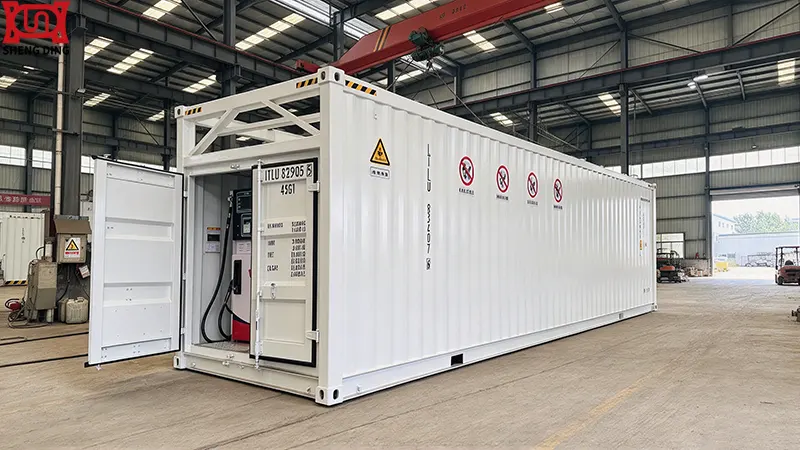
A container fuel station is a complete fueling system built inside a modified ISO shipping container. The container itself serves as the enclosure - providing weather protection, security, and structural support.
Inside the container, the self bunded tank occupies the primary storage compartment. The tank body is typically constructed of steel - often S 235 JR or equivalent carbon steel - and is double-walled, made of steel with the inner and outer walls separated by an interstitial space.
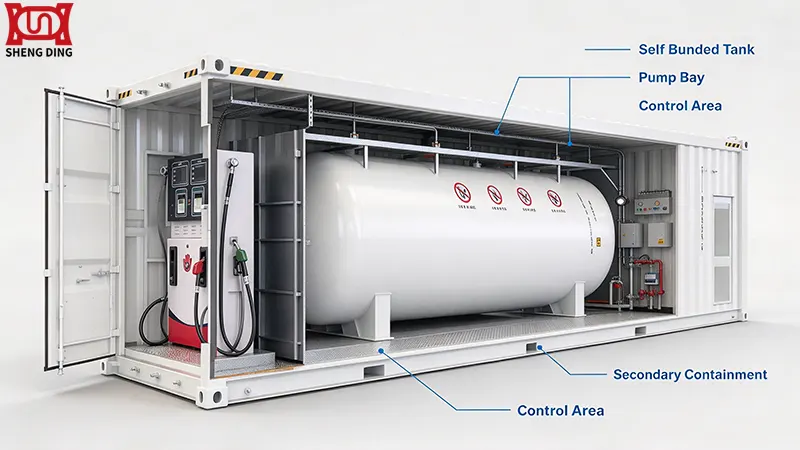
The container layout typically divides into distinct functional zones:
| Compartment | Function |
| Storage compartment | Houses the self bunded tank body and its interstitial monitoring system |
| Pump bay | Contains the fuel dispensing pump, metering equipment, and control systems |
| Equipment niche | Houses electrical controls, generator (if equipped), and safety systems |
| Access door | Lockable entrance for maintenance and fuel dispensing |
This compartmentalised design keeps fuel storage, dispensing equipment, and electrical systems separated for safety and easier maintenance. Some configurations include a two-chamber tank within the same container, allowing storage of different fuel types - diesel and gasoline, for example - in a single unit.
Step 1: Fuel Storage - The Tank-Within-a-Tank Principle
The core operating principle of a self bunded tank is straightforward: fuel is stored only in the inner tank. The outer tank remains empty under normal conditions, serving as a continuously available secondary containment vessel.
In a container fuel station, this means:
- Fuel is delivered into the inner tank through a filling pipe connected to the tank vehicle
- The inner tank holds the product during normal operation
- The outer tank (bund) surrounds the inner tank with a capacity of at least 110% of the inner tank's volume
- If the inner tank develops a leak, the fuel is captured in the interstitial space between the two walls
This design eliminates the need for a separate concrete bund or containment wall around the tank. The containment is built into the tank itself, which is why container fuel stations can be deployed without the extensive civil works required by traditional storage systems.
Step 2: Leak Detection - Continuous Interstitial Monitoring
The space between the inner and outer tank walls - the interstitial space - is continuously monitored for leaks. This is one of the most important safety features of a self bunded tank.
Several monitoring methods are used in container fuel stations:
- Liquid detection sensors placed at the lowest point of the interstitial space identify fuel accumulation and trigger visual or audible alerts
- Vacuum or pressure monitoring systems maintain a specific pressure in the interstitial space and detect changes caused by leaks
- Electronic tank gauging systems provide continuous level and temperature data, often readable remotely
In a container fuel station, the leak detection system is factory-installed and integrated with the station's control panel. If a leak is detected, the system alarms and may automatically shut down dispensing operations until the issue is resolved.
The interstitial monitoring system transforms the outer tank from a passive backup into an active safety system. The operator knows immediately if the primary containment has failed - not weeks later when fuel appears in the soil.
Step 3: Venting - Managing Pressure and Vapors
Fuel storage generates vapors and pressure changes as temperatures fluctuate and fuel is added or withdrawn. The container fuel station includes a venting system to manage these safely.
Key venting components include:
- Vent pipes that allow air to enter and vapors to exit as the fuel level changes
- Flame arrestors or breather valves that prevent external ignition sources from entering the tank
- Pressure/vacuum relief valves that protect the tank from overpressure or vacuum conditions
For gasoline applications, vapor recovery systems may also be installed to capture volatile organic compounds during both tanker unloading and vehicle refueling, reducing emissions and fire risk.
Step 4: Fuel Dispensing - From Tank to Vehicle
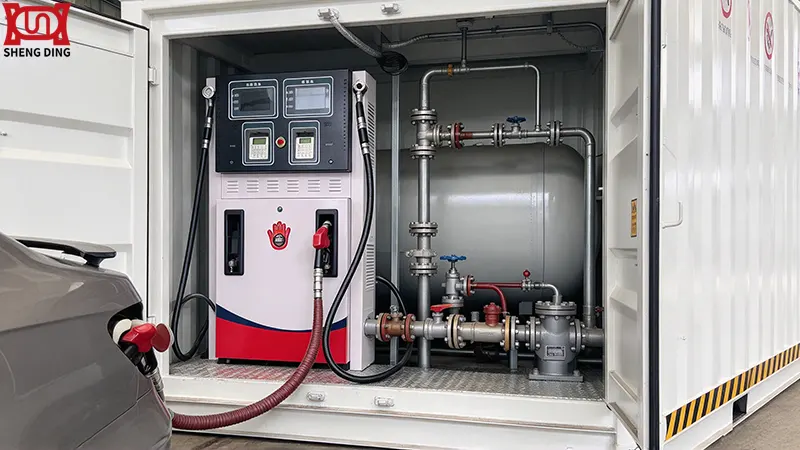
When a vehicle needs fuel, the dispensing process begins with the pump. In a container fuel station, the dispensing pump is typically installed in a dedicated pump bay - a separate compartment from the storage tank, with lockable doors for security.
The dispensing sequence works as follows:
- The operator lifts the nozzle from its holder, which actuates the pump motor
- Fuel is drawn from the inner tank through a suction pipe
- The pump pressurises the fuel and pushes it through the supply hose
- The metering unit measures the volume of fuel dispensed
- Fuel flows through the nozzle into the vehicle tank
The fuel outlet pipe is positioned above the tank bottom - typically at least 0.15 m - to prevent accumulated water or sediment from being drawn into the dispensing system. Self-sealing quick-connect couplings are used on hose connections to ensure leak-proof seals.
Typical dispensing flow rates for container fuel stations range from 40 to 80 litres per minute for diesel and around 40 litres per minute for gasoline, depending on the pump model and application requirements.
Step 5: Safety Systems - Built-In Protection
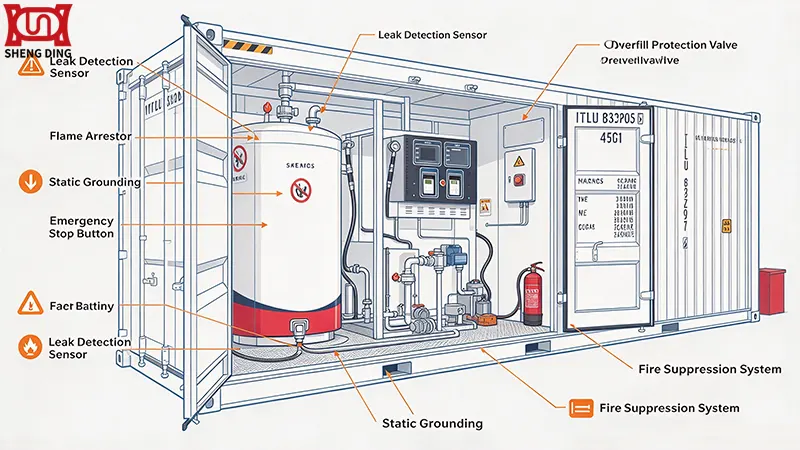
A container fuel station integrating a self bunded tank includes multiple layers of safety protection. These systems work together to prevent incidents and minimise risk if something goes wrong.
| Safety System | Function |
| 110% secondary containment | Outer tank captures any leak from the inner tank, preventing environmental contamination |
| Interstitial leak detection | Continuous monitoring of the space between tank walls |
| Overfill protection | Automatic valve closes when the tank reaches capacity, preventing spills during filling |
| Flame arrestor / breather valve | Prevents external ignition sources from entering the tank through the vent |
| Static grounding system | Dissipates static charge generated during fuel transfer |
| Emergency stop | Shuts down dispensing operations instantly if needed |
| Explosion-proof electricals | ATEX-rated components for hazardous areas |
These safety features are not optional add-ons - they are integrated into the container fuel station design and tested at the factory before shipment. The combination of physical containment, continuous monitoring, and automatic shutdown systems makes the self bunded tank one of the safest options for above-ground fuel storage.
Why Container Fuel Stations Use Self Bunded Tanks
The self bunded tank is the natural choice for container fuel stations because both are designed around the same principle: factory-built, transportable, and compliant without on-site construction.
- No external bund required - the tank carries its own containment, so no concrete or earth bunding is needed at the site
- Factory integration - tank, pump, monitoring, and safety systems are assembled and tested before shipping
- Rapid deployment - the container arrives ready to set on a prepared pad and connect to power and fuel lines
- Relocatable - when the project moves, the entire container fuel station moves with it
For operations in remote work zones, construction sites, mining camps, and logistics depots, this combination of self-contained safety and mobility delivers fuel storage capability without the time and cost of permanent infrastructure.
About Shengding Container
Shengding Container - Taian Shengding Metal Container Manufacturing Co., Ltd - is a professional oil tank and mobile fuel station manufacturer based in China. The company produces skid-mounted fuel stations, portable gas stations, oil storage tanks, and self bunded tanks for storage, refueling, mining, and energy applications.
With more than ten years of experience in oil tanks and skid-mounted filling stations, Shengding Container holds ISO 9001 certification and exports products to more than 20 countries across Asia, Europe, Africa, and Oceania. The company provides 24-hour online and offline technical support, along with professional installation personnel for on-site commissioning.
Conclusion
Understanding how a self bunded tank works inside a container fuel station comes down to one core principle: the tank within a tank. The inner vessel stores the fuel. The outer vessel provides 110% secondary containment. The interstitial space is continuously monitored for leaks. The dispensing system moves fuel from the tank to the vehicle. And the safety systems - overfill protection, flame arrestors, grounding, and emergency shutdown - protect the operation at every stage.
This integrated design is why container fuel stations have become the standard for on-site fuel storage in remote, temporary, and high-risk environments. The containment is built in. The monitoring is continuous. And the entire system arrives factory-tested and ready to deploy.
Need a container fuel station with a certified self bunded tank?
Shengding Container manufactures self bunded tanks and container fuel stations from 5,000L to 100,000L, with full compliance documentation and export-ready configurations.
Written by
TAIAN SHENGDING METAL CONTAINER MANUFACTURING CO., LTD.
Editor Wang
WhatsApp:+86 152 5486 3111
Email:shengdingtank@126.com


- WhatsApp
- E-MailE-Mail:shengdingtank@126.com
- WeChatWeChat:15254863111