7 Best Layouts for Custom Mobile Fuel Stations


Two custom mobile fuel stations can share the same tank capacity and the same ISO container footprint, yet perform completely differently on site. The difference is layout. Tank capacity tells you how much fuel a station holds. Layout determines how fast vehicles move through it, how safely fuel is separated from ignition sources, how easily technicians can service the equipment, and whether the station can adapt when the project changes. This guide compares seven proven layouts for custom mobile fuel stations, each matched to a distinct operational profile.
Why Layout Matters More Than Tank Size
The most common mistake when specifying a custom mobile fuel station is treating tank capacity as the primary design decision. Capacity answers one question: how much fuel is stored. Layout answers the operational questions: how many vehicles can refuel simultaneously, whether different fuels can be dispensed without cross-contamination, how quickly a tanker can unload, and how safely maintenance can be performed.
Industry guidance on skid-mounted fuel station selection makes this point directly: equipment configuration should be based on how the station will operate, not on nominal tank capacity alone. Two stations with the same capacity may still require different pumps, dispensers, instruments, electrical systems and safety arrangements. A 40,000L station serving a single mining haul truck fleet needs a very different layout from a 40,000L station serving a mixed fleet of diesel vans and gasoline cars.
The seven layouts below are not a ranking from "worst" to "best." They are a toolkit. The right layout depends on the fuel types, fleet mix, throughput requirement, site constraints and regulatory environment of a specific project.
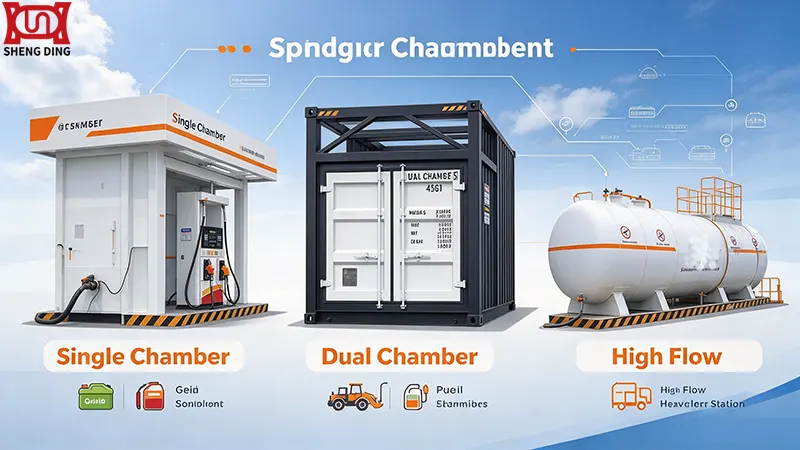
Layout 1: Single-Chamber Standard Layout
How It Works
The single-chamber layout is the baseline configuration. One tank chamber holds a single fuel type - typically diesel. A filling pump niche and a dispenser niche are arranged on the container wall or within the pump bay. All fuel passes through one primary containment chamber before reaching the dispenser.
Key Design Features
- One tank chamber, one fuel type
- Single filling point for tanker unloading
- One or more dispensers drawing from the same chamber
- Electronics niche for system control and monitoring
Best For
Single-fuel fleets with predictable consumption: a construction site running diesel excavators, a farm with diesel tractors, or a logistics depot fuelling a uniform diesel van fleet. The single-chamber layout is also the simplest and most cost-effective starting point for first-time buyers.
Limitations
Cannot dispense two fuel types without cross-contamination risk. If the operation later adds gasoline vehicles or a second diesel grade, the layout cannot adapt without significant modification.
Layout 2: Dual-Chamber Multi-Fuel Layout
How It Works
The dual-chamber layout divides the tank body into two separate, baffled compartments. Each chamber has its own filling point, its own dispenser, and its own isolation. The two chambers share the container envelope but never share fuel.
Key Design Features
- Two tank chambers, two fuel types (typically diesel and gasoline)
- Separate filling systems for each chamber
- Independent dispensing systems to prevent cross-contamination
- EX-rated equipment for the gasoline chamber, including ATEX certification where required
Best For
Mixed fleets operating from a single site: a logistics company with both diesel trucks and gasoline service vehicles, a construction contractor with diesel heavy equipment and gasoline pickup trucks, or a rental fleet with diverse fuel requirements. The dual-chamber layout is also the standard configuration for commercial fuel retail applications where both diesel and gasoline must be available.
Technical Note
Dual-chamber layouts require stricter safety specifications for the gasoline chamber. Barrier explosion-proof fill and vapor recovery are typically mandatory for gasoline, while diesel chambers have different requirements. The layout must accommodate both regulatory regimes within one container.
Layout 3: Isolated Pump Bay Layout
How It Works
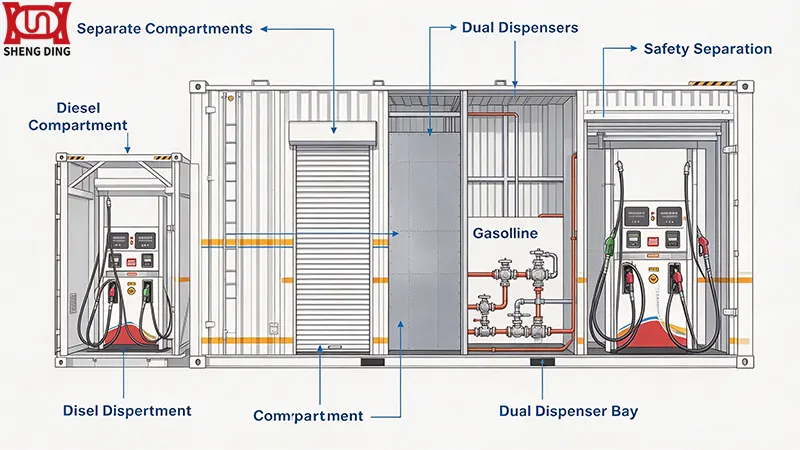
The isolated pump bay layout places the fuel tank in one compartment and the pump, dispenser, metering and fuel management equipment in a separate, lockable bay. The two zones are physically divided within the container. This is the layout used in Shengding Container's 40ft mobile filling station, where the container is divided into a fuel tank compartment and a pump/dispenser compartment, with an optional generator.
Key Design Features
- Fuel storage and dispensing equipment in separate compartments
- Lockable pump bay for security and access control
- Space for filtration, fuel management systems and offloading equipment
- Reduced fire risk by separating fuel from electrical and mechanical equipment
Best For
High-security sites and operations where fuel theft or tampering is a concern. The lockable pump bay prevents unauthorised dispensing and protects sensitive equipment from dust, moisture and vandalism. This layout is common in mining camps, remote construction sites and logistics yards where the station operates unattended for extended periods.
Operational Advantage
Maintenance is easier because technicians can service the pump and metering equipment without entering the fuel storage compartment. This separation also simplifies compliance inspections, as the fuel storage area and the dispensing area can be assessed independently.
Layout 4: Niche-Integrated Modular Layout
How It Works
The niche-integrated layout is a modular approach that arranges functional elements into discrete recesses or niches along the container walls. A typical configuration includes a filling pump niche, a dispenser niche, an electronics niche and an aggregate niche for a generator or additional equipment. All niches are vandal-proof and closed by lockable doors.
Key Design Features
- Functional niches: filling, dispensing, electronics, aggregate
- Vandal-proof, lockable doors on all niches
- Components accessible at eye level for easier operation and maintenance
- Can be configured as single-chamber or dual-chamber systems
- Optional sun roof to protect the tank body from direct sunlight
Best For
Projects requiring a balance between compact footprint and full functionality. The niche layout maximises the usable surface area of the container without increasing the overall envelope. It is well suited to 20ft container stations where space is constrained but multiple functions - filling, dispensing, control and power generation - must be accommodated.
Design Consideration
Because components are distributed across niches, the layout requires careful planning of cable and pipe routing. The advantage is that each function has its own dedicated, protected space, reducing the risk of interference between systems.
Layout 5: High-Flow Mining & Construction Layout
How It Works
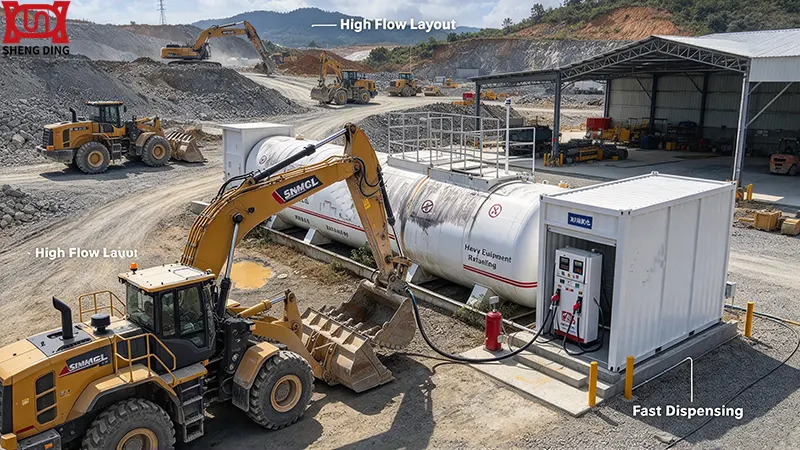
The high-flow layout prioritises dispensing speed and durability over compactness. It is configured with high-capacity pumps, large-diameter hoses and multiple dispensing points to minimise refuelling time for heavy equipment. Spill containment basins are integrated into the layout to capture drips and protect the environment.
Key Design Features
- High-flow pumps, typically 80-120 L/min or higher
- Multiple dispensers or nozzles for simultaneous refuelling
- Heavy-duty hose reels and large-diameter piping
- Integrated spill containment basins
- Reinforced structure for dusty, high-vibration environments
Best For
Mining operations, large construction projects and any site where heavy equipment refuelling time directly affects productivity. A haul truck with a 300L tank refuels in 2.5 minutes at 120 L/min, compared to 7.5 minutes at 40 L/min. For a fleet of ten machines, that difference compounds into hours of recovered productive time every day.
Site Requirement
High-flow layouts require adequate site access for heavy equipment and sufficient space for vehicles to manoeuvre without driving over dispensing hoses. NFPA guidance specifies that mobile fueling vehicles must be positioned to preclude traffic from driving over the dispensing hose. The same principle applies to fixed mobile stations: the layout must account for vehicle traffic patterns, not just equipment arrangement.
Layout 6: Modular Multi-Unit Combination Layout
How It Works
The modular layout abandons the single-container assumption. Instead, multiple container assemblies - main tank containers, auxiliary containers and equipment room containers - are joined together to form a larger station. The modular approach allows capacity and functionality to be scaled by adding units rather than redesigning a single container.
Key Design Features
- Main container assemblies for fuel storage
- Auxiliary container assemblies for additional capacity or fuel types
- Equipment room containers for pumps, controls and power generation
- Framing components that connect modules into a single operating platform
- Each module can be factory-assembled and tested before shipment
Best For
Large-scale operations that need high total capacity but also require transportability. A mining project that starts with two 40,000L units and expands to four units as the fleet grows can use the same modular container design throughout. The modular layout also suits multi-site operations where standardised modules can be configured differently at each location.
Logistics Advantage
Each module fits standard ISO shipping and handling. The station grows by adding containers, not by engineering a larger custom vessel. This reduces lead time for expansion and simplifies spare parts planning across a fleet of stations.
Layout 7: Aviation & Marine Specialised Layout
How It Works
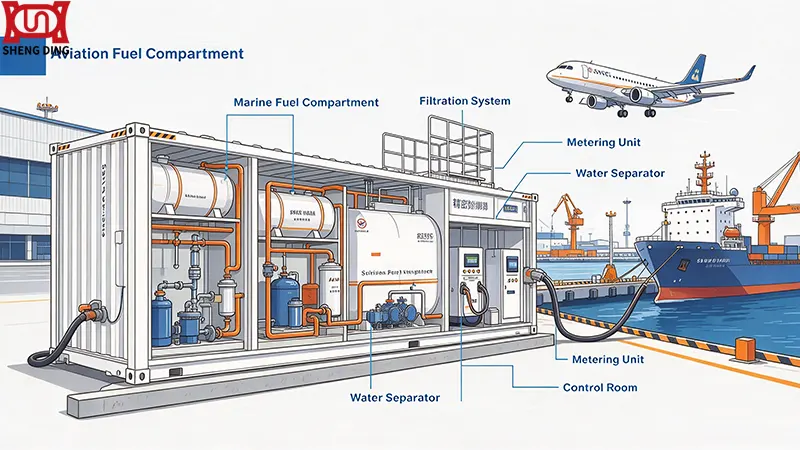
Aviation and marine applications require layouts that address fuel quality, filtration and dispensing interface requirements that differ substantially from road vehicle fueling. Aviation layouts may include specialised filtration and water separation, while marine layouts must accommodate dockside or vessel-based positioning.
Key Design Features
- Aviation-grade filtration and water separation systems
- Dispensing interfaces configured for aircraft or marine vessels
- Optional generator for stand-alone operation in remote airfields or marinas
- Single-chamber or dual-chamber configurations depending on fuel types
- Layout adapted for helicopter or fixed-wing refuelling positions
Best For
Remote airfields, heliports, marinas and coastal fueling points where fixed infrastructure is unavailable or uneconomical. A container fuel station configured for aviation use can be deployed to a remote airstrip and commissioned within days, providing fuel for helicopters or light aircraft without constructing a permanent fuel farm.
Specialisation Requirement
Aviation and marine layouts are not simply road-vehicle stations with different nozzles. Fuel quality management, filtration standards and dispensing protocols differ, and the layout must be designed around those requirements from the outset. Buyers in these segments should specify the application explicitly at the procurement stage.
Layout Comparison at a Glance
| Layout | Fuel Types | Dispensing Speed | Security | Scalability | Typical Application |
| Single-Chamber Standard | 1 | Standard | Moderate | Limited | Single-fuel construction or farm |
| Dual-Chamber Multi-Fuel | 2 | Standard | Moderate | Limited | Mixed fleet, fuel retail |
| Isolated Pump Bay | 1 or 2 | Standard | High | Limited | Unattended remote sites |
| Niche-Integrated Modular | 1 or 2 | Standard | High | Moderate | Space-constrained 20ft stations |
| High-Flow Mining & Construction | 1 or 2 | Very High | Moderate | Moderate | Heavy equipment fleets |
| Modular Multi-Unit | 1-4+ | Configurable | Configurable | Very High | Large or expanding operations |
| Aviation & Marine | 1 or 2 | Specialised | High | Limited | Airfields, heliports, marinas |
How to Choose the Right Layout
Layout selection follows from four operational questions:
- How many fuel types must be dispensed without cross-contamination? One fuel type points to a single-chamber or isolated pump bay layout. Two or more point to dual-chamber or modular configurations.
- What is the required refuelling throughput? Standard fleet vehicles work with standard-flow layouts. Heavy mining or construction equipment requires high-flow configurations.
- Will the station operate attended or unattended? Unattended sites benefit from isolated pump bays with lockable access and integrated security features.
- Is the operation likely to expand? If capacity or fuel types may increase, a modular multi-unit layout avoids premature replacement of the entire station.
These questions should be answered before selecting tank capacity. A station designed around the right layout will deliver better operational performance than a larger tank configured in the wrong arrangement.
For buyers working with Shengding Container, layout customisation is part of the specification process rather than an afterthought. The company's 40ft mobile filling station, for example, is built around an isolated pump bay layout that separates fuel storage from dispensing equipment and allows factory-fitted options including pumps, filtration, offloading and fuel management systems.
Conclusion
The seven layouts profiled here cover the full range of custom mobile fuel station applications, from a single-chamber diesel station on a construction site to a modular multi-unit configuration serving an expanding mining operation, and specialised aviation or marine layouts for remote airfields and marinas.
The common principle across all seven is that layout should follow operation. Tank capacity is a number. Layout is the design decision that determines whether the station is fast, safe, secure and adaptable - or simply large.
When specifying a custom mobile fuel station, start with the operational profile, then select the layout, then size the tank. That sequence produces a station that performs as intended from the first day of commissioning.
Need a custom mobile fuel station layout matched to your operation?
Shengding Container manufactures container and skid-mounted fuel stations with configurable single-chamber, dual-chamber, isolated pump bay and high-flow layouts for mining, construction, logistics and specialised applications.
Written by
TAIAN SHENGDING METAL CONTAINER MANUFACTURING CO., LTD.
Editor Wang
WhatsApp:+86 152 5486 3111
Email:shengdingtank@126.com


- WhatsApp
- E-MailE-Mail:shengdingtank@126.com
- WeChatWeChat:15254863111