7 Mobile Fuel Station Case Studies in Mining & Construction


Mining and construction operations share a defining constraint: the fuel has to be where the work is, not where the infrastructure is. A gold mine in Sudan, an iron ore project in Western Australia, a reclamation site in the Philippines - none of these locations can wait for a permanent fuel depot to be permitted, built and commissioned. The equipment runs now, and it runs on diesel.
The seven case studies below are documented deployments of mobile and skid-mounted fuel stations in mining and construction environments. They are not theoretical configurations. Each one shows a specific operational problem, the equipment deployed to solve it, and the outcome the operator achieved.
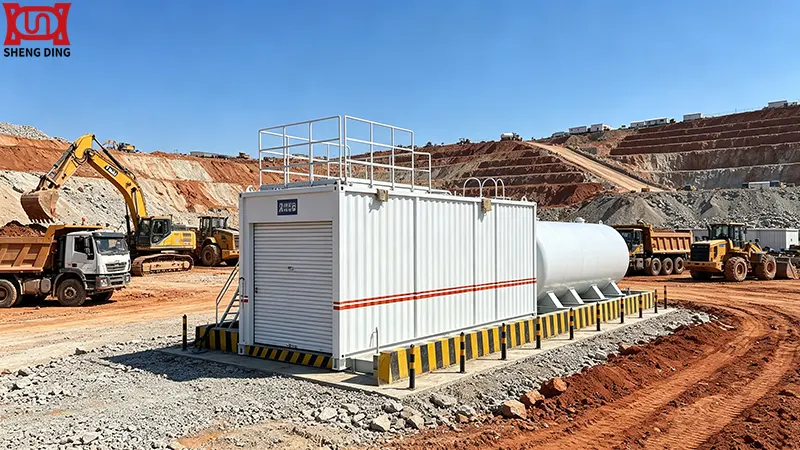
Why These Case Studies Matter
The mobile container fuel station market was valued at USD 2.74 billion in 2025 and is projected to reach USD 6.84 billion by 2032, a CAGR of 13.94%. That growth is driven by projects like the ones below - operations where permanent fuel infrastructure is either uneconomical, impossible to permit in time, or technically unsuitable for the site.
The case studies cover three deployment formats: skid-mounted units, containerized stations, and semi-mobile modular stations. They span four continents and capacities from 20,000 litres to 330,000 litres of total storage. Together they illustrate the range of problems mobile fuel stations solve - and the operational conditions under which each format performs best.
Case Study 1: Sudan Gold Mine - 3-Unit Skid Fleet with Dual Compartments
A gold mining operation in Sudan required on-site fuel for heavy equipment and lubricant supply at the same location. The site lacked the road access, land title and environmental permits needed for a fixed fuel depot.
The solution was a three-unit skid-mounted fleet with dual compartments - one chamber for diesel and one for lubricant. Each unit integrates a double-walled horizontal tank, explosion-proof centrifugal pump, dispenser and PLC cabinet with level alarm and earth interlock. The units are shipped in a 40ft frame and can be set on compacted gravel without civil works.
Average site readiness to first fuel after the skid is positioned on compacted gravel is 48 hours. The dual-compartment configuration eliminated the need for a separate lubricant storage arrangement, consolidating the site's fluid logistics into a single mobile format.
What This Case Demonstrates
For mining operations that need both fuel and lubricants on site, a dual-compartment skid fleet avoids two separate supply chains. The 48-hour deployment window is the critical number - it is the difference between equipment running and equipment idle.
Case Study 2: Pilbara Iron Ore Mine - 330,000L Temporary Fuel Infrastructure for 12-18 Months
An EPCM contractor delivering a bulk earthworks package at an iron ore mine in the remote Pilbara region required a compliant temporary fuel infrastructure solution for an estimated project duration of 12 to 18 months. There was no pre-existing fuel facility on site.
The deployed solution combined three 110,000L self-bunded fuel tanks in a multi-tank arrangement with actuated valve control, an integrated pumping skid supporting both light and heavy vehicle dispensing, a fuel management system with fob-key access and automatic tank gauging, and a battery energy storage system to reduce reliance on continuous diesel generation.
The tanks were supplied on a hire basis - a commercial structure that matched the temporary nature of the project. Safety controls included overfill protection, high- and low-level alarms, fail-close valves and heavy-duty bunded spill grates rated to a 240-tonne safe working load.
What This Case Demonstrates
Temporary does not mean under-engineered. A 12-to-18-month project justified a 330,000L compliant fuel facility - but only because the equipment was hired rather than purchased. The multi-tank arrangement also allowed controlled tanker unloading and staged fuel transfer, which matters when deliveries are infrequent in remote locations.
Case Study 3: Worsley Alumina Mine - Hybrid-Powered 30,000L Stations Cut Generator Fuel Use by 75%
South32, operator of the Worsley Alumina mine, needed two additional fuel storage and dispensing facilities at separate locations on the mine site to refuel heavy vehicles and machinery directly in the work areas. Before the new stations, a fuel truck cycled from the central fuel farm to work sites four times every 24 hours on a fixed schedule - a system that limited fuel availability and created downtime when machines could not refuel on demand.
Two stand-alone 30,000L self-bunded fuel tanks were installed, each paired with a hybrid power system. The main power source is battery energy storage, with a small diesel generator operating only when necessary. This reduced fuel consumption and maintenance by up to 75% compared with continuous diesel generator operation.
The outcome was direct on-site refuelling for machinery, elimination of unnecessary fuel truck trips, and an energy-independent solution suited to the remote location.
What This Case Demonstrates
The economics of a mobile fuel station are not only about the tank. Powering the dispensing equipment with a continuously running diesel generator adds fuel, maintenance and refuelling burden. Hybrid battery power removed most of that secondary cost - a 75% reduction in generator fuel use and maintenance is a material operational saving over the station's service life.
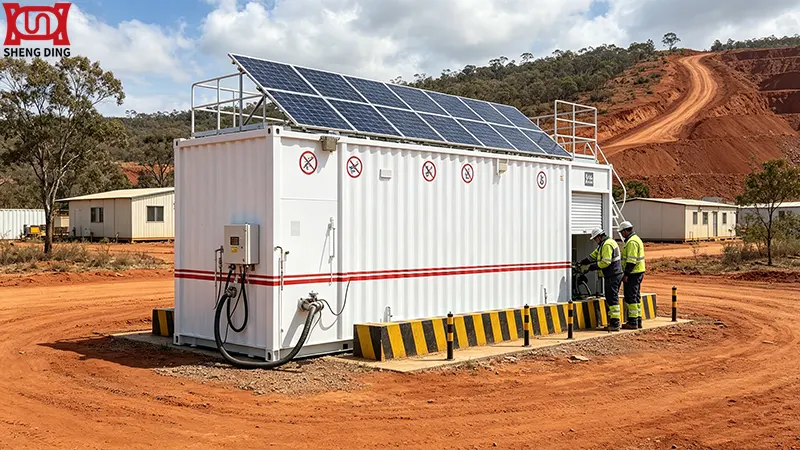
Case Study 4: Chile Antucoya Copper Mine - Semi-Mobile Station with 1,100 L/min High-Flow Dispensing
Minera Antucoya commissioned a semi-mobile fuel station in its mine area to standardise and optimise on-site refuelling. The station provides 150 m3 of storage with continuous operation supported by a main generator and a backup generator.
The layout separates high-flow and standard-flow dispensing: a dedicated high-flow dispenser for CAEX haul trucks delivers 1,100 litres per minute, while a separate island for smaller equipment operates at approximately 450 litres per minute. The station is semi-mobile because it is built from modules on a platform - it can be dismantled, relocated and reinstalled as mining phases progress.
The reported outcome was one additional day of autonomy for the CAEX fleet, reduced personnel exposure on the ground, fewer transfers, and a single operating standard across all shifts. The development plan projects two additional tanks by 2027 to reach 300 m3 and 4-5 days of autonomy.
What This Case Demonstrates
Throughput, not capacity, is the binding constraint for large mining fleets. At 1,100 L/min, a CAEX haul truck with a very large tank refuels in a fraction of the time a standard dispenser would require. The semi-mobile format also solves the relocation problem: mining pits advance, and the fuel station has to follow the work.
Case Study 5: Azerbaijan Azpetrol - 20 Container Stations with 3 Fuel Types and Dual Dispensers
Azpetrol, one of Azerbaijan's leading oil and gas companies, has been receiving mobile fuel stations since 2022 to support rapid expansion of its station network. A total of 20 container-type fuel stations have been delivered, significantly increasing the company's operational reach.
Each 40ft container station is configured for three fuel types - diesel, A95 and A98 - with a dual-dispenser configuration for high-capacity fuelling. An integrated generator enables off-grid operation, and an explosion-proof transfer pump ensures safety in the fuel handling zone.
What This Case Demonstrates
Container stations are not only for single-fuel mining sites. The Azerbaijan deployment shows a multi-fuel, dual-dispenser configuration that supports commercial fuel network expansion. The 20-unit scale also demonstrates that container stations can be produced and delivered repeatedly, not only as one-off custom builds.
Case Study 6: DR Congo - 7 * 40ft Container Stations for Remote High-Demand Locations
A client in the Democratic Republic of Congo received seven 40ft mobile fuel container stations, designed to improve operational efficiency and ensure reliable fuel supply in remote and high-demand locations.
Each unit integrates dual fuel tanks within the container structure, dual dispensers for uninterrupted dispensing under high demand, an integrated automation system for monitoring and reporting, and a heavy-duty transfer pump set.
What This Case Demonstrates
In remote regions where fuel supply chains are fragile, redundancy inside a single station matters. Dual tanks and dual dispensers mean that a single equipment fault does not stop the entire fuelling operation. The automation system also provides fuel accountability - a critical control in environments where fuel theft and unauthorised dispensing are persistent risks.
Case Study 7: Cameroon Transport Company - Two 30-Tonne Mobile Stations as Strategic Fuel Reserves
A major transport company in Cameroon ordered two 30-tonne mobile fuelling stations to address three supply chain pain points: the phase-out of fuel subsidies creating price volatility, severe congestion at the Port of Douala lengthening logistics chains, and the country's near-total reliance on imported refined products following a refinery fire.
The stations allow the company to bulk-purchase fuel when prices are low, bypass the congested port by deploying stocked units directly to fleet depots or large mining sites, and hold fuel as a strategic reserve during supply shortages.
The equipment uses barrier-type explosion-proof technology: the storage tank is filled with an aluminium alloy mesh material that prevents explosion even under open flame, static discharge or gunfire exposure. The system also includes a double-walled tank, automatic fire suppression, emergency shut-off and high-temperature automatic fuel cut-off.
What This Case Demonstrates
Mobile fuel stations are not only a solution to distance. In Cameroon, the station is a procurement and risk-management tool: it moves the fuel purchasing decision from roadside retail prices to a bulk-buy strategy, and it creates a buffer against port congestion and import dependency. The barrier explosion-proof specification reflects an operating environment where fuel security and fire safety are both high priorities.
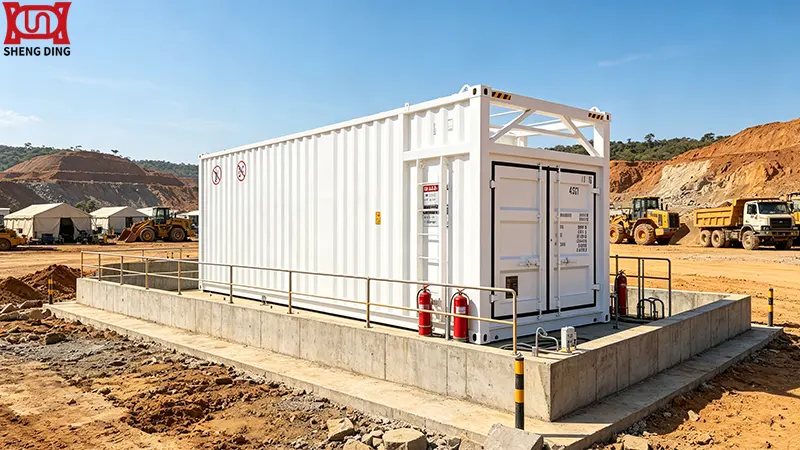
Cross-Case Comparison
| Case | Format | Capacity / Scale | Key Outcome |
| Sudan gold mine | Skid-mounted, 3 units | 20-50 m3 per unit; dual diesel + lubricant | 48-hour site readiness to first fuel |
| Pilbara iron ore | Self-bunded tanks, hired | 3 * 110,000L; 330,000L total | Temporary compliant fuel infrastructure for 12-18 months |
| Worsley Alumina | Self-bunded + hybrid power | 2 * 30,000L | Generator fuel use and maintenance cut by up to 75% |
| Antucoya copper mine | Semi-mobile modular | 150 m3; 1,100 L/min high-flow | 1 extra day of CAEX autonomy; relocatable as pit advances |
| Azerbaijan Azpetrol | 40ft container stations | 20 units; 3 fuel types; dual dispensers | Rapid network expansion with off-grid capability |
| DR Congo | 40ft container stations | 7 units; dual tanks + dual dispensers | Redundant fuel supply in remote high-demand locations |
| Cameroon transport | 30-tonne mobile stations | 2 units; barrier explosion-proof | Bulk-buy strategy and strategic fuel reserve |
What the Seven Cases Have in Common
Across four continents and seven distinct deployments, four patterns repeat.
First, deployment speed is the decisive advantage. The Sudan skid fleet reaches first fuel in 48 hours. Container stations can be operational in 1 to 3 days. The Arctic fuel network in Russia's Irkutsk region saw four container stations commissioned at remote mining sites in June 2026, demonstrating the same rapid-deployment model. In every case, the alternative - waiting for a permanent station - meant equipment idle.
Second, the format follows the site, not the other way around. Skids suit dual-compartment fuel and lubricant supply at a single compact location. Self-bunded tanks suit larger temporary storage with multi-tank arrangements. Container stations suit multi-fuel configurations and repeated deployment across a network. Semi-mobile modular stations suit operations where the mining pit moves.
Third, power supply is part of the fuel problem. The Worsley Alumina case shows that generator runtime can be reduced by up to 75% with hybrid battery power. The Cameroon units carry integrated safety and shutdown systems. A mobile fuel station that depends on a continuously running diesel generator has not fully solved its energy logistics.
Fourth, the safety specification is non-negotiable. Barrier explosion-proof fill, double-walled tanks, overfill protection, emergency shut-off and static grounding appear across these deployments - not as premium options, but as baseline requirements for fuel storage in hazardous and remote environments.
For mining and construction operators, the practical lesson from these seven cases is that mobile fuel station selection starts with three questions: How fast does the fuel need to be on site? Does the station need to move as the project progresses? And what safety and power configuration does the site condition demand?
Conclusion
The seven case studies above span a gold mine in Sudan, an iron ore project in the Pilbara, an alumina mine using hybrid power, a copper mine in Chile with 1,100 L/min high-flow dispensing, a 20-station network in Azerbaijan, a seven-unit deployment in DR Congo, and a two-unit strategic reserve in Cameroon. The equipment differs. The operational logic is the same: put compliant fuel storage where the work is, deploy it faster than permanent infrastructure can be built, and design it for the site conditions rather than a showroom specification.
For buyers evaluating mobile fuel stations for mining or construction, these cases are a reference set. They show what has been deployed, at what scale, and with what result. The next step is to match the format and configuration to the specific operational profile of the project.
Planning on-site fuel supply for a mining or construction project?
Shengding Container manufactures skid-mounted, containerized and self-bunded fuel stations with explosion-proof configurations, multi-compartment options and export documentation for remote project deployment.
Written by
TAIAN SHENGDING METAL CONTAINER MANUFACTURING CO., LTD.
Editor Wang
WhatsApp:+86 152 5486 3111
Email:shengdingtank@126.com


- WhatsApp
- E-MailE-Mail:shengdingtank@126.com
- WeChatWeChat:15254863111