Common Equipment Malfunctions of Skid-Mounted Fuel Station Fuel Dispensers


As integrated and mobile fuel storage and dispensing equipment, skid-mounted fuel stations rely heavily on fuel dispensers as their core terminals. Failures in these dispensers directly impact operational efficiency and safety. Considering the integrated layout, outdoor/mobile environments, and high-pressure fuel delivery characteristics of skid-mounted equipment, common fuel dispenser failures can be categorized into five main types: mechanical systems, hydraulic systems, electrical control systems, metering accuracy, and safety protection systems. Below, Shengding Containers has compiled and released specific failure phenomena, core causes, troubleshooting procedures, and preventative measures, balancing practicality with industry standards (referencing ISO/TC 28 (Technical Committee on Petroleum and Related Products) and AQ 3010-2022 "Safety Specifications for Gas Station Operations"). We hope this explanation will be helpful when operating skid-mounted fuel stations in the future.
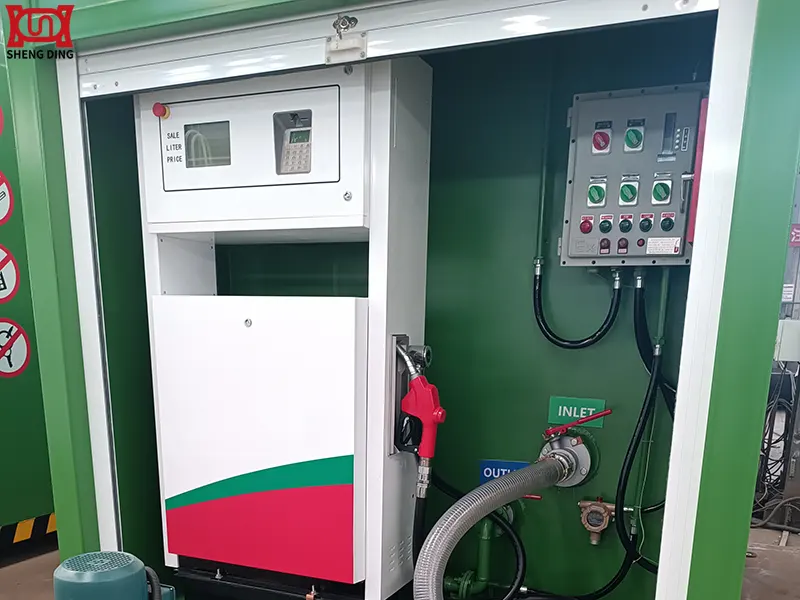
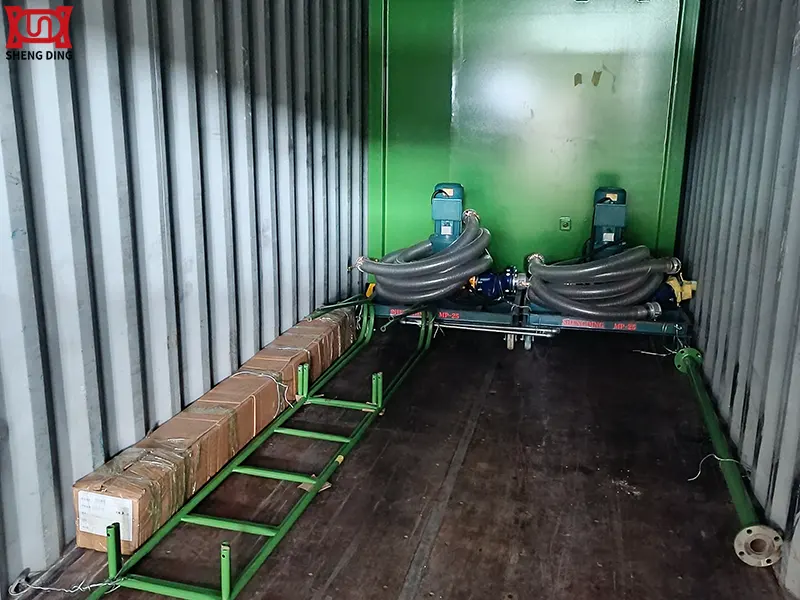
1. Mechanical System Failure (Most Frequent, Accounting for Approximately 40%)
1.1. Fuel Dispenser Not Dispensing Fuel/Dispensing Fuel Extremely Slowly
Symptoms:
- No fuel flows out after startup, or the flow rate is far below the rated value (rated flow rate for standard fuel dispensers: gasoline 30-50 L/min, diesel 40-60 L/min).
Core Causes:
- Suction Side Issues: Clogged/damaged bottom valve (fuel impurities, moisture deposits), leaking suction pipe (loose joints, aging and cracked hoses), insufficient fuel level in the tank (below the suction port height).
- Filter System Clogs: Primary filter (fuel tank outlet) and secondary filter (inside the fuel dispenser) clogged with impurities and gum (especially prone to waxing at low temperatures for diesel).
- Pump Body Failures: Gear pump wear (excessive clearance), stuck vane pump blades, damaged pump shaft seals (air intake).
Troubleshooting Procedure:
- First, check the fuel level in the tank (to avoid false readings, verify the level gauge).
- Turn off the power, remove the fuel dispenser inlet filter, and check for blockages (for diesel fuel, check for wax buildup).
- Start the fuel dispenser and listen to the pump's operation (no abnormal noise -- normal; abnormal noise -- pump malfunction).
- Apply soapy water to the suction pipe connector; if bubbles appear -- leak, tighten or replace the hose.
Solutions and Prevention:
- Blockage: Clean the filter (for diesel fuel, use hot water to melt the wax), replace if severe.
- Leakage: Replace aging hoses and install a sealing gasket (use fuel-resistant rubber gaskets conforming to GB/T 25988-2010 standard).
- Prevention: Clean the filter regularly (every 3 months), clean the fuel tank every 6 months, and filter fuel before it enters the storage area (install a fuel tank inlet filter).
1.2. Intermittent Fuel Dispensing from the Fuel Dispenser (Pulsating Dispensing)
Symptoms:
- Fuel dispensed from the nozzle intermittently, accompanied by vibration of the fuel dispenser.
Core Causes:
- Air intake into the suction pipe (loose connectors, minor cracks in the hose).
- Insufficient fuel intake into the pump (partial blockage of the filter screen).
- Fuel separator malfunction (poor venting, leading to cavitation within the pump).
Troubleshooting and Solutions:
- First, check the suction pipe's seal (soap water leak test).
- Disassemble the fuel separator's vent valve and clean out impurities (a stuck vent valve will prevent air from escaping).
- Replace the aging suction hose (use a fuel-specific hose with a pressure resistance >= 0.6MPa).
2. Hydraulic System Failure (High Safety Risk, Requires Emergency Handling)
2.1. Fuel Leakage (One of the Most Dangerous Failures)
Symptoms:
- Fuel dripping/leaking occurs at the bottom of the fuel dispenser, the nozzle hose, and connectors, accompanied by a fuel odor.
Core Causes:
- Loose pipeline joints (caused by vibration, prone to occur after movement/transport of skid-mounted equipment).
- Aging seals (O-rings and oil seals are not resistant to fuel corrosion, or suffer from long-term high-pressure fatigue).
- Damaged hoses (high-pressure impact, aging and cracking, especially frequent bending of fuel nozzle hoses).
- Internal leakage in valves (wear on the sealing surfaces of solenoid valves and check valves).
Troubleshooting and Emergency Handling:
- Immediately stop the machine, disconnect the power supply (explosion-proof switch), and set up a warning area (no open flames).
- Use absorbent pads to clean up leaking fuel and locate the leak point (focus on checking joints, hoses, and valve flanges).
- Loose joints -- Tighten (use explosion-proof tools); Aging seals -- Replace (must be made of fluororubber, resistant to fuel and temperature -20~120oC); Damaged hoses -- Replace the entire hose (compliant with GB 10543-2003 "Aviation Ground Refueling Hose" or equivalent industry standards).
Preventive Measures:
- Weekly inspection for leaks (use test strips to check hidden areas).
- Replace the fuel nozzle hose every 12 months, and install anti-detachment clips at the joints.
- After transporting skid-mounted equipment, retighten all hydraulic line joints.
2.2. Fuel Nozzle Self-Sealing Malfunction (Abnormal Nozzle Tripping)
Symptoms:
- The fuel nozzle fails to self-seal during refueling (fuel overflows), or frequently trips before the nozzle is full.
Core Causes:
- Clogged self-sealing sensor (the air inlet of the fuel nozzle is blocked by impurities or oil).
- Damaged self-sealing diaphragm (caused by high-pressure fuel impact).
- Fatigue of the fuel nozzle spring (failure of the self-sealing mechanism to reset).
- Clogged vapor recovery system (if the fuel dispenser has vapor recovery function, a blocked recovery line causes abnormal pressure).
Troubleshooting and Resolution:
- Disassemble the fuel nozzle and clean impurities from the air inlet (purge with compressed air).
- Disassemble the fuel nozzle's self-sealing mechanism and check for diaphragm damage (replace damaged diaphragms using oil-resistant ones).
- Frequent nozzle tripping -- Check if the vapor recovery pump is working properly and clean the recovery filter.
Specification Requirements:
- The fuel nozzle's self-sealing sensitivity must comply with GB/T 9081-2021, and the leakage rate after self-sealing should be <= 5 drops/min; otherwise, it is prohibited from use.
3. Electrical Control System Failure (Accounting for approximately 30%, easily misdiagnosed)
3.1. Fuel Dispenser Cannot Start (No Response)
Fault Symptoms:
- After pressing the start button, the fuel dispenser does not move, the display screen shows nothing, or there is only abnormal noise from the pump body but it does not run.
Core Causes:
- Power Supply Failure: Explosion-proof distribution box trips (overload, short circuit), loose/broken power cord (oxising due to outdoor moisture).
- Control Module Failure: Mainboard damage (unstable voltage, lightning strike), malfunctioning button panel (contact oxidation).
- Motor Failure: Explosion-proof motor overload protection triggered (pump body jamming), motor winding burnout (moisture, short circuit).
Troubleshooting Procedure:
- Check the explosion-proof distribution box power supply (whether the air switch is on, use a multimeter to measure if the voltage is normal, 380V/220V).
- If the power supply is normal, check the motor thermal overload protector (whether it trips, reset and try again).
- If the motor still does not run -- disassemble the pump body, check for jamming (clean impurities), or measure the motor winding resistance (three-phase imbalance will cause burnout, requiring replacement of the explosion-proof motor, conforming to Ex d IIB T4 explosion-proof rating).
Preventive Measures:
- Regularly (every 6 months) test the motor insulation resistance ( >= 1MOhm).
- Install surge protection devices on outdoor skid-mounted equipment (compliant with GB 50057-2010), and ensure power lines are protected by explosion-proof conduits.
3.2. Display Abnormalities (Gibberish, No Data)
Fault Symptoms:
- The display shows garbled characters, the oil level/amount does not update, or the screen is black after power-on.
Core Causes:
- Communication failure between the motherboard and the display (loose wiring, interface oxidation).
- Sensor failure: Damaged flow sensor (encoder) (inaccurate counting, leading to abnormal data).
- Display itself failure (damaged backlight, aging LCD panel).
Troubleshooting and Solution:
- Turn off the power and reconnect the motherboard and display (clean the interface oxide layer).
- If the data does not update -- check the flow sensor (disassemble and clean the impeller, measure whether the output signal is normal; normally a pulse signal, the frequency is proportional to the flow rate).
- Black screen -- replace the display backlight module or the entire display assembly (use original parts to ensure metrological accuracy compliance).
3.3. Solenoid Valve Failure (Unable to Switch Oil Supply)
Fault Symptoms:
- No oil is dispensed from the oil nozzle after startup (solenoid valve not open), or oil continues to flow after shutdown (solenoid valve not closing tightly).
Core Causes:
- Solenoid valve coil burnt out (abnormal voltage, moisture).
- Valve core stuck (clogging by impurities, oil condensation).
- Abnormal control signal (main board output signal failure).
Troubleshooting and Solution:
- Measure the solenoid valve coil resistance with a multimeter (normal range 100-300Ohm; infinite resistance indicates burnt-out, requiring replacement with an explosion-proof solenoid valve).
- Disassemble the solenoid valve and clean the valve core (use kerosene for cleaning; strong acids and alkalis are prohibited).
- Check the main board output voltage (the rated voltage of the solenoid valve is usually DC24V or AC220V). If the voltage is normal, the problem is with the solenoid valve; otherwise, it is with the main board.
4. Metering Accuracy Failure (Compliance Critical, Mandatory Verification Required)
4.1. Excessive Refueling Volume Deviation (Positive/Negative Deviation)
Fault Symptoms:
- After metering verification (using a standard measuring instrument), the refueling volume deviation exceeds ¡À0.3% (mandatory requirement of GB/T 9081-2021). For example, if 100L is added, only 99.5L is actually dispensed (negative deviation, customer complaints) or 100.5L (positive deviation, operational losses).
Core Causes:
- Flow sensor failure: impeller wear, inaccurate encoder counting.
- Mechanical counter failure (mechanical fuel dispenser): gear transmission ratio deviation.
- Oil temperature influence: fuel temperature changes cause volume expansion/contraction (temperature compensation function not activated).
- Pipeline leakage (minor leaks lead to reduced actual fuel output).
Troubleshooting and Resolution:
- Prioritize sending the flow sensor for testing (calibrated by a legal metrology institution; replace if unqualified).
- Enable the temperature compensation function (modern fuel dispensers all have this function; the temperature sensor needs calibration).
- Check the pipeline for micro-leakage (use test paper to check joints and valves).
Regulatory Requirements:
- Fuel dispensers must be calibrated every 6 months; those that fail calibration must not be used.
4.2. Mismatch between Fuel Amount and Volume
Symptoms:
- The displayed amount and volume conversion is abnormal (e.g., the unit price is set correctly, but the displayed amount for 10L of fuel is much higher/lower than the theoretical value).
Core Causes:
- Incorrect unit price setting (accidental modification).
- Main board calculation module malfunction (abnormal data storage).
- Flow sensor signal interference (electromagnetic interference causing counting errors).
Troubleshooting and Resolution:
- Recheck and set the unit price (enter administrator mode).
- Restart the fuel dispenser to clear temporary data. If the problem persists, check the mainboard grounding (electromagnetic interference issue; a grounding device needs to be installed, grounding resistance <= 4Ohm).
- Replace the flow sensor (signal transmission fault).
5. Safety Protection System Faults (Involving explosion-proof and fire-proof features, not to be ignored)
5.1. Explosion-proof Alarm Device False Alarm/No Alarm
Fault Symptoms:
- The explosion-proof alarm continuously alarms when there is no leakage, or fails to alarm when there is a fuel leak.
Core Causes:
- Sensor Fault: Combustible gas sensor (catalytic combustion type) poisoned (contaminated by oil or sulfides), sensitivity drift.
- Alarm controller fault (mainboard damage, abnormal power supply).
- Improper sensor installation location (not near easily leaking points, such as the bottom of the fuel dispenser or the manhole of the fuel tank).
Troubleshooting and Resolution:
- Clean the combustible gas sensor probe (wipe with alcohol, calibrate regularly, once a year).
- Test the sensor sensitivity with a standard gas (e.g., isobutane); replace if it fails to meet the standard.
- Adjust the sensor installation position ( <= 0.5m from the ground, close to the hydraulic components of the fuel dispenser).
5.2. Emergency Stop Button Failure
Fault Symptoms:
- The fuel dispenser continues to operate after the emergency stop button is pressed, or the button cannot be reset.
Core Causes:
- Button contacts are oxidized or stuck (due to moisture in outdoor environments).
- The emergency stop circuit is open (aging wires, loose connectors).
- The control module does not receive the stop signal (main board failure).
Troubleshooting and Resolution:
- Disassemble the button, clean the oxide layer on the contacts (apply conductive grease); if stuck, replace the explosion-proof emergency stop button (compliant with Ex d IIB T4 level).
- Use a multimeter to check the continuity of the stop circuit; repair the wire if it is open.
- Main board failure -- Replace the control module (original parts required, ensuring explosion-proof performance).
6. Key Points for Fault Prevention and Maintenance (Compliant with Industry Standards)
6.1. Regular Inspection and Maintenance:
- Daily: Check for leaks, fuel nozzle self-sealing function, and display screen data.
- Weekly: Clean the filter, check the tightness of electrical wiring, and test the emergency stop button.
- Monthly: Test motor insulation resistance and calibrate the temperature sensor.
- Every 6 months: Perform metering verification, tank cleaning, and replace seals/hooks.
- Annually: Calibrate the combustible gas sensor, conduct lightning protection testing, and replace aging electrical components.
6.2. Fuel Quality Control:
- Fuel must be filtered before entering the storage facility (using a >= 100 mesh filter) to prevent the introduction of water and impurities.
- Diesel fuel requires the addition of an anti-gelling agent in winter (to prevent wax buildup and pipeline blockage).
6.3. Environmental Adaptability Protection:
- Outdoor skid-mounted equipment: Install rainproof canopies and sunshades; ensure electrical components are properly sealed against moisture.
- Low-temperature environments: Use low-temperature resistant hydraulic oil (diesel fuel dispensers) and heating devices (to prevent wax buildup on filters).
- High-temperature environments: Enhance ventilation and avoid motor overload.
6.4. Component Selection Specifications:
- All components must meet explosion-proof standards (Ex d IIB T4) and fuel compatibility standards (resistant to gasoline/diesel corrosion).
- The use of non-original parts is prohibited (especially flow sensors, mainboards, and solenoid valves, as these affect metering accuracy and safety).
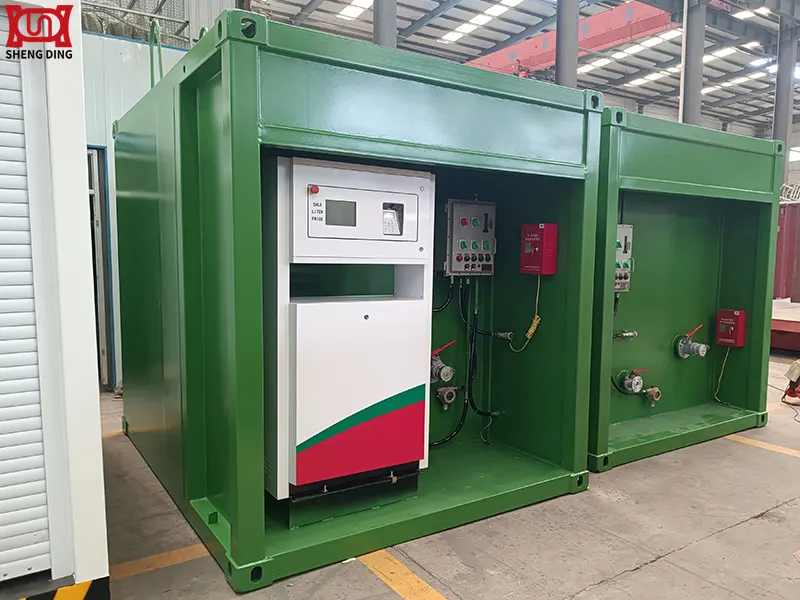
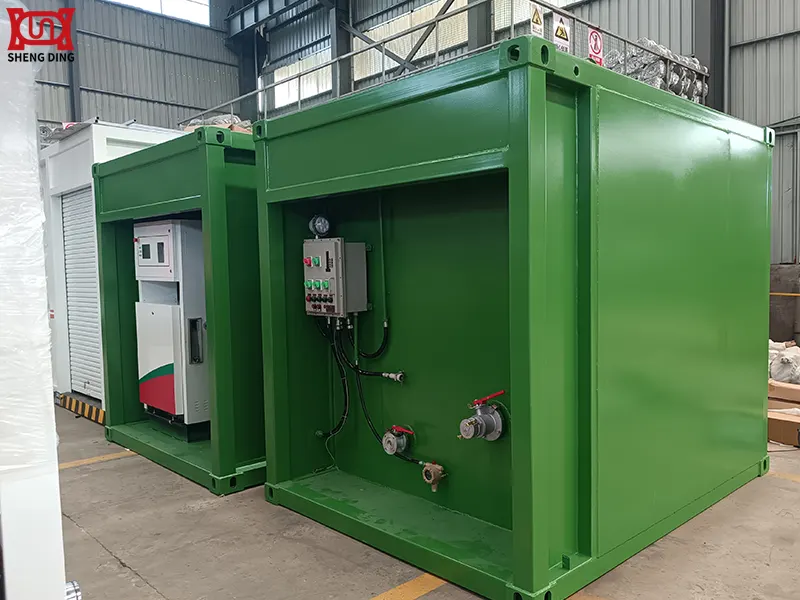
7. Common Fault Quick Location Checklist
| Fault Phenomenon | Priority Troubleshooting Direction | Emergency Handling Measures |
| No Fuel Dispensing | Filter Clogged -- Suction Pipe Air Leak -- Pump Failure | Clean Filter -- Tighten Connectors -- Shut Down and Inspect Pump |
| Fuel Gun Self-Sealing Malfunction | Air Inlet Clogged -- Self-Sealing Diaphragm Damaged | Clean Impurities -- Replace Diaphragm |
| Leakage | Loose Connectors -- Hose Damage -- Seal Aging | Tighten Connectors -- Replace Hose -- Shut Down and Patch Leak |
| Display Screen Garbled Characters | Loose Wiring -- Flow Sensor Failure | Reconnect Wiring -- Calibrate Sensor |
| Metering Deviation Exceeds Standard | Flow Sensor -- Temperature Compensation -- Pipeline Leakage | Send Sensor for Inspection -- Enable Compensation -- Detect Leak |
This classification covers over 90% of common faults in skid-mounted fuel station fuel dispensers. In actual operation and maintenance, it is necessary to refer to the original manufacturer's manual for the equipment model (such as Zhengxing, Hengshan, Beilin, etc.) and prioritize troubleshooting high-frequency fault points (filter blockage, leakage, electrical loosening). At the same time, it is essential to strictly comply with industry standards such as explosion-proof and metering to avoid safety accidents or compliance risks caused by faults. If complex faults are involved (such as motherboard burnout or pump body overhaul), it is recommended to contact the original manufacturer's after-sales service or a qualified professional repair organization.
Written by
TAIAN SHENGDING METAL CONTAINER MANUFACTURING CO., LTD.
Editor Wang
WhatsApp:+86 152 5486 3111
Email:shengdingtank@126.com


- WhatsApp
- E-MailE-Mail:shengdingtank@126.com
- WeChatWeChat:15254863111