Diesel vs Gasoline Skid-Mounted Fuel Stations: The 6 Most Significant Technical Differences


A mining contractor in Zambia needs diesel on site within three weeks. A logistics depot in Singapore wants to fuel its gasoline fleet. Both are looking at skid-mounted fuel stations -- but the equipment they need is not the same.
Diesel and gasoline may look similar at a glance, but their physical properties create fundamentally different engineering requirements for skid stations. Here are the 6 most significant technical differences every buyer must understand.
Introduction
Skid-mounted fuel stations -- factory-built, self-contained fueling systems assembled on a steel frame -- are designed to handle both diesel and gasoline. Many units can even store both fuels in a single station with partitioned tanks.
But specifying a station that handles both fuels is not as simple as checking a box. The physical and chemical differences between diesel and gasoline affect tank design, safety systems, environmental compliance, hardware selection, and even how the station is classified by regulators.
Understanding these differences is essential for:
- Choosing the right equipment for your application
- Ensuring regulatory compliance
- Avoiding costly modifications or retrofits
- Protecting your investment over the equipment's 8-10 year lifecycle
Below are the 6 most significant technical differences between diesel and gasoline skid-mounted fuel stations.
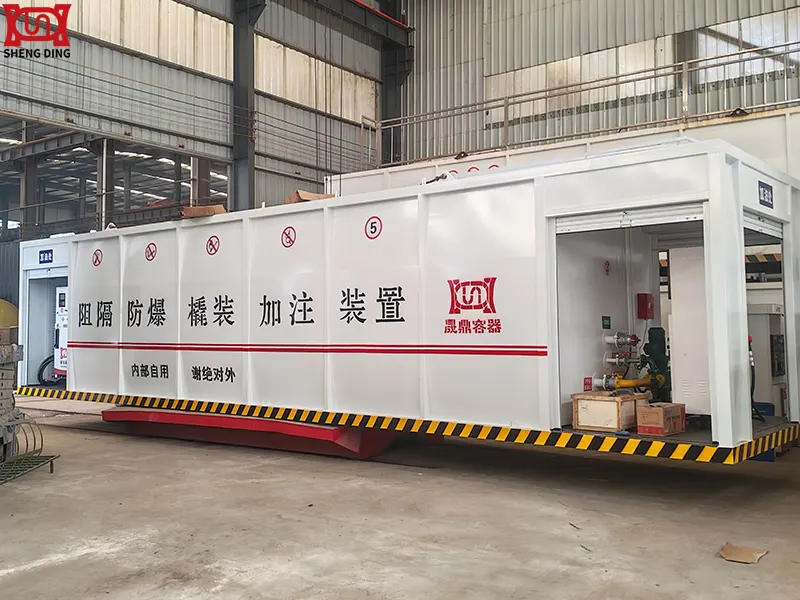
1. Flash Point & Fire Hazard Classification
The Numbers
The most fundamental difference between diesel and gasoline is volatility -- how easily the fuel evaporates and forms flammable vapors.
| Property | Diesel | Gasoline |
| Flash point | 52-96oC (125-205oF) | Below -40oC |
| NFPA 30 classification | Class II combustible liquid | Class I flammable liquid |
| Fire hazard classification (China) | A | B |
Gasoline's flash point is around -43oC. At normal ambient temperatures, gasoline is constantly evaporating and producing flammable vapors. Diesel, by contrast, has a flash point well above room temperature -- it doesn't produce significant flammable vapors unless heated.
What This Means for Equipment Design
This volatility difference drives several downstream engineering decisions:
Electrical area classification: Because gasoline produces flammable vapors at ambient temperatures, all electrical equipment in a gasoline skid must meet stricter explosion-proof ratings (e.g., Ex d IIBT4). Diesel stations have less stringent requirements in many areas, though explosion-proof equipment is still standard practice for safety.
Tank venting: Gasoline tanks require more sophisticated venting systems with pressure/vacuum vents and flame arrestors to prevent vapor release and external ignition sources from entering the tank. Diesel tanks have simpler venting requirements.
Explosion-proof fill: According to GB 50156-2021, gasoline tanks in skid-mounted stations must be fitted with explosion-proof devices or materials. While diesel tanks may also use barrier explosion-proof technology, the regulatory requirement is specifically mandated for gasoline.
The takeaway: Gasoline stations face stricter safety requirements across the board due to the fuel's inherent volatility.
2. Vapor Recovery Requirements
The Regulatory Reality
This is perhaps the most visible compliance difference between diesel and gasoline skids.
Gasoline skids typically require Stage II vapor recovery systems. These systems capture volatile organic compounds (VOCs) during both:
- Tanker unloading (Stage I) -- vapors displaced from the tank are returned to the tanker
- Vehicle refueling (Stage II) -- vapors are drawn back into the storage tank
Vapor recovery systems must achieve at least 95% VOC reduction.
Diesel skids, by contrast, produce far less vapor at ambient temperatures. Vapor recovery is often simpler or not required.
Why the Difference?
Gasoline is composed of light hydrocarbons that evaporate readily. Diesel is composed of heavier hydrocarbons with much lower vapor pressure. At normal temperatures, diesel simply doesn't produce the same volume of flammable vapors.
What to Ask Your Supplier
- Does your gasoline skid include both unloading and dispensing vapor recovery?
- Does your diesel skid require vapor recovery in my jurisdiction?
- Have the systems been tested and certified for vapor recovery efficiency?
The takeaway: Gasoline stations have mandatory vapor recovery requirements that add cost and complexity. Diesel stations typically do not -- but always check local regulations.
3. Density & Weight Calculation
The Numbers
Diesel and gasoline have different densities, which affects everything from tank capacity planning to transport weight calculations.
| Property | Diesel | Gasoline |
| Density at 20oC | 820-845 kg/m3 | 715-780 kg/m3 |
| Typical weight per 10,000L | 8.4 tons | 7.4 tons |
| 50,000L tank weight | 42 tons | 38 tons |
At the same volume, diesel is approximately 8-10% heavier than gasoline.
Regulatory Impact
This density difference has a direct impact on station classification under Chinese standards.
According to GB 50156-2021, diesel tank volume is counted at half its actual capacity when calculating total station volume for classification purposes.
For example:
- A station with a 50m3 diesel tank is counted as 25m3 for classification
- A station with a 50m3 gasoline tank is counted as 50m3
This means a diesel-only station can have twice the physical storage capacity of a gasoline-only station while remaining in the same regulatory classification.
Practical Implications
- Foundation design: Diesel stations require stronger foundations due to the higher weight of the full tank
- Transport planning: The same volume of diesel weighs more -- affecting shipping costs and crane requirements
- Regulatory compliance: Diesel stations can achieve higher storage capacity within the same regulatory tier
The takeaway: Diesel is heavier per liter, which affects foundation design and transport -- but regulators give diesel a significant capacity advantage in station classification.
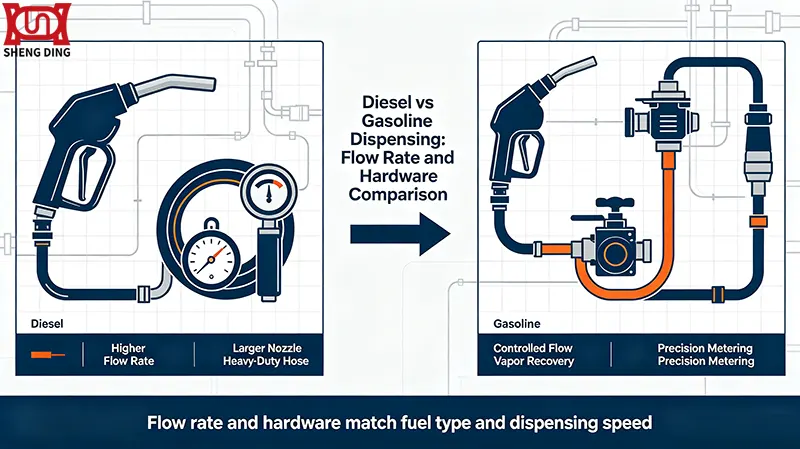
4. Flow Rate & Dispensing Hardware
The Numbers
Diesel and gasoline have different dispensing requirements based on the typical applications and the fuel's physical properties.
| Application | Typical Flow Rate |
| Retail gasoline | 30-50 L/min |
| Retail diesel | 40-70 L/min |
| Fleet/commercial diesel | 70-120 L/min |
Why the Difference?
Application drives the difference: Diesel fuels heavy equipment -- mining trucks, construction machinery, agricultural equipment, and commercial fleets. These vehicles have large fuel tanks and benefit from higher flow rates to minimize downtime.
Gasoline primarily fuels passenger vehicles with smaller tanks, where standard flow rates are sufficient.
Hardware Differences
Hoses, nozzles, and seals must handle diesel's higher lubricity and viscosity. Diesel is more viscous than gasoline, which means:
- Diesel dispensers may require larger-diameter hoses and nozzles
- Seals and gaskets must be compatible with diesel's chemical properties
- Filtration requirements differ -- diesel often requires water separators and particulate filters
The takeaway: Diesel stations typically require higher-flow hardware suited for commercial and industrial applications. Gasoline stations use standard retail dispensing equipment.
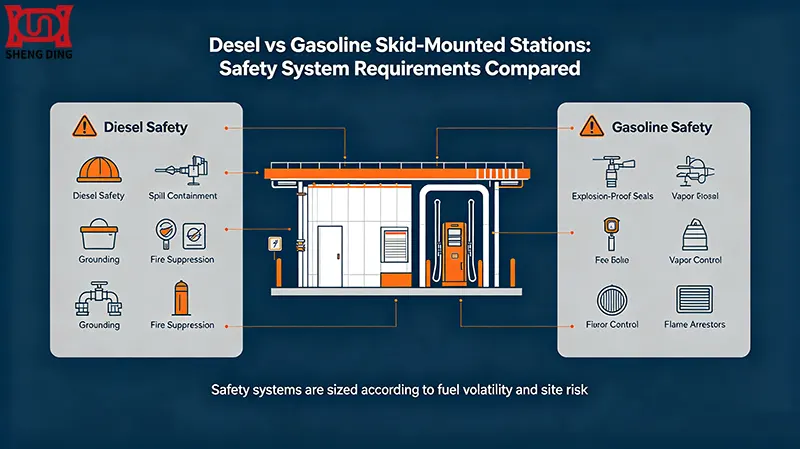
5. Explosion-Proof & Safety System Requirements
The Regulatory Framework
While both diesel and gasoline skids incorporate safety systems, the stringency and mandatory nature of certain systems differ significantly.
Gasoline stations face stricter requirements because gasoline is classified as a Class I flammable liquid. Key differences include:
| Safety System | Gasoline | Diesel |
| Barrier explosion-proof fill | Mandatory | Often optional |
| Vapor recovery | Mandatory (Stage I + II) | Often not required |
| Combustible gas detection | Standard | Recommended for large stations |
| Electrical area classification | Stricter (Zone 1/2) | Less stringent |
Common Requirements
Both diesel and gasoline skids typically include:
- Double-walled steel tanks with leak detection
- Automatic fire suppression (activation <=95oC)
- Emergency pressure relief devices
- Overfill prevention (90% alarm, 95% shut-off)
- Lightning protection and static grounding
- Emergency shutdown systems (ESD)
Diesel-Specific Considerations
Diesel has its own unique requirements:
- Cold-weather operation: At temperatures <=4oC, low-pour-point diesel must be used
- Fuel heating: In extreme cold, diesel may require tank heating systems to maintain pumpability
- Water contamination: Diesel is more susceptible to water contamination and microbial growth, requiring regular water draining and potentially biocide treatment
The takeaway: Gasoline stations face mandatory, stricter safety requirements across multiple systems. Diesel stations have more flexibility -- but cold-weather operation introduces its own challenges.
6. Fuel Compatibility & Material Selection
Tank Materials
Both diesel and gasoline can be stored in carbon steel tanks -- typically Q235B or Q345R carbon steel. However, there are important differences:
Corrosion considerations:
- Gasoline can be more aggressive toward certain seal materials
- Diesel's higher viscosity and lubricity affect pump and seal wear differently
- Biodiesel blends (B5-B20) introduce additional compatibility considerations
Coating requirements:
- Both fuel types require double-layer anti-corrosion coatings (epoxy + polyurethane)
- Coating selection must account for the specific fuel chemistry
Dual-Fuel Stations
Many skids are designed to handle both diesel and gasoline in a single unit with partitioned tanks. These dual-fuel stations must:
- Use materials compatible with both fuel types
- Maintain separate dispensing systems for each fuel
- Ensure no cross-contamination between fuel compartments
What to Verify
- Are tank materials certified for both diesel and gasoline storage?
- Are seals, gaskets, and hoses compatible with your specific fuel type?
- If using biodiesel blends, is the system rated for B5-B20?
- Does the supplier provide material compatibility documentation?
The takeaway: While carbon steel works for both fuels, seals, coatings, and compatibility documentation must be verified for your specific fuel application.
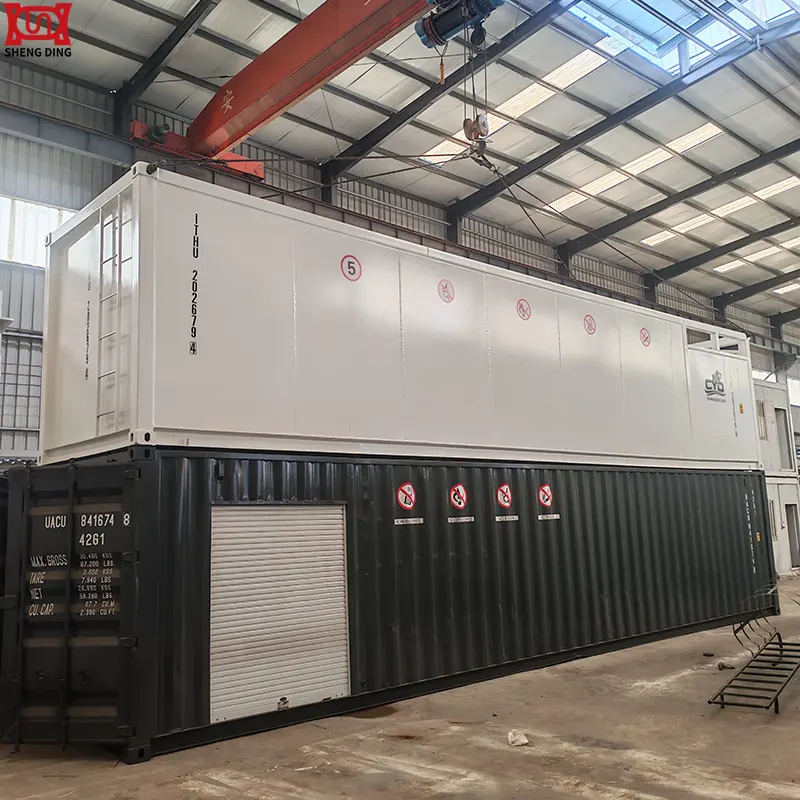
Summary Comparison Table
| Factor | Diesel Skid | Gasoline Skid |
| Flash point | 52-96oC | Below -40oC |
| NFPA classification | Class II combustible | Class I flammable |
| Vapor recovery | Often not required | Mandatory (Stage II) |
| Density | 820-845 kg/m3 | 715-780 kg/m3 |
| Weight per 50,000L | 42 tons | 38 tons |
| Typical flow rate | 40-120 L/min | 30-50 L/min |
| Barrier explosion-proof | Often optional | Mandatory |
| Primary applications | Mining, construction, fleet | Retail, passenger vehicles |
| Cold-weather concerns | Fuel gelling, heating required | Minimal |
| Regulatory capacity advantage | Yes (volume) | No |
How to Choose: Decision Guide
| Your Scenario | Recommended Approach |
| Mining, construction, or heavy equipment | Diesel skid with high-flow dispenser (70-120 L/min) |
| Retail or passenger vehicle fueling | Gasoline skid with vapor recovery and explosion-proof fill |
| Fleet depot with mixed vehicles | Dual-fuel skid with partitioned tanks |
| Cold-climate operation | Diesel skid with fuel heating and low-pour-point diesel |
| Regulatory flexibility | Diesel skid -- volume advantage |
| Maximum environmental compliance | Gasoline skid with full vapor recovery |
Conclusion
Diesel and gasoline may both be fuels, but the equipment that stores and dispenses them is fundamentally different in design, safety systems, regulatory requirements, and hardware specifications.
The six differences covered here -- flash point, vapor recovery, density, flow rate, safety requirements, and material compatibility -- drive everything from the price of the equipment to the complexity of installation and the cost of ongoing compliance.
When specifying a skid-mounted fuel station, don't assume that "one size fits all." Ask your supplier:
- Is this station designed specifically for diesel or gasoline -- or both?
- Does it include the mandatory safety systems for my fuel type?
- Does it meet the vapor recovery requirements in my jurisdiction?
- What is the maximum flow rate -- and does it match my application?
- Are all materials and seals compatible with my fuel?
Choose the right fuel. Choose the right equipment. And never compromise on safety.
Ready to specify the right skid-mounted fuel station for your fuel type? Contact Shengding Container for expert guidance, transparent specifications, and customized solutions.
Written by
TAIAN SHENGDING METAL CONTAINER MANUFACTURING CO., LTD.
Editor Wang
WhatsApp:+86 152 5486 3111
Email:shengdingtank@126.com


- WhatsApp
- E-MailE-Mail:shengdingtank@126.com
- WeChatWeChat:15254863111