Double-Wall Tank Leak Detection Systems: 7 Methods Compared for Skid-Mounted Fuel Stations


A double-wall tank without the right leak detection system is like a smoke detector with no battery - the hardware looks protective, but it won't warn you when danger arrives. A single fuel leak can cost $255,000 to remediate. Here are 7 leak detection methods compared, so you can choose the right one for your skid-mounted fuel station.
Introduction: Why Leak Detection Matters
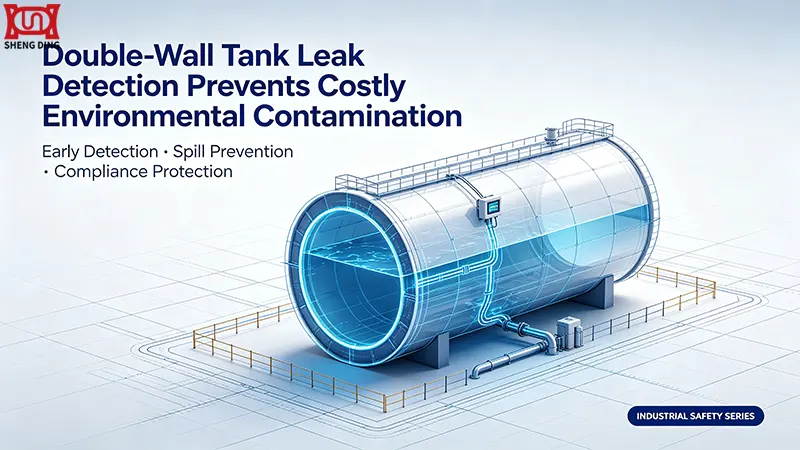
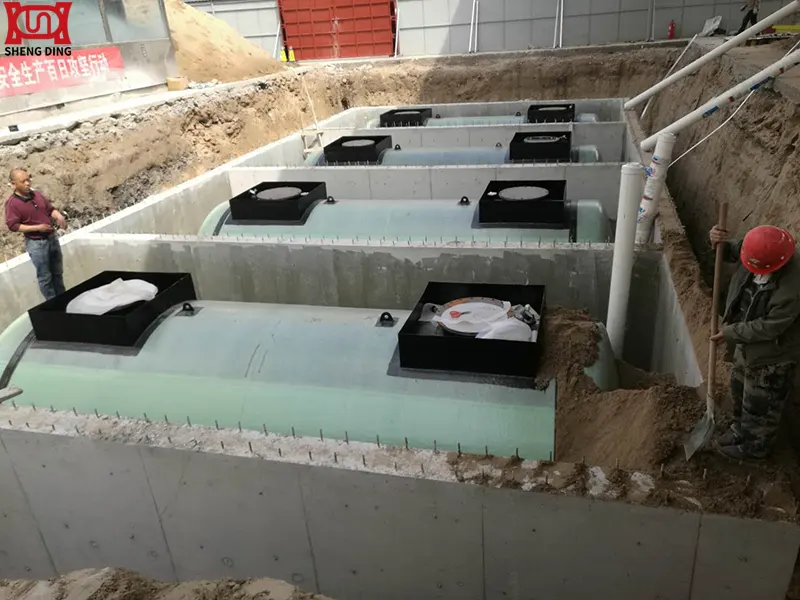
Double-wall tanks are the industry standard for skid-mounted fuel stations. GB 50156-2021 explicitly requires that skid-mounted fueling devices must use double-walled steel tanks, and the space between the two tank walls must be equipped with a leak detection device capable of detecting leaks at any point on either the inner or outer wall.
The purpose is simple: catch leaks early, before fuel reaches the environment. But the *method* of detection varies widely - from simple manual visual checks to sophisticated continuous electronic monitoring systems. Each method has different strengths, weaknesses, costs, and regulatory classifications.
According to GB/T 30040-2013, leak detection systems are classified into five levels (I through V) based on their environmental protection capability. Systems that can be used directly in the interstitial space of double-wall tanks include Level I, II, and III systems.
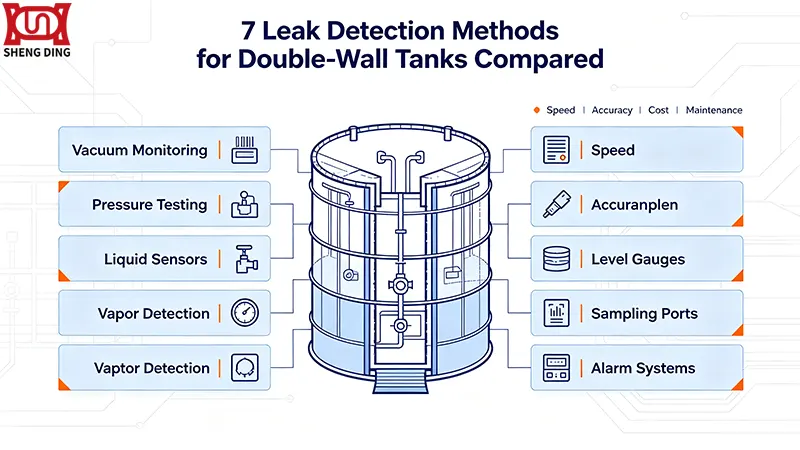
Below are 7 leak detection methods compared across principle, advantages, disadvantages, and regulatory level.
1. Manual Visual Inspection (Gauge Stick / Dipstick)
Principle
A gauge stick is inserted into a monitoring port that extends into the interstitial space and visually inspected for evidence of leaked product from the inner tank or groundwater infiltration from a breach in the outer tank. Petroleum-detecting paste may be placed on the end of the stick to help identify leaked product. Double-walled piping systems typically slope or drain back to containment sumps that can be visually inspected for product.
Advantages:
- Lowest cost - no electronic equipment required
- Simple to understand and implement
- No ongoing power or maintenance costs
Disadvantages
- Requires manual inspection at least once every 30 days
- Cannot detect leaks between inspections - a slow leak could go undetected for weeks
- Human error factor - inspections can be missed or performed poorly
- May not detect small or slow leaks reliably
Regulatory Level: Not classified under GB/T 30040 (not an automated system).
Best for: Temporary installations, budget-constrained projects, or as a backup to electronic systems.
Worst for: Any application requiring continuous environmental protection or regulatory compliance in developed markets.
Method 2: Pressure Monitoring System (Positive Pressure)
Principle
A certain positive pressure (usually air or inert gas) is applied to the interstitial space, and pressure changes are continuously monitored.
- Inner wall leak: Liquid (fuel) from the tank penetrates into the interstitial space, causing pressure to increase
- Outer wall leak: Gas in the interstitial space leaks into the external soil or water, causing pressure to drop
Advantages
- Fast response time
- Can distinguish between inner and outer wall leaks
- Technology is relatively mature
- Classified as Level I under GB/T 30040 - highest environmental protection
Disadvantages
- Sensitivity to small leaks may be inferior to vacuum method
- Significantly affected by temperature changes - requires temperature compensation
- Potential for false alarms due to thread seal failures
- Requires continuous pressure source, increasing operating costs
Regulatory Level: Level I - can detect leaks at any position on the tank wall and ensures no liquid enters the environment when a leak is detected.
Best for: Applications where distinguishing between inner and outer wall leaks is critical.
Worst for: Environments with wide temperature fluctuations or where continuous power is unreliable.
Method 3: Vacuum Monitoring System (Negative Pressure)
Principle
A vacuum (negative pressure) is established and maintained in the interstitial space, and changes in vacuum level are continuously monitored. An integrated vacuum pump extracts air from the monitoring chamber until a defined operating pressure is reached, and the measuring unit continuously monitors this condition.
- Inner wall leak: Liquid or air enters the gap space, resulting in a decrease in vacuum (pressure rise)
- Outer wall leak: External air or water is drawn into the gap space, also resulting in a decrease in vacuum
Advantages
- 100% detection rate - sounds an alarm at the slightest leak, whereas liquid detectors often only react when considerable amounts of fuel have already leaked out
- Intrinsically safe and self-monitoring - a defect in the leak detector or interruption in the suction line automatically triggers a fault message
- Double-sided protection - monitors tightness of both inner tank (fuel loss) and outer tank (groundwater ingress) simultaneously and around the clock
- More sensitive to tiny liquid leaks than pressure method
- Classified as Level I under GB/T 30040
Disadvantages
- Generally cannot directly distinguish between inner and outer wall leaks (requires additional inspection)
- System is relatively complex
- Higher initial cost than simpler methods
- Requires continuous power for electronic vacuum detectors
- Static (non-powered) versions available for transport modules without permanent power
Regulatory Level: Level I - highest environmental protection
Best for: Permanent installations, environmental compliance, and any application where early leak detection is critical.
Worst for: Temporary installations without reliable power.
Method 4: Liquid Media (Hydrostatic / Brine-Filled) System
Principle
The interstitial space is filled with a specific liquid (conducting liquid, typically brine or a low-freezing-point fluid) and a liquid level sensor is installed at the lowest point. The liquid level is continuously monitored with a float.
- Inner wall leak: Oil enters the gap space. Since oil density is typically lower than the guiding liquid, it floats above and flows into the collection tank, triggering the level sensor
- Outer wall leak: Guiding liquid leaks into the external soil, causing the liquid level in the gap space to drop - sensor triggers low-level alarm
Advantages
- Can detect leaks at any position on the tank wall
- No stored liquid enters the environment when a leak is detected (though the guiding liquid may)
- Uses the static pressure of the guiding liquid - no additional power source required, low operating cost
- No false alarms due to seal leakage
- High system stability
- Classified as Level II under GB/T 30040
Disadvantages
- Guiding liquid may enter the environment in the event of an outer wall leak
- Requires selection of environmentally guiding liquid (e.g., brine is commonly used internationally for FF-type tanks)
- More complex installation than dry sensors
- Requires periodic maintenance of the liquid medium
Regulatory Level: Level II - can detect leaks at any position; no stored liquid enters environment, but guiding liquid may.
Best for: FF-type (fiberglass) double-wall tanks where brine-filled systems are common.
Worst for: Applications where even minimal liquid discharge is unacceptable.
Method 5: Interstitial Fluid / Liquid Sensor (Dry Interstitial Monitoring)
Principle
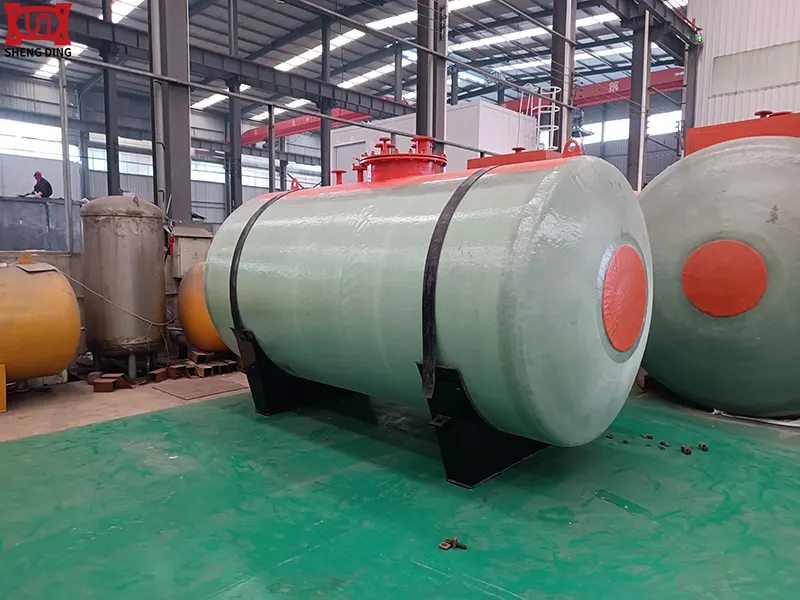
Fluid sensing systems detect petroleum or groundwater in the normally dry interstitial space of double-walled tanks or piping. A sensor is installed at the lowest point in the interstitial space; when liquid flows past the sensor, it triggers an alarm.
Types of sensors include
- Electro-optic sensors - use light refraction to detect liquid presence
- Conductivity sensors - leaked product alters the resistance of sensing wires, activating an alarm
- Capacitance sensors - detect changes in dielectric constant when liquid is present
- Discriminating sensors - can distinguish between hydrocarbons leaking from the inner wall and water leaking in from the outer wall
Advantages
- Simple structure, easy to use
- Low installation cost
- Can be installed in tight interstitial spaces
- Some sensors can be remotely tested without removal
Disadvantages
- Only detects leaks below the liquid level in the inner tank and below the groundwater level in the outer tank
- If inner and outer walls leak simultaneously, stored liquid can directly enter the environment without triggering an alarm
- Not recommended in developed markets - Canada directly prohibits this method
- Classified as Level III under GB/T 30040 - lowest among systems applicable to double-wall tanks
Regulatory Level: Level III - limited detection capability; risk of environmental release before alarm.
Best for: Low-risk applications or as a secondary/backup system.
Worst for: Any application requiring high environmental protection or compliance with strict regulations (not recommended in North America).
Method 6: Vapor Sensing System
Principle
The interstitial space is monitored continuously for the presence of petroleum vapors using automated equipment that triggers an alarm in the presence of petroleum fumes. The monitoring port may also be checked once a month for petroleum vapors with a portable field instrument.
Advantages
- Can detect vapors from very small leaks
- Continuous monitoring capability
- No liquid medium to maintain
Disadvantages
- May not detect leaks of non-volatile liquids
- Sensor calibration and maintenance required
- Potential for false alarms from external vapor sources
- Less common than liquid-based methods
Regulatory Level: Covered under GB/T 30040.4 for vapor sensor systems.
Best for: Gasoline and other volatile fuel storage.
Worst for: Diesel or heavy fuel oil where vapor pressure is low.
Method 7: Photoelectric / Fiber Optic Detection System
Principle
A pair of optical fibers extends substantially from the top to the bottom of the annulus of the double-walled tank. The presence of liquid in the interstitial space alters the optical properties of the fibers, triggering an alarm.
Advantages
- No electrical components in the hazardous area - intrinsically safe
- Can potentially identify the location of a leak along the fiber
- Immune to electromagnetic interference
- Long service life
Disadvantages
- Higher initial cost
- More complex installation
- Less common - fewer suppliers and service options
- May require specialized expertise for troubleshooting
Regulatory Level: Emerging technology; not specifically classified in GB/T 30040 but can meet Level I/II requirements depending on implementation.
Best for: Hazardous areas where electrical sensors pose additional risk, or applications requiring leak location identification.
Worst for: Budget-constrained projects or regions without specialized technical support.
Comparison Summary Table
| Method | Detection Type | Power Required | Inner/Outer Differentiation | Leak Position Coverage | Regulatory Level | Relative Cost | Best Application |
| Manual Visual | Periodic | No | No | Limited | Unclassified | $ | Temporary installations |
| Pressure | Continuous | Yes | Yes | Full wall | Level I | $$ | When wall differentiation is critical |
| Vacuum | Continuous | Yes (or static) | No | Full wall | Level I | $$$ | Highest reliability, permanent sites |
| Liquid Media | Continuous | No | No | Full wall | Level II | $$ | FF-type tanks, no-power sites |
| Fluid Sensor | Continuous | Yes | Some models | Partial (below liquid level) | Level III | $ | Low-risk / backup only |
| Vapor Sensor | Continuous | Yes | No | Full wall | Level III/II | $$ | Volatile fuels (gasoline) |
| Fiber Optic | Continuous | Yes (remote) | Possible | Full wall | Emerging | $$$$ | Hazardous areas, leak location |
How to Choose: Decision Guide
| Your Priority | Recommended Method | Reasoning |
| Maximum environmental protection | Vacuum or Pressure (Level I) | Highest regulatory; ensures no liquid reaches environment |
| No reliable power source | Liquid Media (brine-filled) | Uses static pressure; no power required |
| Budget is primary concern | Fluid Sensor (Level III) | Lowest cost - but be aware of regulatory limitations |
| Need to know which wall is leaking | Pressure System | Can distinguish inner vs outer wall leaks |
| Hazardous area / intrinsic safety | Fiber Optic or Vacuum (intrinsically safe) | No electrical components in hazardous zone |
| Regulatory compliance in developed markets | Vacuum or Pressure (Level I) | Canada and many US states prohibit Level III systems |
| Volatile fuels (gasoline) | Vacuum or Vapor Sensor | Early detection of vapor leaks |
Regulatory Compliance Quick Reference
| Standard | Key Requirement |
| GB 50156-2021 6.4.1 | Skid-mounted devices must use double-walled steel tanks with leak detection in the interstitial space |
| GB 50156-2021 6.5.6 | Leak detection should use online monitoring systems; liquid sensor accuracy ¡Ü3.5mm |
| GB/T 30040-2013 | Five-level classification; Level I (Pressure/Vacuum), Level II (Liquid Media), Level III (Sensors) |
| EPA (UST) Requirements | Interstitial monitor must be checked at least once every 30 days |
| EPA (UST) Double-Wall | Must be able to detect a release through the inner wall |
Conclusion
Leak detection is not a feature to be specified casually. The method you choose determines whether you catch a leak within hours or weeks - and that difference determines whether you face a simple repair or a $255,000 environmental remediation.
For skid-mounted fuel stations, continuous monitoring is the industry standard. Among continuous methods, vacuum and pressure systems offer the highest Level I protection, while liquid media systems offer a reliable no-power alternative. Fluid sensors may be tempting due to low cost, but their limited detection capability and regulatory restrictions in developed markets make them a poor choice for permanent installations.
When specifying your double-wall tank leak detection system, ask your supplier:
- 1. What method do you use?
- 2. What is its GB/T 30040 classification?
- 3. Has it been tested and calibrated?
- 4. Does it provide continuous or periodic monitoring?
- 5. What happens when a leak is detected - and what happens if the system fails?
Choose wisely. The environment - and your balance sheet - will thank you.
Ready to specify the right leak detection system for your skid-mounted fuel station? Contact Shengding Container for expert guidance, transparent specifications, and customized solutions.
Written by
TAIAN SHENGDING METAL CONTAINER MANUFACTURING CO., LTD.
Editor Wang
WhatsApp:+86 152 5486 3111
Email:shengdingtank@126.com


- WhatsApp
- E-MailE-Mail:shengdingtank@126.com
- WeChatWeChat:15254863111