Skid-Mounted Fuel Station Market 2026: 5 Key Trends Shaping the Industry


From USD 2.74 billion in 2025 to USD 6.84 billion by 2032 -- the mobile container fuel station market is growing at an extraordinary CAGR of 13.94%. Here are the five trends driving this transformation and what they mean for buyers and suppliers alike.
Introduction
The skid-mounted fuel station industry is no longer a niche corner of the energy equipment market. What was once a solution for remote mining sites and temporary construction camps has evolved into a strategic pillar of modern energy logistics -- serving logistics parks, ports, airports, corporate fleets, military operations, and emergency response networks worldwide.
According to Global Info Research, the global skid-mounted fuel station market generated approximately USD 946 million in revenue in 2025 and is projected to reach USD 1.359 billion by 2032, with a compound annual growth rate (CAGR) of 5.4%. The broader mobile container fuel stations market -- which includes containerized units, portable dispensers, and skid-mounted systems -- was valued at USD 2.74 billion in 2025 and is expected to hit USD 3.07 billion in 2026, ultimately reaching USD 6.84 billion by 2032 at a CAGR of 13.94%.
In China alone, the domestic market for barrier explosion-proof skid-mounted fueling devices is projected to reach approximately RMB 8 billion (over USD 1.1 billion) in 2026, with an annual growth rate of 15% to 18% and annual shipments exceeding 8,000 units. The 2026 Chinese skid-mounted fuel station market is expected to surpass RMB 48 billion (approximately USD 6.6 billion) in scale.
What's driving this explosive growth? Below are the five key trends shaping the skid-mounted fuel station market in 2026 and beyond.
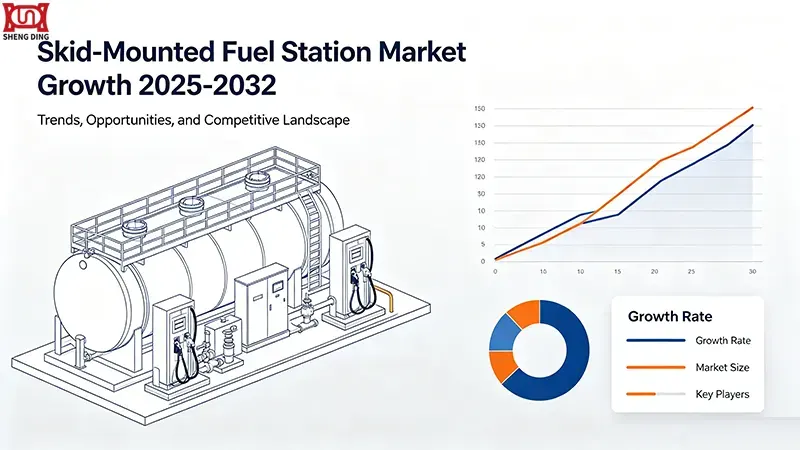
Trend 1: Accelerating Market Growth -- From Niche Solution to Mainstream Infrastructure
The most fundamental trend is simple: the market is growing rapidly and steadily.
| Metric | Value |
| Global skid-mounted fuel station market (2025) | ~USD 946 million |
| Global skid-mounted fuel station market (2032 forecast) | USD 1.359 billion |
| CAGR (2026-2032) | 5.4% |
| Mobile container fuel stations market (2025) | USD 2.74 billion |
| Mobile container fuel stations market (2032 forecast) | USD 6.84 billion |
| CAGR (2026-2032) | 13.94% |
| China barrier explosion-proof skid market (2026) | ~RMB 8 billion (~USD 1.1B) |
| China skid-mounted station market (2026) | RMB 48 billion (~USD 6.6B) |
What's driving this growth?
Cost reduction and efficiency remain the primary drivers. Enterprises are realizing that skid-mounted stations eliminate the need for large-scale civil engineering -- construction costs are far lower than traditional gas stations, which often require investments of tens of millions of yuan. Construction takes only weeks, compared to the 1-2 years required for traditional stations. For example, Yanchang Petroleum's first skid-mounted station in a coal mine went from planning to operation in just one month.
Fuel cost savings are equally compelling. A construction site project by Hainan Transportation Investment Group demonstrated that using a skid-mounted station allowed equipment to refuel nearby, reducing fuel costs by 15% and downtime waiting for fuel by 80%.
Regulatory compliance is another powerful driver. Following the comprehensive inclusion of diesel under hazardous chemical management regulations, illegal underground tanks and modified container units face strict crackdowns. Compliant skid-mounted devices have become the only legal alternative for internal, self-use fueling.
As one industry report notes, the core drivers of market demand are "cost reduction and efficiency improvement for enterprises, energy self-sufficiency, expansion of logistics infrastructure, and energy construction in emerging markets".
Trend 2: Smart Technology Integration -- From Basic Equipment to Intelligent Systems
The days of "dumb" fuel stations are over. In 2026, smart technology is rapidly becoming the industry standard.
The penetration rate of smart skid-mounted units equipped with IC cards, license plate recognition, and remote tank level monitoring has already exceeded 60%. According to industry data, intelligent operations and maintenance penetration jumped from 28% in 2023 to 61% in 2026.
What "smart" means in practice:
- Remote telemetry and IoT-enabled sensors convert static refueling units into connected nodes that provide real-time inventory, safety diagnostics, and predictive maintenance insights
- Automated controls tighten performance profiles, allowing operators to reduce leakages, enhance inventory visibility, and comply with evolving safety regulations
- Unmanned and remotely supervised operations enable longer operating windows and lower on-site personnel costs
- IC card systems and license plate recognition provide secure, auditable usage tracking
Equipment with smart monitoring, fault self-diagnosis, and real-time vapor recovery data upload capabilities commands a purchase premium of 12% to 18% -- but delivers 23% savings in operation and maintenance costs over the equipment's lifecycle.
The business model shift
The industry is undergoing a fundamental transformation from equipment sales to intelligent solution services. Manufacturers are no longer just selling steel tanks and pumps -- they're offering integrated service propositions that deliver measurable uptime and fuel efficiency improvements.
This shift is enabling new commercial models:
- Pay-per-use and subscription-based access to fueling systems
- Rental and leasing models that convert capital expenditure into operating expenditure
- Integrated logistics services that bundle hardware with fuel management
As the market report from 360iResearch notes: "The sector is shifting from purely commoditized equipment sales toward integrated service propositions that deliver measurable uptime and fuel efficiency improvements".
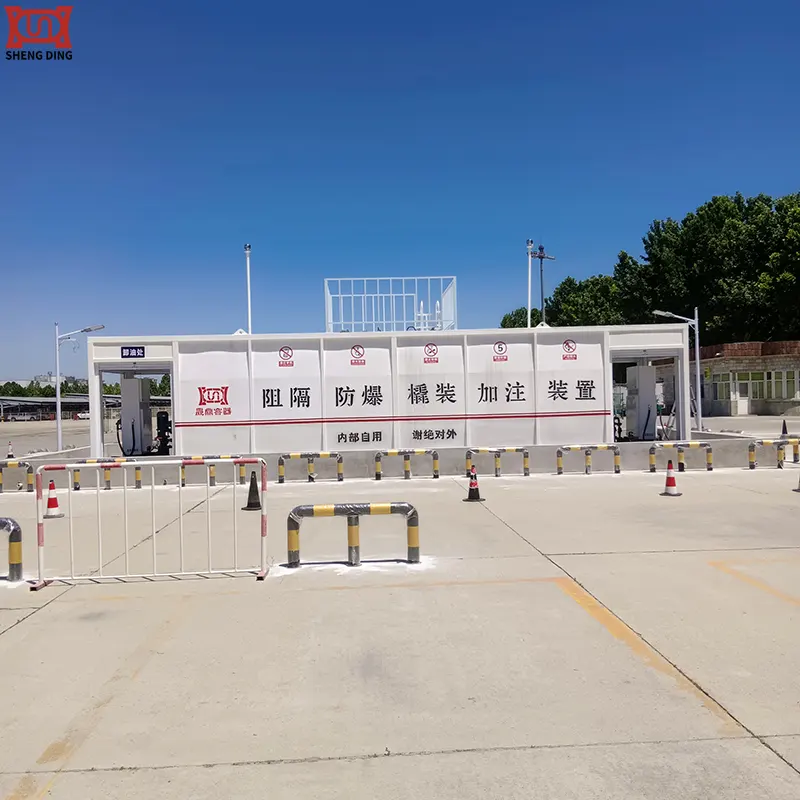
Trend 3: Multi-Energy Integration -- Beyond Diesel and Gasoline
The energy transition is reshaping the skid-mounted fuel station market in profound ways. Skid-mounted stations are no longer just about diesel and gasoline -- they're becoming multi-energy platforms.
The shift to alternative fuels
The industry is adapting to an increasingly complex energy mix, incorporating:
- Biofuels and blended fuels
- Hydrogen -- the global skid-mounted hydrogen refueling station market was estimated at USD 1.43 billion in 2024, with a CAGR of 8.23%
- LNG (Liquefied Natural Gas) -- the global LNG mobile refueling station market is projected to grow from USD 661 million in 2025 to USD 850 million by 2032
- Electrified fueling architectures, including battery charging capabilities integrated into containerized platforms
What this means for equipment design
Energy diversification is redefining product architecture:
- Fundamental design changes to containment, dispensing interfaces, and safety protocols
- Material compatibility requirements for biofuels and blended fuels
- Multi-fuel capability as a core value proposition
The future role of skid-mounted stations
Against the backdrop of energy transition, the future role of skid-mounted fuel stations is extending from "simple energy supply terminals" to "regional energy supply and demand adapters" and "distributed energy storage nodes".
This is a critical insight for buyers: the skid-mounted station you purchase today may need to handle not just diesel, but also biofuels, hydrogen blends, or even provide charging capabilities in the future. Investing in multi-energy-ready equipment is becoming a strategic necessity.
Trend 4: Global Market Expansion -- Regional Dynamics Reshaping the Industry
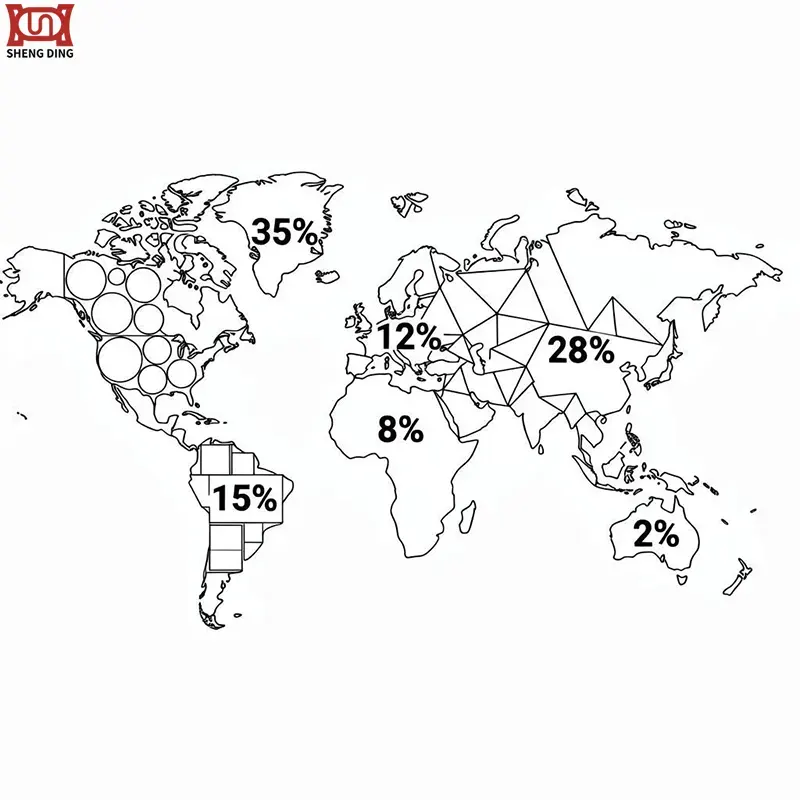
The skid-mounted fuel station market is truly global, with distinct dynamics across five major regions: North America, Europe, Asia Pacific, South America, and the Middle East & Africa.
Asia Pacific: The Fastest-Growing Market
Asia Pacific is the fastest-growing skid-mounted fuel station market globally. As a manufacturing and logistics powerhouse, China has seen applications rapidly evolve from simple equipment sales to a comprehensive solution model of "equipment + IoT + intelligent management platform".
Transportation network development in emerging markets such as Southeast Asia and South Asia is still in its early stages. Traditional gas stations have long construction cycles and high capital requirements, making skid-mounted fuel stations an ideal choice for energy-scarce regions due to their flexibility and rapid deployment capabilities.
China's export boom: In 2025, China's exports of barrier explosion-proof skid-mounted fuel stations grew by 41% year-over-year, primarily Southeast Asia, Africa, and the Middle East. Manufacturers with international certifications such as ATEX and IECEx now see overseas orders account for over 35% of their total business.
North America & Europe: Mature but Sophisticated
In developed markets, skid-mounted fuel stations already have high penetration rates. Demand remains strong across corporate fleets, logistics parks, and port terminals.
These markets place greater emphasis on:
- Intelligent management capabilities
- Environmental compliance
- Strict requirements for explosion-proof technology and vapor recovery systems
Middle East, Africa & Latin America: High-Growth Emerging Markets
These regions suffer from underdeveloped transportation infrastructure and insufficient energy supply. Skid-mounted fuel stations provide significant convenience, meeting the energy needs of multiple sectors including transportation, industry, and commerce.
Regional market structure at a glance
| Region | Characteristics | Growth Outlook |
| Asia Pacific | Fastest-growing; China leads in manufacturing & IoT integration | Very High |
| North America | Mature; high penetration; focus on intelligence & compliance | Moderate |
| Europe | Mature; strict environmental standards | Moderate |
| Middle East & Africa | Infrastructure gaps; high demand for flexible solutions | High |
| South America | Emerging; growing industrial & mining applications | High |
Trend 5: Rising Regulatory Barriers & Industry Consolidation
The skid-mounted fuel station industry is entering a phase of maturation and consolidation. The days of "anything goes" assembly shops are ending.
Tightening regulatory requirements
Safety assessments, environmental impact evaluations, and manufacturing qualification thresholds are rapidly tightening. This is accelerating the exit of unlicensed assembly plants from the market.
In China, the 2025 revision of the Technical Conditions for Barrier Explosion-Proof Skid-Mounted Fueling Devices explicitly requires skid-mounted units to achieve "plug-and-play, one-touch start-stop" functionality -- a requirement that eliminated approximately 30% of traditional welding manufacturers.
The competition landscape shows significant (polarization). The top 5 enterprises now hold 62% of total market share, while smaller manufacturers face accelerated elimination due to rising technology barriers and stricter qualification requirements.
The rise of full-chain manufacturers
Industry research highlights a critical insight: manufacturers with full-chain manufacturing capabilities -- from barrier explosion-proof material production to complete equipment integration -- have a market survival rate 4.2 times higher and customer repurchase rates 3.8 times higher than pure assembly operations.
This is a critical consideration for buyers: when evaluating suppliers, look beyond price to assess manufacturing depth, certification completeness, and long-term viability.
Regional policy variations
Buyers should also be aware that filing and registration policies for self-use skid-mounted units vary significantly by province and municipality. Consultation with local emergency management departments prior to deployment is highly recommended.
The long-term risk: new energy adoption
The market faces long-term headwinds from the adoption of new energy heavy-duty trucks. Buyers must carefully consider the 8-to-10-year equipment residual value cycle when making purchasing decisions. Investing in multi-energy-ready equipment is one way to mitigate this risk.
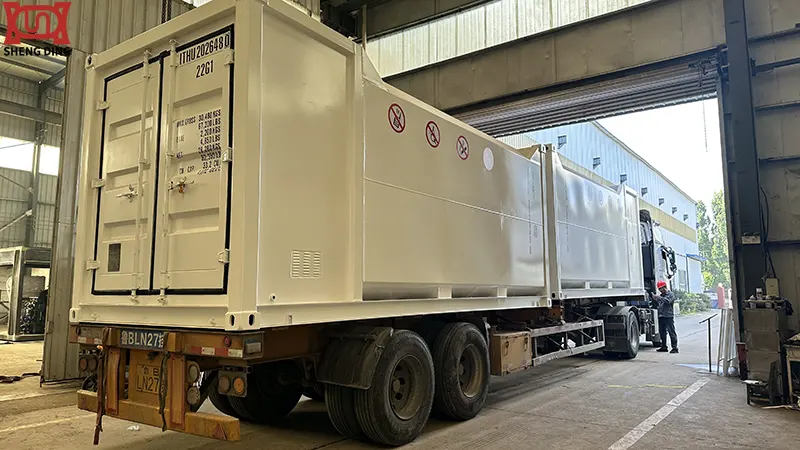
Conclusion: What These 5 Trends Mean for You
The skid-mounted fuel station market in 2026 is defined by rapid growth, technological sophistication, energy diversification, global expansion, and regulatory tightening. For buyers and suppliers alike, these trends create both opportunities and risks.
For buyers:
- Act now: The market is growing rapidly -- waiting means higher prices and longer lead times
- Invest in smart: Equipment with IoT and remote monitoring capabilities delivers lower lifetime costs
- Think multi-energy: Your station should be ready for biofuels, hydrogen, or electric charging
- Choose full-chain suppliers: Manufacturers with deep capabilities are more reliable long-term partners
- Check local regulations: Policies vary significantly by region
For suppliers:
- Differentiate through intelligence: Smart features are no longer optional
- Expand globally: Emerging markets offer enormous growth potential
- Invest in certifications: ATEX, IECEx, and other international certifications open export markets
- Build full-chain capabilities: Integration from materials to finished equipment is a competitive advantage
The skid-mounted fuel station industry is no longer a niche -- it's a strategic growth sector at the intersection of energy, logistics, and technology. Those who understand and act on these five trends will be positioned for success in 2026 and beyond.
Ready to invest in a skid-mounted fuel station that meets 2026 standards? Contact Shengding Container for expert guidance, custom solutions, and compliance support.
Written by
TAIAN SHENGDING METAL CONTAINER MANUFACTURING CO., LTD.
Editor Wang
WhatsApp:+86 152 5486 3111
Email:shengdingtank@126.com


- WhatsApp
- E-MailE-Mail:shengdingtank@126.com
- WeChatWeChat:15254863111