The 7 Major Factors Influencing the Service Life of Skid-Mounted Fueling Stations


Thanks to their advantages-including minimal footprint, rapid construction, and mobility-skid-mounted fueling stations are increasingly being deployed in various settings, such as logistics parks, industrial and mining enterprises, and public transit depots. However, in actual operation, the service lives of different skid-mounted stations vary significantly. Some can operate safely and stably for over 15 years, while others begin to suffer from issues-such as tank leakage and frequent equipment malfunctions-after just five or six years. This disparity is no mere coincidence. From the very moment the equipment leaves the factory, its service life is collectively influenced by a multitude of factors, including design and manufacturing quality, environmental conditions, routine maintenance, and human operational practices. Understanding and mastering these critical factors not only extends the equipment's operational lifespan but also effectively mitigates safety risks and reduces total lifecycle costs. Today, we at Shengding Containers will systematically outline the 7 major factors that influence the service life of skid-mounted fuel stations, helping operators identify potential hazards in advance and ensure safe, long-term operational stability.
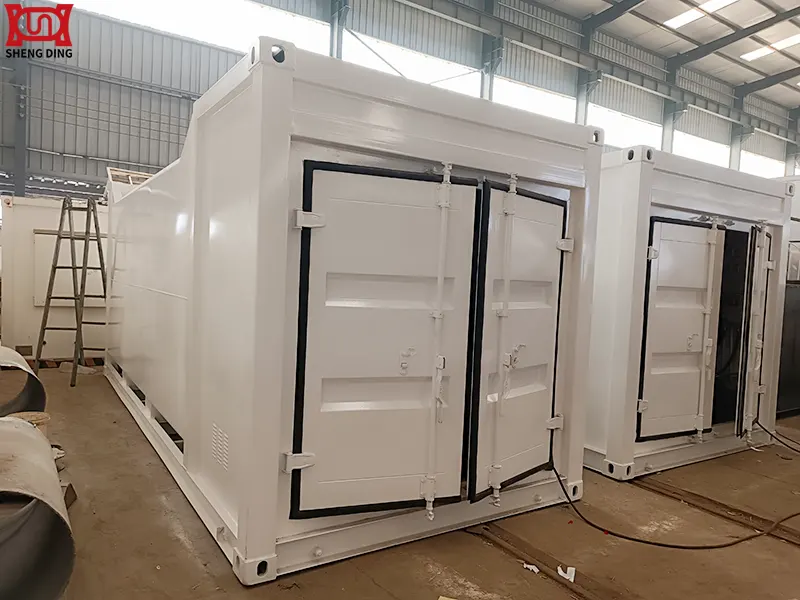
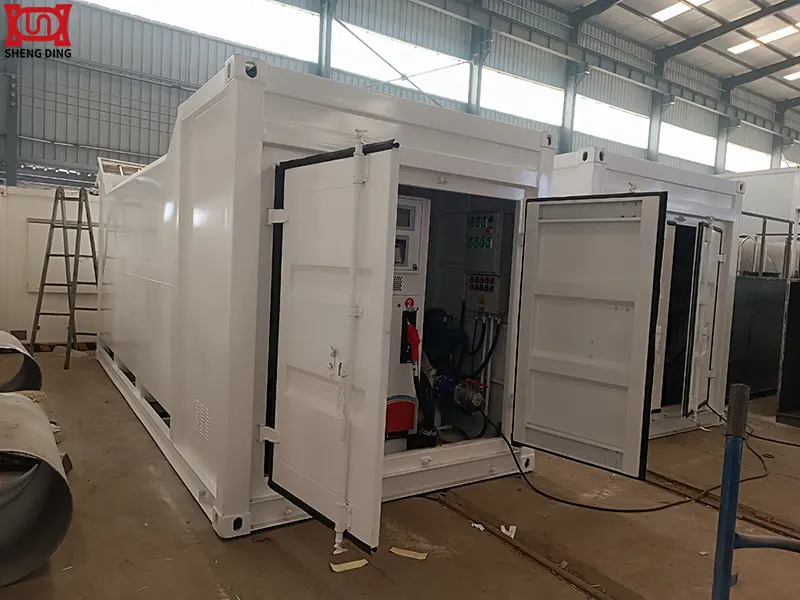
1. Quality of Tank and Structural Materials (A Core Factor)
Material composition serves as the fundamental basis determining the service life of a Shengding skid-mounted fueling station; it directly dictates the equipment's resistance to corrosion and fatigue.
1.1. Core Foundation: Tank Plate Material - Data Discrepancies
1.1.1. High-Quality Plate Material (Q345R Pressure Vessel Steel Plate)
- Plate Yield Strength: 345 MPa.
- Impurity Content: Sulfur <= 0.015%, Phosphorus <= 0.025%.
- Average Annual Natural Corrosion Rate: 0.02-0.03 mm/year.
- Structural Fatigue Resistance Lifespan: 12-15 years.
- Failure Rate (Weld Cracking/Tank Deformation): <= 3%.
1.1.2. Standard-Grade Non-Standard Plate Material (Q235 General Steel Plate)
- Plate Yield Strength: 235 MPa.
- Impurity Content: Sulfur and Phosphorus levels exceed standards by 30%-50%.
- Average Annual Natural Corrosion Rate: 0.05-0.08 mm/year.
- Structural Fatigue Resistance Lifespan: 6-8 years.
- Failure Rate (Weld Cracking/Tank Deformation): 18%-25%.
1.1.3. Inferior Recycled Steel Plate
- Plate Strength: Fails to meet standards; lacks toughness.
- Average Annual Corrosion Rate: >= 0.12 mm/year.
- Actual Service Life: 3-5 years.
- Incidence of Hazards (Tank Perforation/Localized Corrosion): > 40%.
1.2. Double-Walled Tank Structure and Materials
Shengding skid-mounted fuel stations come standard with double-walled oil storage tanks; the structural materials directly determine the risk of leakage and the overall service life:
1.2.1. SS Double-Walled Steel Tank (Steel + Steel: All-Metal Structure)
- Inner and Outer Wall Plate Thickness: Inner layer 6-8 mm; Outer layer 4-6 mm.
- Design Service Life (Under intact anti-corrosion protection): 15 years.
- Stable Period for Inter-wall Leak Detection/Warning: >= 12 years.
- Structural Deformation Value (Under extreme temperature fluctuations/vehicle vibration): <= 2 mm.
1.2.2. SF Double-Walled Tank
- Outer Layer (FRP/Fiberglass) Aging Resistance Lifespan: 10-12 years.
- Aging and Chalking Cycle of FRP Layer: Degradation begins after 8 years of outdoor exposure.
- Comprehensive Effective Service Life: 10-12 years.
1.2.3. Simple Single-Layer Tanks
- Lacks external protective layer; wall thickness reduced by 20%-30%.
- Localized pitting corrosion appears after 3 years; high probability of leakage occurring around the 5-year mark.
- Comprehensive Service Life: <= 5 years.
1.3. Aging & Corrosion Data for Internal and External Anti-Corrosion Coating Materials
The anti-corrosion coating serves as the "protective layer" for the tank bodies in Shengding skid-mounted fueling stations; the quality of the coating material determines the rate at which the tank body corrodes:
1.3.1. Industrial-Grade Oil-Resistant, Static-Dissipative Anti-Corrosion Coating
- Coating Thickness: Inner wall >= 300 µm; Outer wall (heavy-duty anti-corrosion) >= 400 µm.
- Coating Adhesion Rating: Grade 1 (Highest Standard).
- Coating Aging and Peeling Cycle: 10-12 years.
- Reduces inner wall corrosion rate by: 65%-75%.
1.3.2. Ordinary Paint / Low-End Anti-Corrosion Coatings
- Coating Thickness: 100-150 µm; thin application resulting from material reduction.
- Coating Aging and Peeling Cycle: 2-3 years.
- Poor oil resistance and weather resistance; prone to blistering and cracking in humid environments.
- Unable to prevent corrosion caused by accumulated water in fuel or sulfides, thereby accelerating tank body deterioration.
1.4. Data on the Impact of Structural Materials for Supports, Piping, and Connectors
The materials used for the overall framework, piping, flanges, and support structures of Shengding skid-mounted fueling stations determine the system's overall resistance to aging.
1.4.1. Hot-Dip Galvanized + Thickened Carbon Steel Structural Components
- Galvanizing layer thickness: 80-120 µm.
- Outdoor rust resistance lifespan: 10+ years.
- Piping material: Seamless steel tubing; compressive strength >= 1.6 MPa.
- Failure rate (structural loosening, rust-induced fracture): <= 5%.
1.4.2. Cold-Galvanized / Non-Galvanized Simplified Structure
- Galvanizing layer thickness < 30 µm, or no anti-rust treatment applied.
- Rusting appears within 2 years; severe structural corrosion occurs within 4-6 years.
- Pipe fittings: Thin-walled, non-standard materials with insufficient pressure resistance.
- Probability of connector aging and leakage: > 30%.
2. Corrosive Environments
External and internal corrosion will rapidly shorten the service life of the equipment.
2.1. Comparison of Average Annual Corrosion Rates for Tanks in Different Environments
Using the skid-mounted main tank (carbon steel substrate + standard anti-corrosion treatment) as the baseline for assessment:
2.1.1. Typical Inland Dry Environment (Standard Operating Conditions)
- Average annual corrosion rate of the tank's outer wall: 0.02-0.03 mm/year.
- Corrosion rate caused by internal oil media: 0.015 mm/year
- Rusting rate of structural components and supports: Low and stable.
- Theoretical full service life: 12-15 years
2.1.2. High-Humidity, Rainy / Low-Lying, Waterlogged Environment
- Average annual corrosion rate of the tank's outer wall: 0.05-0.07 mm/year.
- Accelerated corrosion rate: Increased by 180%-230% compared to the standard environment.
- Cycle for anti-corrosion coating blistering and peeling: 3-5 years.
- Reduced overall service life: Decreased to 7.8-9.75 years.
2.1.3. Coastal Salt-Mist Corrosion Environment
- Strong electrochemical corrosion driven by chloride ions; average annual corrosion rate of the outer wall: 0.09-0.12 mm/year.
- Accelerated corrosion rate: Increased by 350%-400% compared to the standard environment.
- Pitting corrosion observed on steel structures, flanges, and pipelines within 3 years; rust layer thickening observed within 5 years.
- Reduced overall service life: Decreased to 5.4-6.75 years.
2.1.4. Chemical Park / Acid Rain / Dust Corrosion Environment
- Presence of acidic/alkaline media and corrosive gases; outer wall corrosion rate: 0.10-0.13 mm/year.
- Accelerated corrosion rate: Increased by over 400% compared to the standard environment.
- Cycle for coating aging and cracking: 2-3 years; internal corrosion caused by tank media intensifies simultaneously.
- Extreme service life limit: 4-6 years.
2.1.5. Mining Area / Heavy Industry High-Dust, Humid Environment
- Dust particles absorb moisture to form a corrosive layer, leading to a high incidence of localized pitting corrosion.
- Localized corrosion rates can reach: 0.15 mm/year.
- The failure rate due to rust and corrosion in brackets, bases, and grounding components increases by more than 300%.
2.2. Impact of Corrosive Environments on the Aging Cycles of Core Components
2.2.1. Anti-corrosion Coatings
- Standard Environment: Effective protection for 10-12 years.
- High-Humidity/Acid Rain Environment: Protective lifespan reduced by 45%.
- Coastal Salt-Mist Environment: Protective lifespan reduced by over 60%.
2.2.2. Piping, Valves, and Seals
- Standard Environment: Aging-based replacement cycle for seals is 3 years.
- Highly Corrosive Environment: Replacement cycle shortened to 1-1.5 years.
- Probability of leakage failure in metal pipe fittings: Increased by 280%.
2.2.3. Electrical and Safety Components
- Combined effects of humidity and corrosive gases: Oxidation rates for wiring terminals and explosion-proof components increase by 3.2 times.
- Failure rates for static grounding and liquid level detection equipment: Increase by an average of 35% annually.
2.3. Quantification of Failure Probabilities in Corrosive Environments
2.3.1. Mildly Corrosive Environment
- Annual share of rust-related failures: 12%-15%.
- Annual increase in maintenance costs: 15%-20%.
2.3.2. Moderately Corrosive Environment
- Annual share of rust-related failures: 28%-35%.
- Annual increase in maintenance costs: 30%-40%.
2.3.3. Severely Corrosive Environment
- Annual share of rust-related failures: 55%-65%.
- Annual increase in maintenance costs: Over 50%.
- Significantly elevated risks of tank pitting, moisture ingress into the interlayer, and damage to the outer shell.
3. Defects in Manufacturing and Installation Processes
Inherent defects can plant the seeds for potential early-stage failures.
3.1. Data on the Impact of Welding Process Defects
Based on a benchmark of qualified full-penetration welds, non-destructive testing compliance, and standard weld seams:
3.1.1. Qualified Welding Process
- Non-destructive testing pass rate for weld seams: 100%.
- Local corrosion rate within the weld zone: 0.025 mm/year.
- Failure rate (cracking/leakage) of weld seams: <=2%.
- Overall structural fatigue life of the tank body: 12-15 years.
3.1.2. Welding Defects:
Common welding defects include slag inclusions, porosity, incomplete penetration, lack of fusion, etc.
- Accelerated localized corrosion at weld seams: 0.08-0.1125 mm/year; corrosion rate increased by 3.2 to 4.5 times.
- Pitting corrosion appears at weld seams within 3 years; high probability of micro-leakage within 5 years.
- Probability of weld seam cracking failure: Increased by 260%.
- Overall service life directly reduced by: 35%-45%.
3.1.3. Absence of Non-Destructive Testing (NDT) / Non-Standard Manual Welding
- Weld stress concentration factor exceeds standard limits by 2.8 times.
- Risk of weld seam tearing increases by over 3 times following vehicle vibration or foundation settlement.
- Actual service life: Only 5-7 years.
3.2. Defects in Tank Forming and Plate Processing
3.2.1. Standard Process:
CNC rolling, uniform pressing, stress relief treatment.
- Tank shell stress is uniform; no localized thinning occurs.
- Strong resistance to deformation; no dents or distortions under long-term pressure loads.
- Structural degradation cycle: Over 10 years.
3.2.2. Process Defects:
Forced cold-pressing, plate cutting errors, localized thinning.
- Localized shell stress exceeds standard limits by 2.2 times; prone to deformation due to long-term fatigue.
- Local plate wall thickness deviation exceeds standard limits by 20%-30%; corrosion accelerates in weak zones.
- Incidence of localized dents and bulges: 32%.
- Time to pitting perforation in weak zones is accelerated by 4-6 years.
3.3. Defects in Structural Reinforcement and Factory Assembly
3.3.1. Standard Configuration:
Thickened reinforcing ribs, integral frame welding, vibration-damping design.
- Base, supports, and reinforcing rib structures are robust and stable.
- Resistance to deformation from external vibration or vehicle loads: <=1.5 mm.
- Annual failure rate (frame corrosion/structural loosening): <=4%.
3.3.2. Process Defects:
Reduced number of reinforcing ribs, spot-welded fixation, thinned frame materials.
- Structural rigidity is reduced; deformation values reach 4-6 mm during long-term operation.
- Water accumulates in the crevices at frame connection points, leading to crevice corrosion; the corrosion rate increases 2.5-fold.
- The entire equipment structure experiences vibration and resonance, accelerating wear on pipeline and valve seals.
- The service life of structural components is reduced by 50% due to premature aging and failure.
3.4. Defects in Anti-Corrosion Construction Processes (Critical Factory Procedures)
3.4.1. Standard Anti-Corrosion Treatment:
Compliant sandblasting for rust removal + Multi-layer heavy-duty anti-corrosion coating + Constant-temperature curing
- Rust Removal Grade: Sa2.5.
- Compliant coating adhesion; resistant to oil and weathering.
- Effective service life of the anti-corrosion protective layer: 10-12 years.
3.4.2. Process Defects:
Simplified manual grinding, incomplete rust removal, thin coating (material-saving), low-temperature paint application
- Rust removal fails to meet standards; coating adhesion decreases by 60%.
- The anti-corrosion layer blisters, peels, and detaches within 3 years, exposing localized areas of bare steel.
- Corrosion rate in exposed bare steel areas surges to 0.10-0.14 mm/year.
- The overall anti-corrosion service life of the tank is reduced by 60%-70%.
3.5. Quantitative Data on Defects in On-Site Installation Processes
3.5.1. Compliant Installation:
Level concrete foundation, vibration-damping underlayment, flexible pipeline connections, symmetrical load distribution
- Foundation settlement differential: <= 3 mm.
- Pipelines free of rigid tension or torsion; seal service life: 3-5 years.
- Percentage of failures attributable to installation issues: <= 8%.
3.5.2. Installation Defects:
Uneven or tilted foundation, absence of vibration damping, rigid pipeline connections, off-center load distribution.
- Foundation settlement differential exceeds limits, resulting in long-term eccentric loading; additional stress on the tank increases 3-fold.
- Pipelines are forcibly connected; flange and joint seals undergo compressive deformation, increasing the probability of leakage by 300%.
- Localized areas of the tank experience long-term uneven stress, accelerating plate fatigue and localized corrosion.
- The annual frequency of maintenance required due to installation-related issues increases by an average of 42%.
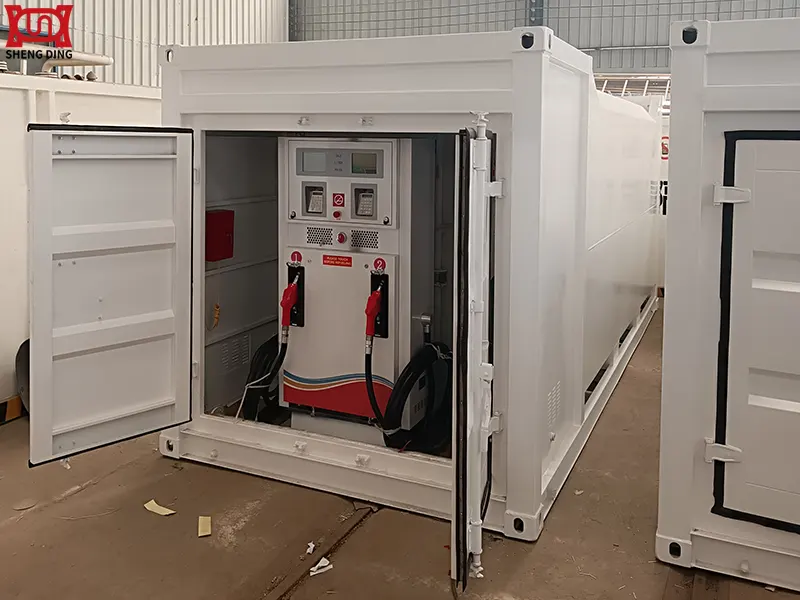
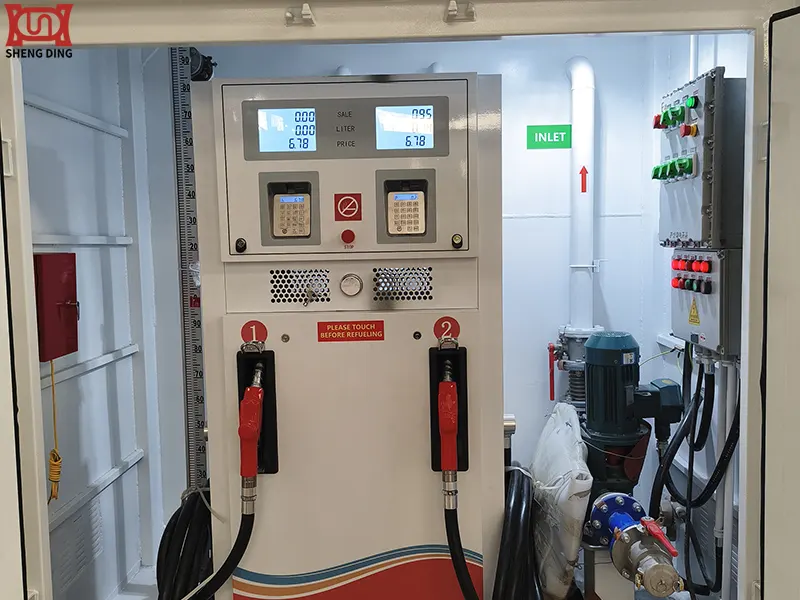
4. Maintenance Standards (Key to Service Life Extension)
A lack of standardized maintenance accelerates equipment failure and aging exponentially.
- Lack of Regular Inspections: Failure to periodically inspect for corrosion, weld integrity, leaks, coating damage, grounding resistance, and the status of cathodic protection systems.
- Failure to Replace Consumables: Seals, filters, pump bodies, fueling nozzles, hoses, and sensors are kept in service beyond their intended lifespan, leading to frequent malfunctions.
- Inadequate Cleaning: The accumulation of sludge at tank bottoms, impurities in pipelines, and blockages in vapor recovery systems exacerbate corrosion and wear.
5. Operational Load and Frequency
Overloading and high-frequency usage accelerate mechanical fatigue.
- Full/Overload Operation: Prolonged operation at or above designed flow rates and pressures leads to rapid fatigue damage in pumps, motors, and pipelines.
- Frequent Start-Stop Cycles: Excessive fueling frequency and high instantaneous surge pressures intensify wear on electrical and mechanical components.
- Poor Fuel Quality: The use of substandard fuels-containing impurities, high water content, or high sulfur levels-causes corrosion and wear that far exceed the equipment's design parameters.
6. Aging of Electrical and Safety Systems
Electrical failures can easily trigger cascading damage and safety incidents.
- Wiring Deterioration: Cracked cable sheathing, oxidized connections, and degraded insulation lead to short circuits, electrical leakage, and uncontrolled equipment operation.
- Instrument Failure: Liquid level gauges, pressure gauges, flow meters, and leak detectors become inaccurate or malfunction, rendering them unable to provide early warnings for potential hazards.
- Safety System Degradation: Collapse of explosion-proof barriers, jamming of emergency shut-off valves, failure of static grounding systems, and malfunctions in vapor recovery systems compromise overall safety.
7. Natural Environment and External Forces
Extreme environmental conditions and physical impacts can cause sudden, catastrophic damage.
- Temperature Extremes: High temperatures accelerate coating degradation and fuel/vapor volatilization; low temperatures can cause pipelines, pump bodies, and seals to crack due to freezing.
- Wind, Rain, and Lightning: Lightning strikes, strong winds, and heavy rains can cause foundation settlement, structural loosening, and moisture-induced short circuits in electrical systems.
- Physical Impact: Collisions with vehicles, crushing by heavy objects, or displacement during hoisting operations can result in tank deformation, cracked welds, and ruptured pipelines.
Conclusion
- Ideal Scenario: High-quality materials + Standardized manufacturing + Favorable environment + Professional maintenance --> 10-15 years.
- Typical Scenario: Moderate specifications + Routine maintenance + Ordinary environment --> 7-10 years.
- Harsh Scenario: Inferior materials + Corrosive environment + Neglected maintenance --> 3-5 years (or even less).
In summary, the service life of a skid-mounted fueling station is not determined by a single factor, but rather results from the combined interplay of equipment quality, corrosion protection, environmental conditions, maintenance practices, operational management, design standards, and the condition of wear parts. Among these factors, the corrosion resistance of the storage tank and the thoroughness of routine maintenance are often the most critical elements in determining whether the equipment will enjoy a "long life." For operators, rather than passively undertaking repairs only after serious equipment malfunctions occur, it is far more prudent to prioritize equipment quality right from the initial selection phase and to establish a standardized system for inspections, cleaning, and maintenance. Only by prioritizing "prevention" can the true investment value of a skid-mounted fueling station be realized, ensuring its continuous and safe operation even under complex working conditions. Looking ahead, while advancements in materials and corrosion-protection technologies are expected to further enhance the durability of skid-mounted stations, ultimately, diligent management remains the timeless guarantee for extending their service life.
Written by
TAIAN SHENGDING METAL CONTAINER MANUFACTURING CO., LTD.
Editor Wang
WhatsApp:+86 152 5486 3111
Email:shengdingtank@126.com


- WhatsApp
- E-MailE-Mail:shengdingtank@126.com
- WeChatWeChat:15254863111