Three Common Methods for Calibrating the Flow Rate of Skid-Mounted Fuel Station Fuel Dispensers


Skid-mounted fuel station fuel dispensers require flow calibration before startup and monthly. This is primarily because vibrations during installation, transportation, and daily use can cause errors in the flow meter. Flow calibration for skid-mounted fuel station fuel dispensers must strictly adhere to industry metrological verification procedures. While the core requirements are the same as for conventional gas station fuel dispensers, the special attributes of skid-mounted equipment-integration, explosion-proof design, outdoor installation, and integrated piping-must be considered. On-site calibration should prioritize portability, explosion-proof design, and ease of operation. Currently, there are three relatively standard flow calibration methods in the industry: the standard measuring instrument method, the volumetric tube method, and the mass method. All three methods can be used to calibrate the meter. If calibration errors occur, they can be reduced or eliminated by adjusting the meter. Today, Shengding Containers will explain the three commonly used methods for flow calibration of skid-mounted gas station fuel dispensers.
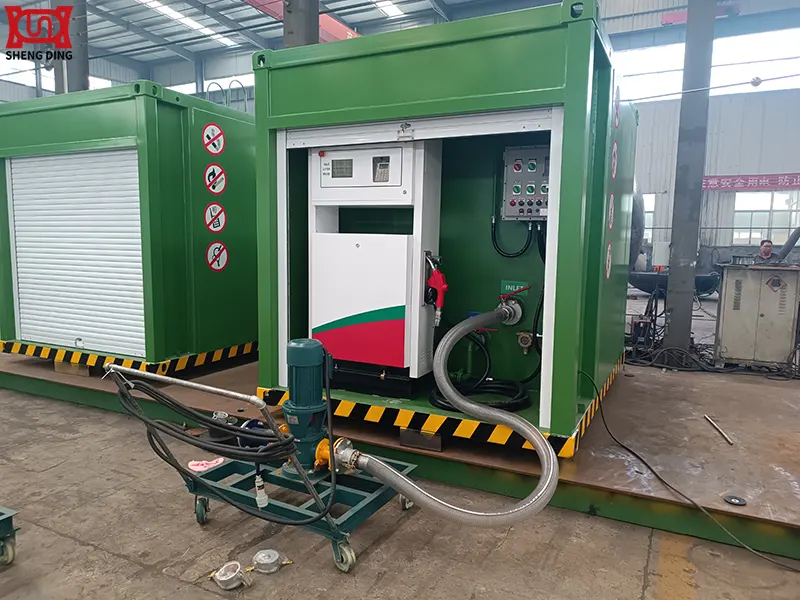
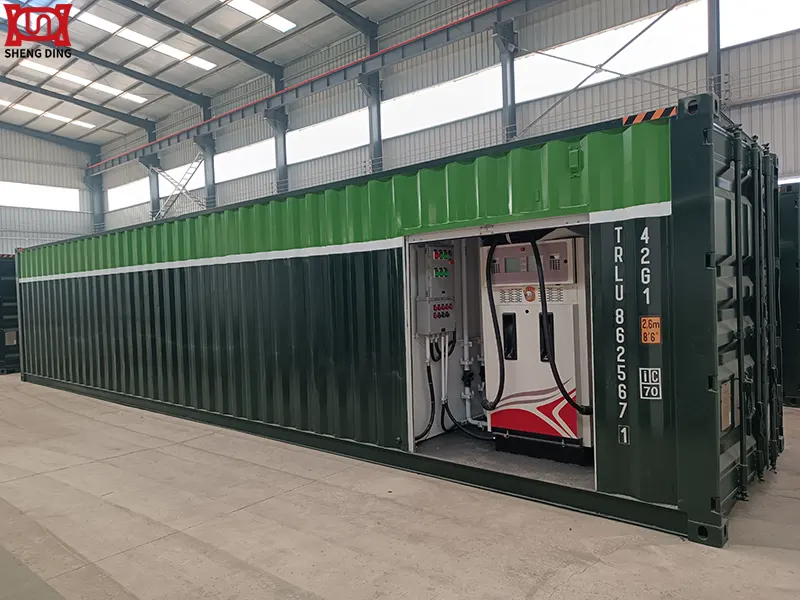
1. Standard Measuring Instrument Method
This is the most common method for on-site calibration of skid-mounted fuel stations. It is suitable for outdoor use and explosion-proof requirements. The equipment is portable (explosion-proof standard metal measuring instrument), the operation process is simple, it complies with legal verification standards, and it is also a common method used by market supervision departments for on-site verification.
Core Principle
- Using a legally verified explosion-proof metal standard measuring instrument (commonly 10L/20L/50L specifications, with 20L often used for skid-mounted stations) as the measurement benchmark, fuel is directly poured into the measuring instrument under normal dispensing conditions from the fuel dispenser. The volume displayed on the fuel dispenser is compared with the actual calibrated volume of the measuring instrument to calculate the measurement error and determine whether it is qualified.
Applicable Scenarios
- Daily on-site calibration of skid-mounted fuel stations, legal verification by market supervision departments, and initial calibration after equipment installation. Suitable for diesel/gasoline skid-mounted fuel dispensers, outdoor operation has no site restrictions.
Practical Steps
1.1. Preliminary Preparation (Core Mistake-Proofing, Skid-Mounted Exclusive)
- Explosion-Proof Protection: Open flames and mobile phones are prohibited on site. Calibration personnel must wear anti-static clothing and shoes, use explosion-proof tools, and place dry powder fire extinguishers nearby. Ensure good ventilation.
- Static Grounding: Connect the skid-mounted main body, fuel dispenser, and standard measuring instruments to the same grounding electrode via a static grounding wire. The grounding resistance should be <=100ohm (the skid-mounted equipment has an integrated grounding terminal, which can be directly connected).
- Pipeline Evaporation: Start the skid-mounted fuel dispenser and run it idle for 30-60 seconds to evacuate the gas from the fuel dispenser and the integrated skid-mounted pipeline, preventing gas resistance from causing measurement errors.
- Oil Temperature Stabilization: Calibration should only begin after the oil temperature fluctuation is <=2oC (the skid-mounted oil tank is sealed, and the oil temperature fluctuation is small; generally, 5 minutes of standing is sufficient).
1.2. Formal Calibration
The national standard requires that fuel dispensers be calibrated at both the standard flow rate and the minimum flow rate. Only when both calibrations pass is the overall system considered compliant. Since skid-mounted fuel dispensers are mostly constant/adjustable flow rate models, the following procedures must be strictly followed:
- Standard Flow Rate: Adjust the fuel dispenser flow rate to 0.8~1.0Qmax (Qmax is the maximum flow rate of the fuel dispenser; generally 5~6 L/min for gasoline engines and 8~10 L/min for diesel engines). Slowly pour fuel into the standard measuring vessel until it reaches the calibrated mark. Immediately stop the fuel dispenser and record the displayed volume V1.
- Minimum Flow Rate: Adjust the fuel dispenser flow rate to <=0.2max (<=1 L/min for gasoline engines and <=2 L/min for diesel engines). Repeat the above filling operation and record the displayed volume V2.
- Parallel Testing: Perform three parallel calibrations at each flow rate point. Before each test, pour the fuel from the measuring vessel back into the skid-mounted fuel tank to avoid temperature changes. The deviation of the three data points should be <=0.2%.
1.3. Data Calculation and Error Judgment
- Measurement Error Formula: Error = (Displayed Volume of Fuel Dispenser - Actual Volume of Meter) / Actual Volume of Meter * 100%.
- Acceptance Threshold: A single calibration error <= 0.3%, the average error of three parallel tests <= 0.3%, and a single error not exceeding 0.5% are considered acceptable.
- Volume Correction: If the oil temperature deviates from the meter's calibrated temperature (20oC) by >5oC, it needs to be corrected to the standard volume at 20oC according to the oil's volumetric expansion coefficient (gasoline expansion coefficient 0.0012/oC, diesel 0.0008/oC). Skid-mounted stations generally have smaller oil temperature deviations, simplifying the calculation.
2. High-Precision Method: Volume Tube Method
This is the highest precision calibration method, but due to the large size and high cost of the equipment, it is not suitable for on-site operation at skid-mounted stations. It is mainly used for factory inspection of skid-mounted fuel dispensers or high-precision testing by third-party institutions.
Core Principle:
- Using a standard volumetric tube (a precision metal pipe calibrated by the National Institute of Metrology) as the measurement benchmark, the fuel dispensed from the fuel dispenser is guided into the volumetric tube. A photoelectric/mechanical detector inside the tube records the standard volume value of the medium passing through, which is then compared with the volume displayed on the fuel dispenser to calculate the error.
Applicable Scenarios:
- Factory calibration by skid-mounted fuel dispenser manufacturers; high-precision calibration of large skid-mounted stations in refined oil depots. Generally not used in on-site skid-mounted stations.
Key Operating Points:
- Mandatory Equipment Calibration: The standard volumetric tube has a calibration cycle of one year and must have a legally valid calibration certificate.
- Leak-Free Pipeline: Before calibration, check the connection between the volumetric tube and the fuel dispenser for leaks and air locks.
- Multi-Flow Point Coverage: Calibration must be performed at the minimum, commonly used, and maximum flow points, with error requirements consistent with the standard measuring instrument method (0.3%).
3. Emergency Method: Mass Method
When no explosion-proof standard measuring instrument is available on-site, the explosion-proof mass method can be used for emergency calibration. This method is suitable for oils with large density fluctuations (such as non-standard diesel and winter-resistant diesel). It requires an explosion-proof electronic scale and is slightly more complex to operate, but its accuracy meets daily calibration requirements.
Core Principle:
- The actual mass of the oil output from the fuel dispenser is weighed using a calibrated explosion-proof electronic scale. The mass is converted to a standard volume at 20oC using the real-time density of the oil detected on-site. This volume is then compared with the volume displayed on the fuel dispenser to calculate the measurement error.
Applicable Scenarios:
- On-site emergency calibration at skid-mounted stations; daily verification when no standard measuring instrument is available. It is primarily used for diesel skid-mounted fuel dispensers (gasoline is volatile, and there will be losses during the weighing process, resulting in slightly lower accuracy).
Key Practical Steps
- 3.1. Weigh the empty fuel container (m1) using an explosion-proof electronic scale, ground it, and place it below the fuel dispenser's outlet.
- 3.2. Start the fuel dispenser and dispense fuel at the normal/minimum flow rate. After stopping, weigh the total mass of the container and fuel (m2). The actual dispensed fuel mass m = m2 - m1.
- 3.3. Use a hydrometer to measure the real-time density pt of the fuel (including temperature correction) and convert it to the standard density p20 at 20oC.
- 3.4. Calculate the standard volume: V = m/p20, and compare it with the volume displayed on the fuel dispenser. Error judgment follows national standards.
- 3.5. Gasoline calibration requires rapid operation to reduce evaporation loss. It is recommended to perform this in a sealed fuel container.
4. Calibration Precautions for Skid-Mounted Fuel Dispensers
Skid-mounted equipment integrates piping, fuel tanks, and fuel dispensers. The calibration process must take into account this integrated nature to avoid calibration errors due to improper operation. The following are key points summarized from industry practice and can be directly applied:
- 4.1. Do not disassemble the fuel dispenser separately: The skid-mounted fuel dispenser and skid-mounted piping are rigidly connected. Do not disassemble the inlet and outlet pipes of the fuel dispenser before calibration, otherwise it will damage the pipeline seal, leading to air resistance/leakage, and invalid calibration data.
- 4.2. Integrated pumps and valves must be functioning normally: Calibration must be performed when the skid-mounted built-in pump, solenoid valve, and filter are functioning normally (skid-mounted equipment has operation indicator lights). If the pump and valve pressure is insufficient (<=0.2MPa), troubleshoot the problem before calibration.
- 4.3. Avoid calibration when the fuel tank level is low: When the fuel tank level is <=1/4, the pump is prone to drawing in air, causing unstable fuel dispensing from the fuel dispenser. Calibration must be performed when the fuel tank level is >=1/3.
- 4.4. After calibration, a lead seal must be applied: If the fuel dispenser's error exceeds the tolerance, the internal metering device (flow adjustment screw) must be adjusted by a legally authorized calibration personnel. After successful calibration, the metering adjustment part of the fuel dispenser must be sealed with a lead seal. Unauthorized disassembly is prohibited (skid-mounted fuel dispensers have a dedicated lead seal location).
- 4.5. Strict adherence to the calibration cycle: According to national standards, the legal calibration cycle for skid-mounted fuel dispensers is 6 months. For skid-mounted stations used outdoors (such as construction sites and logistics parks), due to the complex environment, it is recommended to conduct on-site self-calibration every 3 months.
- 4.6. Record retention requirements: After calibration, a "Skid-mounted Fuel Dispenser Flow Calibration Record" must be retained, including: calibration date, skid-mounted equipment number, fuel dispenser model, fuel type, fuel temperature/density, three calibration data points for each flow rate, error value, calibration personnel, and calibration certificate number. This record must be kept with the skid-mounted equipment file.
5. Quick Handling Solution for Calibration Failure
If the fuel dispenser error exceeds the tolerance (>0.3%) after calibration, there is no need to disassemble the equipment. Adjust and recalibrate using the following steps:
- 5.1. Have a legally authorized calibration personnel open the fuel dispenser's meter end cover and locate the flow adjustment screw (clockwise rotation decreases the display volume, reducing the error; counterclockwise rotation increases the display volume, increasing the error).
- 5.2. Make small adjustments (<=1/4 turn each time), then tighten the end cover. Perform one calibration using the standard measuring instrument method for the commonly used flow rate and observe the error change.
- 5.3. Repeatedly fine-tune until the error is within 0.3%, then complete three parallel calibrations for the commonly used/minimum flow rates. After passing the calibration, seal the meter adjustment part.
- 5.4. If the error still exceeds the tolerance after adjustment, check for leaks in the skid-mounted pipeline and wear on the fuel dispenser's meter. Replace any damaged parts and recalibrate.
Conclusion
The core implementation plan for flow calibration of skid-mounted fuel station fuel dispensers is as follows: On-site calibration should prioritize the use of explosion-proof standard measuring instruments (suitable for integrated, outdoor, and explosion-proof applications), strictly adhering to the standard calibration procedure using both common and minimum flow points, with errors controlled within 0.3% of the national standard. High-precision testing utilizes the volumetric tube method, and emergency calibration employs the mass method. All calibration operations must be performed by personnel with metrological verification qualifications. After successful calibration, a verification certificate should be affixed and retained to ensure the accuracy of the skid-mounted fuel dispensers and compliance with safety supervision and metrological regulations. These are the three commonly used methods for flow calibration of skid-mounted fuel station fuel dispensers. We hope this information will be helpful when calibrating skid-mounted fuel station fuel dispensers in the future.
Written by
TAIAN SHENGDING METAL CONTAINER MANUFACTURING CO., LTD.
Editor Wang
WhatsApp:+86 152 5486 3111
Email:shengdingtank@126.com


- WhatsApp
- E-MailE-Mail:shengdingtank@126.com
- WeChatWeChat:15254863111