Top 5 Factors Affecting Skid-Mounted Fuel Station Lead Time & Pricing


Two quotations for a 30,000L skid-mounted fuel station arrive on the same day. One is $28,000. The other is $65,000. Both list the same tank capacity. Both promise delivery. The gap is not a pricing error. It is the accumulated result of five variables that determine what the station actually contains, how long it takes to build, and what it costs to put it on site.
Lead time and pricing in the skid-mounted fuel station market are often treated as a single number in a quotation. In reality, each is the output of a set of specification decisions made well before the purchase order is signed. This article breaks down the five factors that drive both - with benchmarks and data - so buyers can read a quotation for what it actually says, not just what it costs.
Why Lead Time and Pricing Are Not Independent Variables
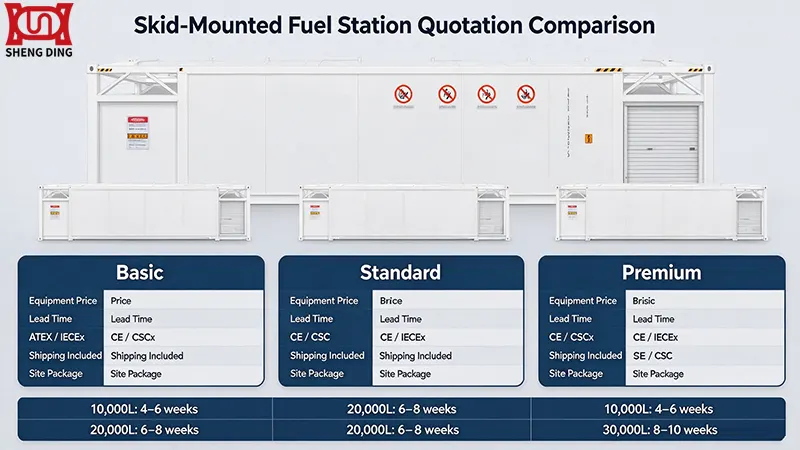
Pricing and lead time are usually discussed as separate procurement questions. In skid-mounted fuel stations, they are tightly coupled. A specification choice that adds cost almost always adds time - and a schedule decision often carries a price consequence.
The coupling runs in both directions. Specifying a more robust tank construction raises the material and fabrication cost and extends the fabrication sequence. Adding a certification package adds both a direct certification fee and months of processing time. Choosing a container format over an open skid raises the ex-works price but can reduce freight handling time because the unit ships as standard ISO cargo.
For buyers, the practical implication is that lead time and price should be negotiated as one specification package, not as two separate line items. A supplier who quotes a fast delivery and a low price is usually quoting a narrower scope, not a more efficient operation.
These ranges are not arbitrary. They correspond to the five factors below. Each factor can move the final number materially, and in most procurement exercises, the largest cost and schedule variances come from factors two through four rather than from the tank itself.
Factor 1: Station Format and Structural Enclosure
The first and most visible pricing variable is the structural format of the station. The three mainstream mobile fuel station formats - open skid, containerized, and trailer-mounted - carry different baseline costs and different logistics profiles.
An open skid integrates all equipment onto a steel base without an enclosed shell. It is the lowest-cost format, typically 10% to 30% cheaper than a containerized version at the same capacity, because it omits the container enclosure, doors, ventilation, and integrated weather protection. Typical ex-works pricing for a 10,000L-class open skid falls in the $25,000 to $55,000 range.
A containerized station houses the same equipment inside a standard ISO container. The enclosure adds cost but delivers weather protection, security, and - critically for international buyers - CSC-certified shipping as standard container freight. Containerized units typically price 10% to 30% above an equivalent open skid, with 10,000L-class ex-works pricing in the $35,000 to $80,000 range.
Trailer-mounted units sit on a road-legal trailer chassis. They offer the highest mobility but require road certification and compatible towing equipment, and they price above both skid and container formats for the same capacity.
| Format | Typical ex-works price (10,000L class) | Lead-time profile | Best suited to |
| Open skid | $25,000-$55,000 | Shorter fabrication; standard freight handling | Mild climates, budget-focused, large capacity |
| Containerized | $35,000-$80,000 | Slightly longer build; faster port handling with CSC plate | Harsh environments, security, international shipping |
| Trailer-mounted | $40,000-$90,000 | Chassis certification adds time | Frequent relocation, emergency response |
The format decision also has a lead-time consequence that buyers often miss. An open skid may require flat-rack or break-bulk shipping, which can extend port handling and add out-of-gauge charges. A containerized unit with a valid CSC plate ships as standard 20ft or 40ft cargo, eliminating specialised vessel requirements and often reducing total transit time despite a slightly longer fabrication phase.
Factor 2: Core Equipment Specification and Component Quality
The largest price differences hide inside the equipment specification, not in the nominal capacity. Two 30,000L stations can differ by more than 100% in price because of decisions made about the tank, the explosion-proof system, the dispensing configuration, and the control package.
Tank construction and materials
Material choice alone can swing price by 30% to 50%. Carbon steel is the baseline; high-strength low-alloy steel with superior corrosion resistance moves the cost upward. Stainless steel construction - sometimes specified for coastal or chemically aggressive environments - carries a raw material cost roughly double that of carbon steel plate. The tank's internal coating system is another variable: epoxy versus fibreglass lining changes both cost and service life. Wall thickness matters too: 6mm is a common standard, but a 1mm change across the tank surface carries a measurable fabrication cost difference.
Explosion-proof specification
Barrier explosion-proof fill is a core safety feature and one of the areas with the greatest cost variance. A basic barrier fill material versus a certified, tested system with third-party documentation represents a different price category. The same applies to electrical equipment: standard industrial components versus ATEX- or IECEx-certified components can change the electrical package cost by a factor that is not visible on a capacity-based quote.
Dispensing and control configuration
Dispenser count, flow rate, metering technology, hose length, nozzle type, and fuel management features all add cost and build time. A single-dispenser, single-nozzle configuration is the baseline. A dual-dispenser configuration with separate flow rates for heavy and light vehicles - as seen in mining deployments - requires additional pumps, piping, metering, and control integration. Smart features such as remote tank monitoring, cardlock access, and automatic tank gauging add a purchase premium but reduce operating cost over the service life.
On lead time, equipment specification is the second-largest driver after certification. Standard components from established supply chains can be assembled in weeks. Non-standard pump brands, special coating systems, or imported dispenser packages can add weeks to the fabrication sequence because they are ordered in, not held in stock.
Factor 3: Certification and Regulatory Compliance Package
Certification is the factor most likely to turn a short lead time into a long one, and the factor most often underestimated at the quotation stage.
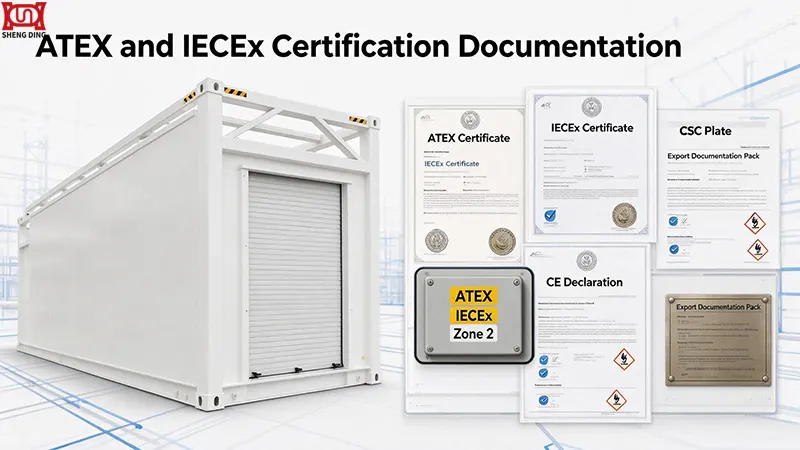
Explosion-proof certification for the target market is not a document that can be produced quickly. ATEX and IECEx certification typically costs $15,000 to $50,000 per product line and takes 12 to 18 months from initial application to certificate issuance. UL certification runs $20,000 to $60,000 and can take 12 to 24 months. An existing IECEx certificate can fast-track an ATEX application to 7 to 14 days, but only if the IECEx test report and quality assessment report are already in place.
| Certification | Typical cost | Typical timeline | Implication for lead time |
| ATEX | $15,000-$50,000 | 12-18 months | Cannot be compressed at the equipment order stage |
| IECEx | $15,000-$50,000 | 12-18 months | Existing certificate can shorten ATEX processing to 7-14 days |
| UL / HazLoc | $20,000-$60,000 | 12-24 months | Longest pathway; plan for it at project inception |
The practical consequence is that certification does not usually affect the fabrication lead time of a single unit - it determines whether the unit can legally be sold and installed in the target market at all. A buyer who specifies a European destination after the station is built may discover that the electrical package requires ATEX certification that does not yet exist, adding months and tens of thousands of dollars to the project. The correct approach is to specify the destination market and certification requirement at the procurement stage, so the supplier builds to the required standard from the outset.
Shipping-related certification also carries lead-time risk. A missing gas-free certificate or an incorrect dangerous-goods classification does not delay fabrication, but it can stall a completed unit at the port for days or weeks, generating demurrage costs that erase the value of any price negotiation.
Factor 4: Customization Scope and Engineering Complexity
Customization is where a standard lead time estimate becomes unreliable. A ¡°custom¡± skid-mounted fuel station can mean anything from a different paint colour to a multi-compartment tank with independent dispensing systems, integrated power generation, and a bespoke control architecture.
Low-complexity customization - paint, branding, a different nozzle configuration, minor layout adjustments - typically adds days rather than weeks and a modest price increment. It can usually be absorbed within a standard 10-to-30-day fabrication window.
High-complexity customization changes the engineering sequence. A dual-chamber tank with separate fuel types requires independent filling, venting, dispensing, and safety systems, along with stricter electrical classification for the gasoline chamber. A semi-mobile modular station built from multiple platforms requires structural engineering for relocation and reinstallation. An aviation or marine layout requires specialised filtration, water separation, and dispensing interfaces that are not part of a road-vehicle station design.
In these cases, lead times move into the 12-to-16-week range for custom configurations, and the price increase is driven by engineering hours, non-standard component procurement, and additional testing and inspection scope. The customization premium is not a fixed percentage - it is a function of how far the design departs from the supplier's standard platform.
For buyers, the practical rule is to distinguish between customization that changes the product and customization that changes the label. The first affects both price and lead time materially. The second usually does not.
Factor 5: Logistics, Delivery Terms, and Total Landed Cost
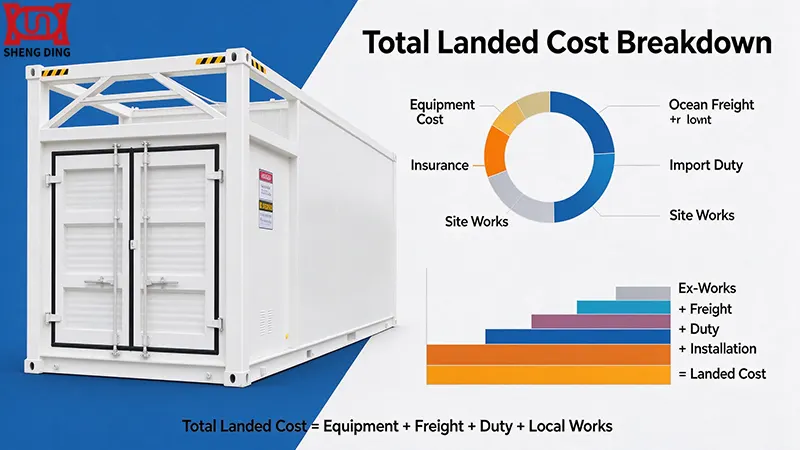
The ex-works price is not the project price. Shipping and delivery-related costs can represent 10% to 25% of the total landed cost for international buyers, and logistics decisions affect the schedule from factory gate to site commissioning.
| Cost line | Typical range | Notes |
| Ocean freight, one 20ft slot | $1,500-$6,800 | Lane and season dependent |
| Destination port, haulage, crane | $2,000-$10,000 | A 20ft unit may require a 25t crane |
| Duty and clearance | 0%-25% of CIF | HS code and country dependent |
| Site works | $12,000-$50,000 | Pad, power, earthing, bollards |
| Commissioning and approvals | $2,000-$8,000 | Metrology, electrical, fire, training |
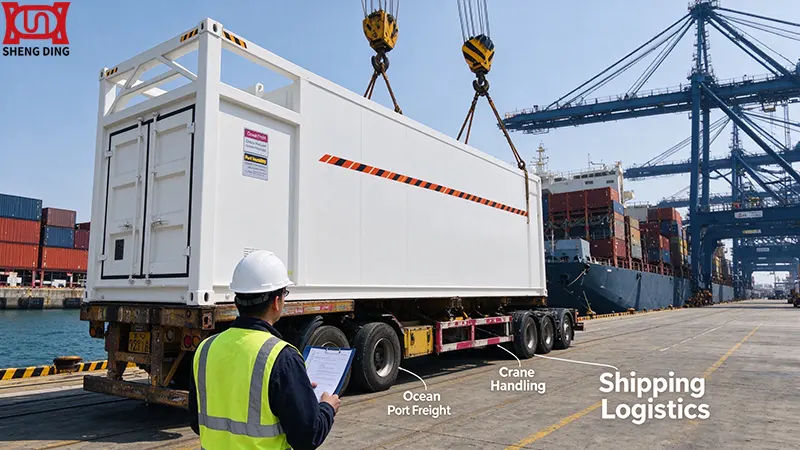
Lead-time exposure in logistics is concentrated in two places: port handling and documentation. Sea freight from China to Africa, Latin America, or Europe typically takes 2 to 8 weeks. Customs clearance and inland transport add days. A single documentation error - a missing CSC plate, an incorrect dangerous-goods declaration, or an absent gas-free certificate - can add further delay and cost. By contrast, a containerized unit with a valid CSC plate is treated as standard ISO cargo, avoiding out-of-gauge fees and specialised vessel requirements that can extend port time.
Incoterms choice also matters. An FOB quotation leaves the buyer responsible for ocean freight, insurance, and destination charges, which may be cheaper or more expensive than the supplier's CIF arrangement depending on the buyer's freight relationships. The quotation should state the applicable Incoterm and list inclusions and exclusions explicitly, because a low ex-works price with a broad exclusions list often lands higher than a mid-range CIF quote.
How the Five Factors Interact: A Practical Benchmark
The five factors do not operate independently. A station that is containerized (Factor 1), specified with a certified explosion-proof package (Factor 2 and 3), customised into a dual-chamber configuration (Factor 4), and shipped on a CIF basis to a distant port (Factor 5) will carry a materially higher price and a longer lead time than a standard open skid with a domestic delivery.
A useful reference point is the 10-year total cost of ownership model. A 20ft skid station priced at $25,000 to $70,000 ex-works typically costs $140,000 to $210,000 to own over ten years before fuel, once freight, duty, site works, power, commissioning, and maintenance are counted. Delivered and commissioned cost for a 20ft unit commonly falls in the $45,000 to $180,000 range depending on destination and scope. This is why comparing ex-works quotations without matching scope and delivery terms produces misleading conclusions: the lowest equipment price can correspond to the highest landed and lifecycle cost.
Frequently Asked Questions
How long does it take to manufacture a skid-mounted fuel station?
Standard configurations commonly take 10 to 30 days from order confirmation to shipment. Custom configurations requiring engineering changes, non-standard components, or complex safety integration typically move into the 12-to-16-week range. Certification timelines are separate and can run 12 to 24 months for ATEX, IECEx, or UL, which is why certification should be specified before the equipment order is placed.
Why can two quotations for the same tank capacity differ by more than 100%?
Nominal capacity is only one specification line. The difference comes from tank material and wall thickness, explosion-proof system certification, dispenser count and flow rate, control and monitoring features, container versus open-skid format, and the certification and documentation package. A $28,000 quote and a $65,000 quote for a 30,000L station typically describe stations with materially different equipment and compliance scopes.
Does certification affect lead time if the supplier already holds the certificate?
If the supplier already holds a valid certificate for the exact product configuration, certification does not add to fabrication lead time. If the configuration is new, or if the certificate does not cover the target market, the certification process runs on its own timeline - 12 to 18 months for ATEX or IECEx, 12 to 24 months for UL - and cannot be compressed by expediting the equipment build.
What delivery terms should I use to compare quotations fairly?
Ask every supplier to quote on the same Incoterm and to provide an itemised scope with inclusions and exclusions. A useful comparison is delivered-and-commissioned cost, not ex-works price, because freight, duty, site works, and commissioning can add 30% to 100% to the equipment price depending on destination. If suppliers quote on different Incoterms, convert them to a common basis before comparing.
Can lead time be shortened after the order is placed?
In some cases, yes - but at a cost. A supplier may be able to expedite standard component procurement or allocate additional fabrication capacity for a premium. However, certification timelines, custom engineering, and ocean freight schedules are generally not compressible. The most reliable way to shorten total project lead time is to finalise the specification and certification requirements before the order is placed, avoiding rework and documentation delays after fabrication begins.
Conclusion
Skid-mounted fuel station lead time and pricing are not random. They are the output of five factors: station format, core equipment specification, certification and compliance scope, customization complexity, and logistics and delivery terms. Each factor moves both numbers, and the largest variances usually sit in specification and certification rather than in the tank capacity itself.
The practical implication for buyers is to stop comparing capacity-based quotations and start comparing specification packages. A quotation that lists only capacity and price is not a comparable quotation. A quotation that states the format, tank construction, explosion-proof certification, dispensing configuration, certification scope, Incoterm, and exclusions can be compared - and negotiated - on a like-for-like basis.
Lead time and price are negotiated together because they are produced together. The specification decisions that determine one determine the other.
Need a like-for-like quotation with lead time and pricing broken down by scope?
Shengding Container provides itemised quotations for skid-mounted and container fuel stations, with certification scope, Incoterm, and lead-time assumptions stated explicitly.
Written by
TAIAN SHENGDING METAL CONTAINER MANUFACTURING CO., LTD.
Editor Wang
WhatsApp:+86 152 5486 3111
Email:shengdingtank@126.com


- WhatsApp
- E-MailE-Mail:shengdingtank@126.com
- WeChatWeChat:15254863111