Top 8 Safety Certifications Required for Export Container Fuel Station


A container fuel station leaves the factory fully tested. Weeks later it sits in a bonded warehouse at the destination port - because one certification mark is missing and the shipping documents do not match the dangerous goods classification. Demurrage fees accumulate by the day. This scenario is not unusual. Exporting a container fuel station requires navigating a layered web of international certifications, and missing even one can halt the shipment.
Here are the 8 safety certifications every exporter and buyer must verify before a container fuel station leaves the factory.
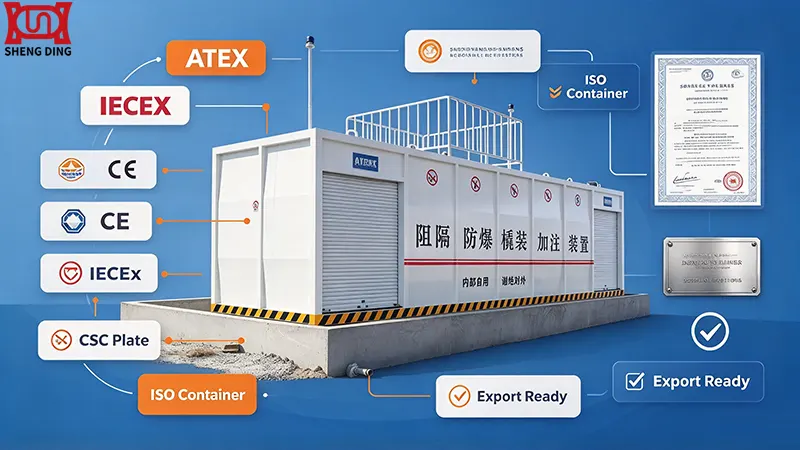
Introduction: Why Certifications Are the Real Export Gate
A container fuel station is not ordinary industrial cargo. It contains or has contained flammable liquids, includes electrical components in hazardous areas, falls under dangerous goods regulations for shipping, and requires local regulatory approval at the destination.
For international buyers, certifications like ATEX and IECEx are non-negotiable for customs clearance and on-site regulatory acceptance. Without them, equipment can be rejected at the port, held for costly modifications, or rendered inoperable on site.
The 8 certifications below cover the full export chain - from explosion protection and tank construction to maritime shipping and fuel metering accuracy.
Certification 1: ATEX - Explosion-Proof Equipment for the EU Market
ATEX is the mandatory certification for electrical and non-electrical equipment used in potentially explosive atmospheres within the European Union, governed by ATEX Directive 2014/34/EU.
What It Covers
A container fuel station's pumps, dispensers, control panels, sensors, lighting, and emergency stop buttons all operate in or near hazardous areas. ATEX certification confirms that these components will not become an ignition source in an environment where flammable vapors may be present.
What to Verify
- All electrical components carry ATEX certification for the specific zone classification of the installation
- Certification documents are original, verifiable, and match the equipment serial numbers
- The supplier can provide third-party test reports for explosion-proof performance
Red flag: A supplier who says "our products meet international standards" but cannot produce original ATEX certificates with matching serial numbers.
Why it matters for container fuel stations: the containerized enclosure concentrates fuel vapors in a confined space. Every electrical device inside that space must be certified for the hazard.
Certification 2: IECEx - International Explosion-Proof Certification
IECEx is the international counterpart to ATEX, based on the IEC 60079 series of standards. It is recognized in more than 70 countries and serves as the global benchmark for explosion-proof equipment.
What It Covers
IECEx certification covers the same categories of equipment as ATEX - pumps, dispensers, controls, sensors - but under an internationally harmonized scheme. For markets outside the EU that do not have their own explosion-proof certification systems, IECEx is often the accepted credential.
ATEX vs. IECEx: What Buyers Need to Know
ATEX and IECEx share nearly identical technical foundations, both derived from IEC 60079. The difference is jurisdictional: ATEX is legally required for the EU market, while IECEx is the internationally recognized voluntary scheme.
What to Verify
- IECEx certificates reference the specific IEC 60079 standard applicable to each component
- The certificate holder matches the equipment manufacturer
- The certification remains valid (IECEx certificates have expiry dates)
Why it matters for container fuel stations: a unit with IECEx certification may still require local electrical approval in some markets, such as the Philippines. IECEx is a strong foundation, but it is not a universal substitute for local market access marks.
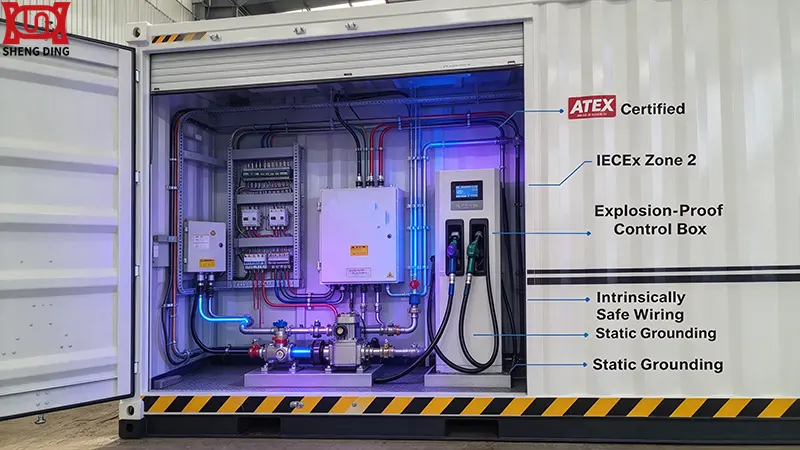
Certification 3: CE Marking - EU Market Access License
The CE mark is the mandatory "license to sell" for equipment placed on the European Union market. For a container fuel station, CE marking is not a single certificate but a declaration of conformity with multiple applicable directives.
The Directives That Apply
| Directive | Scope |
| Pressure Equipment Directive (PED 2014/68/EU) | The tank and pressure assemblies |
| ATEX Directive (2014/34/EU) | Equipment in explosive atmospheres |
| Measuring Instruments Directive (MID 2014/32/EU) | The fuel dispenser, where applicable |
What to Verify
- A valid EU Declaration of Conformity covering all applicable directives
- The technical file is available for review (or at least referenced)
- The CE mark is affixed correctly and traceable to the manufacturer
Red flag: A CE mark presented as a standalone certificate, without the underlying Declaration of Conformity and technical documentation.
Why it matters for container fuel stations: CE marking is the entry ticket to the entire EU market. Without it, the unit cannot be lawfully placed into service, regardless of how well it performs.
Certification 4: EAC Mark - Eurasian Economic Union Access
For markets including Russia, Belarus, Kazakhstan, Armenia, and Kyrgyzstan, the EAC (Eurasian Conformity) mark is mandatory. The relevant technical regulation for fuel storage equipment is TR CU 032/2013 on pressure equipment safety.
What It Covers
EAC certification confirms that the container fuel station's pressure equipment - primarily the tank and associated piping - meets the safety requirements of the Eurasian Economic Union.
What to Verify
- EAC certificate or declaration references TR CU 032/2013
- The certification body is accredited within the EAEU system
- The certificate covers the specific tank design and capacity being exported
EAC certification is often overlooked by buyers focused on EU or North American markets. For projects in Central Asia or Russia, it is not optional - customs will require it.
Why it matters for container fuel stations: the EAEU is a single market of over 180 million people. Without EAC, the unit cannot clear customs in any member state.
Certification 5: UL 142 / UL 2085 - North American Tank Safety Standards
For the United States and Canada, tank construction and fire safety are governed by Underwriters Laboratories standards.
UL 142 - Steel Aboveground Tanks
UL 142 is the recognized North American standard for steel aboveground tanks for flammable and combustible liquids. It covers tank design, construction, and testing for atmospheric-pressure storage.
UL 2085 - Fire-Resistant Tanks
UL 2085 covers protected aboveground tanks with enhanced fire resistance. Where local fire codes require a fire-rated tank, UL 2085 is the applicable standard.
The Broader North American Matrix
UL is only one part of the North American compliance picture. Equipment must also address:
- ASME - tank design and pressure integrity (see Certification 6)
- NFPA 30 / NFPA 30A - fire safety and fuel dispensing facility codes
- UL/CSA - electrical safety
- Often a local Professional Engineer (P.E.) stamp
What to Verify
- The tank carries a UL 142 listing (or UL 2085 where fire resistance is required)
- The UL mark is traceable to the specific tank model
- The supplier can provide the UL file number
Why it matters for container fuel stations: a tank without UL 142 listing will not pass inspection in most US jurisdictions, regardless of its origin or other certifications.
Certification 6: ASME / API 650 / EN 12285-2 - Tank Structural Standards
Beyond market-specific marks, the tank itself must be built to a recognized structural standard. Three standards dominate international container fuel station construction.
ASME Boiler and Pressure Vessel Code
ASME provides the design and pressure integrity framework for tanks and pressure vessels. For North American projects, ASME compliance is often a baseline requirement.
API 650 - Welded Steel Tanks
API 650 covers welded steel tanks for oil storage and is widely referenced in international projects. It provides a recognized basis for tank structural design and welding quality.
EN 12285-2 - European Factory-Made Steel Tanks
EN 12285-2 is the European standard for factory-made steel tanks for flammable and combustible liquids. Many European-manufactured container fuel stations are built to this standard, and it is frequently cited alongside ATEX and CE certification.
What to Verify
- The tank design standard is explicitly stated in the technical documentation
- Pressure test reports and weld NDT reports are available
- The standard matches the requirements of the destination market
Why it matters for container fuel stations: the tank is the single largest and most safety-critical component. "Built to international standards" is not a standard - the specific code must be named and documented.
Certification 7: IMDG Code / ADR / DOT - Dangerous Goods Shipping Compliance
This is the certification category that causes the most port delays, and the one most often overlooked by first-time exporters.
The Classification Problem
A container fuel station contains or has contained flammable liquid. Even after emptying and cleaning, fuel residues may remain in tanks, piping, pumps, and seals. The unit may therefore fall under dangerous goods regulations during transport.
The applicable regulations vary by mode:
| Regulation | Mode | Region |
| IMDG Code | Maritime | International |
| ADR | Road | Europe |
| DOT | Transport | United States |
Required Documentation
For a unit classified as dangerous goods, shipping documents must include:
- Proper shipping name, UN number, hazard class (Class 3: Flammable liquids), flash point, and packing group
- A gas-free certificate confirming the tank has been purged of flammable vapors after cleaning
- A Material Safety Data Sheet (MSDS) for the fuel type
What to Verify
- The supplier provides a gas-free certificate from an approved certifying body
- The dangerous goods declaration matches the actual condition of the unit
- The MSDS is included and current
The consequence of getting it wrong: a missing gas-free certificate or incorrect dangerous goods classification can lead to port rejection, fines, forced re-export, or demurrage costs that accumulate daily while the unit sits in bonded storage.
Why it matters for container fuel stations: this is not a product certification - it is a shipping document. But without it, the product cannot legally move.
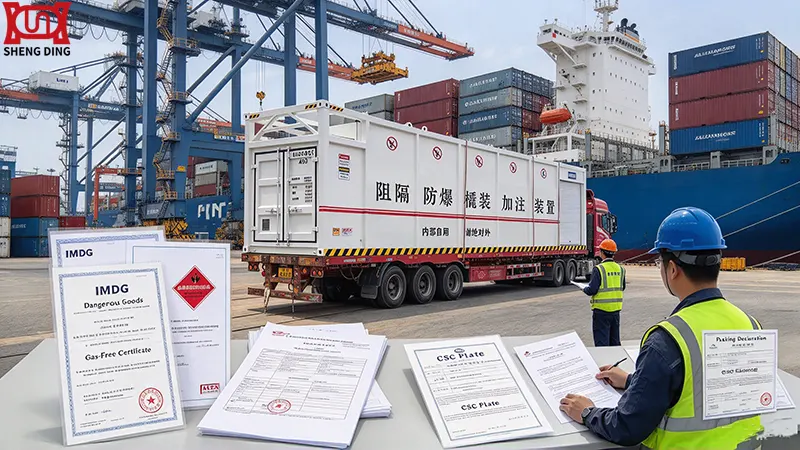
Certification 8: CSC Plate & ISO 1496-3 - Container Safety and Structural Certification
If the container fuel station is built inside a modified ISO container, the container itself must carry two related certifications.
CSC Plate - Container Safety Convention
The CSC plate certifies that the container meets international structural safety standards and is approved for maritime transport. Without a valid CSC plate:
- Shipping lines may refuse to load the unit
- Port authorities can reject the container
- Insurance coverage may be void in case of damage
- The unit cannot legally be used as a shipping container again
ISO 1496-3 - Tank Container Testing Standard
ISO 1496-3 is the international standard for tank containers for liquids, gases, and pressurized dry bulk. It covers design requirements and testing, including structural strength and leak-tightness.
A compliant container fuel station is typically engineered to ISO 1496-3 standards and delivered with a CSC plate and approval documents for customs clearance.
What to Verify
- A valid CSC plate is affixed and matches the container serial number
- The unit is engineered to ISO 1496-3 (not merely ISO 1496-1, which covers general cargo containers)
- CSC approval documents and pressure test certificates are included in the data book
Why it matters for container fuel stations: a container station without a valid CSC plate is not a shippable container. It becomes a piece of cargo that requires special, costly handling - or cannot move at all.
Quick Reference: 8 Certifications Checklist
| # | Certification | Primary Market / Scope | Critical Check |
| 1 | ATEX | EU - explosion-proof equipment | Original certificates with matching serial numbers |
| 2 | IECEx | International (70+ countries) - explosion-proof | Valid certificate referencing IEC 60079 |
| 3 | CE Marking | EU - market access | Declaration of Conformity covering PED + ATEX |
| 4 | EAC Mark | EAEU (Russia, Kazakhstan, etc.) | TR CU 032/2013 compliance |
| 5 | UL 142 / UL 2085 | North America - tank safety | UL listing traceable to tank model |
| 6 | ASME / API 650 / EN 12285-2 | Tank structural standard | Specific code named in documentation |
| 7 | IMDG / ADR / DOT + gas-free certificate | Dangerous goods shipping | Gas-free certificate from approved body |
| 8 | CSC Plate + ISO 1496-3 | Container structural certification | Valid CSC plate, ISO 1496-3 data book |
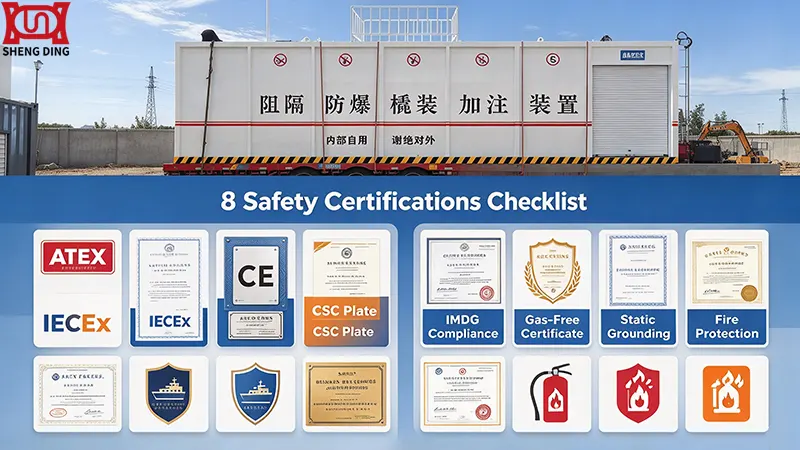
How These Certifications Fit Together
The 8 certifications are not a flat list. They operate on three levels, and a compliant export depends on all three being addressed.
Level 1 - Market access: ATEX, CE, EAC, and UL determine whether the unit can legally be placed on the market and put into service in the destination country.
Level 2 - Product safety and performance: IECEx, ASME/API/EN 12285-2, and UL 142/2085 confirm that the equipment is built to recognized safety and structural benchmarks.
Level 3 - Transport and operational compliance: IMDG/ADR/DOT with the gas-free certificate, and CSC/ISO 1496-3, determine whether the unit can legally move across borders and be accepted at the port.
A unit may pass Level 1 and Level 2 and still fail at the port because Level 3 documentation is incomplete. Conversely, perfect shipping documents cannot compensate for a missing CE or ATEX certificate. All three levels are necessary.
The practical takeaway: specify the destination market and shipping route at the procurement stage, not after the unit is built. Reputable suppliers design core components to the highest common denominator (e.g., ATEX and ASME) and then manage the specific certification logistics for the end destination.
About Shengding Container
Shengding Container (Taian Shengding Metal Container Manufacturing Co., Ltd.) manufactures export-ready container fuel stations, skid-mounted fuel stations, and self bunded tanks. The company holds ISO 9001 certification and provides certification documentation packages covering ATEX, IECEx, CE, UL/ASME (where required), CSC plate, and dangerous goods shipping documentation for international projects.
Products are exported to markets across Asia, Europe, Africa, and Oceania, with 24-hour technical support and on-site commissioning personnel available. For buyers specifying a container fuel station for export, Shengding Container provides a full certification checklist review at the quotation stage - before manufacturing begins.
Conclusion
Exporting a container fuel station is not a manufacturing problem. It is a documentation and certification problem. The 8 certifications covered here - ATEX, IECEx, CE, EAC, UL 142/2085, ASME/API/EN 12285-2, IMDG/ADR/DOT with gas-free certification, and CSC/ISO 1496-3 - form the compliance backbone of any successful international shipment.
The most expensive mistake is treating certifications as an afterthought. A unit that fails at the port costs far more than the certification work would have cost at the factory. Specify the target market early. Request original certificates, not assurances. And verify every document before the container leaves the factory gate.
Need a container fuel station with a complete export certification package?
Shengding Container provides market-specific compliance reviews and a transparent documentation checklist before you commit to a purchase order.
Written by
TAIAN SHENGDING METAL CONTAINER MANUFACTURING CO., LTD.
Editor Wang
WhatsApp:+86 152 5486 3111
Email:shengdingtank@126.com


- WhatsApp
- E-MailE-Mail:shengdingtank@126.com
- WeChatWeChat:15254863111