8 Core Aspects of Tank Equipment Inspection for Skid-Mounted Fuel Stations


As an integrated refueling unit combining oil storage, dispensing, explosion protection, and environmental safety functions, skid-mounted fuel stations are widely deployed in settings such as logistics parks, industrial and mining enterprises, and public transit depots, owing to their advantages of minimal footprint, short construction cycles, and high mobility. As the core component of a skid-mounted station, the safety of the tank equipment directly impacts the safety of surrounding personnel, the environment, and property. To effectively prevent safety incidents-such as leaks, fires, and explosions-from occurring, it is imperative to establish a systematic and standardized inspection mechanism. Based on standards such as the Technical Standards for Automobile Refueling, Gas-filling, and Hydrogen-filling Stations and the Technical Requirements for Barrier-Explosion-Proof Skid-Mounted Refueling (Gas-filling) Devices, this article outlines eight core aspects of tank equipment inspection for skid-mounted fuel stations. By addressing critical dimensions-including tank structure, explosion-proof performance, leak-tightness, and electrical safety-these guidelines provide technical support for ensuring the safe operation of the equipment throughout its entire lifecycle.
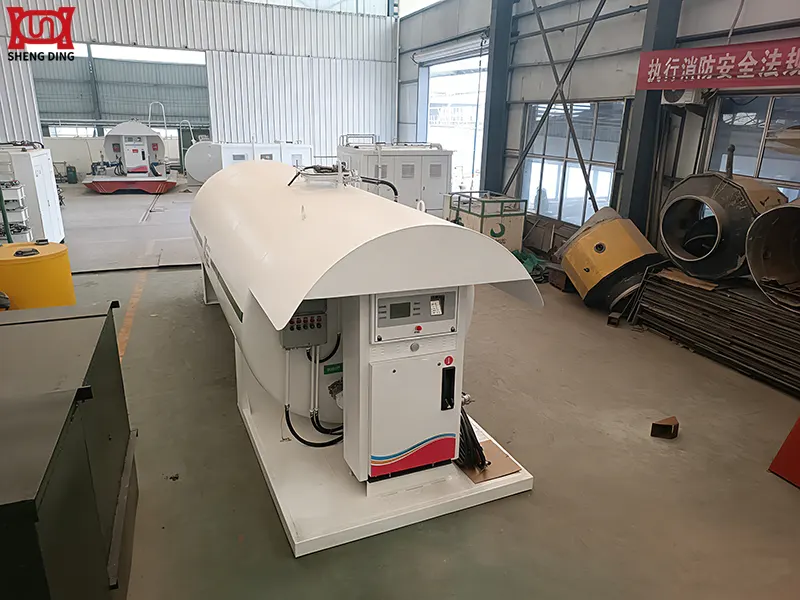
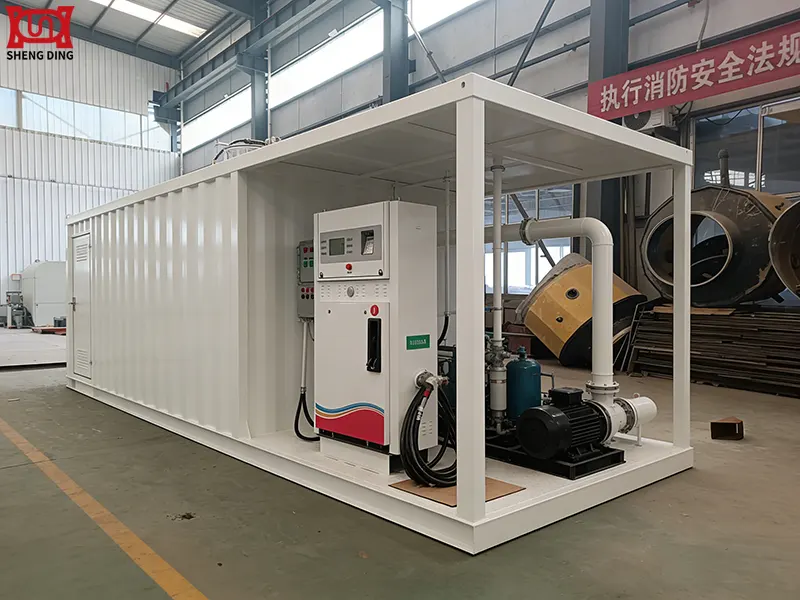
1. Tank Structural Integrity Inspection
Inspection of tank structural integrity primarily encompasses checks on wall thickness, roundness, verticality, localized bulges or depressions, bottom plate flatness, weld quality, and related parameters.
1.1. Tank Geometric Dimensions and Verticality
- Tank Diameter/Length Deviation: The upper and lower deviation in diameter must not exceed 0.5% and must remain within 5 mm.
- Tank Verticality: The verticality deviation over the full height of the tank must be <= 0.3% (typically <= 10 mm per 3 meters).
1.2. Tank Wall Thickness Inspection
- Shell Wall Thickness: The actual measured wall thickness must be >= 80% of the designed wall thickness.
- End Cap (Head) Wall Thickness: The actual measured wall thickness must be >= 80% of the designed wall thickness.
- Critical Thinning Areas: The bottom of the tank, the areas surrounding oil inlet and outlet ports, and the locations of support rings must be inspected point-by-point.
1.3. Tank Deformation Inspection
- Localized Depressions: The depth of any depression must be <= 50 mm and must not compromise structural strength.
- Bulges/Protrusions: No obvious bulges or signs of structural instability/deformation are permitted.
- Ellipticity (Roundness): The difference between the maximum and minimum diameters within any single cross-section must be <= 1% of the nominal diameter.
1.4. Weld Appearance and Non-Destructive Testing
- Weld Appearance: Free of cracks, porosity, slag inclusions, incomplete penetration, and excessive undercut.
- Non-Destructive Testing (UT/MT/PT): Longitudinal and circumferential welds shall undergo 100% UT or spot checks as per design requirements; defect levels must meet Grade II acceptance criteria.
1.5. Tank Bottom Plate / Lower Head Inspection
- Bottom Plate Flatness: Local unevenness (protrusions/depressions) <= 30 mm.
- Corrosion, Pitting, and Cracks: Pitting depth <= 20% of wall thickness; cracks are not permitted.
1.6. Manhole / Flange / Nozzle Structure Inspection
- Manhole Reinforcement and Flange Perpendicularity: Flange sealing face horizontal/vertical deviation <= 1 mm/m.
- Nozzle Welds and Stress Concentration Zones: Free of cracks, leaks, and severe corrosion.
1.7. Support and Base Structure
- Support/Saddle Contact: No looseness, cracking, or severe corrosion.
- Tank-to-Base Connection: All bolts present and tightened; no shearing or deformation.
1.8. Overall Sealing Integrity
- Structural Inspection After Hydrostatic/Airtightness Testing: No permanent deformation, leaks, or abnormal sounds observed during pressure holding.
2. Double-Wall Tank Leak Detection
Leak detection for double-wall tanks at skid-mounted fuel stations centers on monitoring the interstitial space and verifying tank integrity. It encompasses four main categories: online monitoring, manual inspections, specialized testing, and system function verification.
2.1. Interstitial Space Leak Monitoring
- Inspection Riser Manual Observation: Open the dust cap on the inspection riser and perform a visual/probe inspection to check the interstitial space for accumulated oil or water.
- Interstitial Fluid Level Sensor Monitoring: Accuracy <= 3.5 mm; provides real-time monitoring of the interstitial fluid level and triggers an alarm if a preset threshold is exceeded.
- Oil-Water Differentiation: Distinguishes between oil leaks from the inner tank (product) and water ingress from the outer tank (groundwater).
- Interstitial Vacuum Monitoring: Maintains negative pressure (typically >= 5 kPa) within the interstitial space; triggers an alarm in the event of a sudden drop in vacuum level.
- Pressure Decay Test: The interstitial space is pressurized to a specified value; the pressure is held while observing for any drop. The absence of a pressure drop constitutes a pass.
- Real-time data acquisition, audible and visual alarms, self-diagnostics for faults, communication stability, and response time (<= 2s).
2.2. Tank Body Integrity Inspection
- Weld Inspection: Vacuum box method (negative pressure of 0.03 MPa), magnetic particle testing, and penetrant testing to detect cracks and porosity.
- Wall Thickness Inspection: Ultrasonic thickness measurement to assess corrosion-induced thinning.
- Seal Inspection: Inspection of sealing surfaces on manholes, flanges, dipsticks, etc., to check for leaks or signs of aging.
- Anti-corrosion Coating Inspection: High-voltage spark testing (for FRP outer tanks) and visual inspection to detect pinholes or physical damage.
- Structural Integrity: Inspection for deformation, weld cracking, and damage to support structures.
2.3. Ancillary Systems and Environmental Monitoring
- Standpipe System Inspection: Check for unobstructed flow, pipe diameter (>= DN80), wall thickness (>= 4mm), and connectivity at the tank bottom.
- Surrounding Environment Monitoring: Inspection of the tank farm ground, containment pits, and soil gas (using PID detectors) to identify potential hidden leaks.
- Flammable Gas Detection: Monitoring within the tank farm and surrounding areas; explosion-proof rating T4; alarm thresholds set at <= 25% LEL (Level 1) and <= 50% LEL (Level 2).
2.4. Specialized Testing
- Interstitial Airtightness/Pressure Test: Pressurization and pressure-holding test; no pressure drop allowed.
- Sensor Calibration and System Commissioning.
- Vacuum/Pressure Decay Test: Conducted quarterly or semi-annually.
- Simulated Leak Test: Verification of alarm accuracy.
- Specialized Inspection of Wall Thickness, Welds, and Anti-corrosion Coatings: Conducted annually or biennially.
3. Tank Pressure Resistance / Airtightness Testing
Pressure resistance and airtightness testing for double-walled tanks in skid-mounted fuel stations is categorized into three main types: inner tank pressure resistance, outer tank pressure resistance, and interstitial airtightness.
3.1. Inner Tank Pressure Test
- Test Medium: Clean water (Chloride ion content <= 25 mg/L); Water temperature >= 5oC.
- Test Pressure: 1.5 times the design pressure (Typical design pressure for skid-mounted tanks is 0.08-0.1 MPa, corresponding to a test pressure of 0.12-0.15 MPa).
- Pressure Holding Procedure: Slowly increase pressure to the test pressure; hold for 30 minutes; reduce pressure to the design pressure (0.08 MPa); hold again for 30 minutes.
- Acceptance Criteria: No pressure drop, no leaks, no visible deformation.
- Pressure Gauge: Accuracy class >= 2.5.
- Measurement range: 1.5 to 3 times the test pressure.
3.2. Outer Tank Pressure Test
- Test Medium: Clean water; Water temperature >= 5oC.
- Test Pressure: 0.1 MPa.
- Pressure Holding Procedure: Increase pressure to 0.1 MPa -> Hold for 10 minutes; reduce pressure to 0.08 MPa -> Hold for 30 minutes.
- Acceptance Criteria: No pressure drop, no leaks, no deformation.
3.3. Double-Walled Tank Interstitial Space Airtightness/Leak Test
- Test Medium: Dry, clean compressed air.
- Test Pressure: 35 kPa (0.035 MPa) (Either positive pressure or vacuum is acceptable).
- Pressure Holding Duration: 30 minutes.
- Acceptance Criteria: No pressure decay, no leaks.
- Applicable Scenarios: Mandatory for new tanks prior to ex-works release or installation; mandatory following major overhauls or restarts after decommissioning; for verification of daily leak monitoring systems.
3.4. Tank Airtightness Test
- Test Medium: Dry, clean compressed air.
- Test Pressure: Design pressure (0.08 MPa).
- Holding Time: 30 min.
- Detection Method: Apply soapy water to welds, flanges, and nozzles; absence of continuous bubbling indicates acceptance.
- Acceptance Criteria: No pressure drop, no leaks.
3.5. Test Data Summary Table
| Test Item | Test Medium | Test Pressure | Holding Procedure | Acceptance Criteria |
| Inner Tank Hydrotest | Clean Water | 1.5 * Design Pressure | 30 min -> Reduce to Design Pressure for another 30 min | No pressure drop, no leaks, no deformation |
| Outer Tank Hydrotest | Clean Water | 0.1 MPa | Hold at 0.1 MPa for 10 min -> Hold at 0.08 MPa for 30 min | No pressure drop, no leaks, no deformation |
| Interlayer Airtightness | Compressed Air | 35 kPa | 30 min | No pressure drop, no leaks |
| Tank Body Airtightness | Compressed Air | 0.08 MPa | 30 min | No pressure drop, no bubbles |
3.6. Key Compliance and Operational Points
- Pressure Gauge Requirements: Accuracy >= Class 2.5, appropriate range, calibrated prior to testing.
- Pressurization Rate: <= 0.1 MPa/min; sudden pressure surges are strictly prohibited.
- Safety Measures: Secure and cordon off the test area; inspect only after pressure has been fully relieved.
- Record Keeping: Document pressure curves, holding times, and test results; retain records for >= 1 year.
- Exemption Conditions: If the manufacturer has already performed the hydrotest and provided a passing report, and the tank shows no visible external damage upon site inspection, and the interlayer airtightness test passes, the on-site hydrotest may be waived.
4. Performance Testing of Explosion-Suppression Materials
Test Scope:
- Filling status, density, and explosion overpressure value of the explosion-suppression material.
Data Requirements:
- Packing Density: 0.15-0.20 kg/L (measured via water displacement method).
- Explosion Pressure Rise: <=0.05 MPa.
- Condition: No collapse, compaction, or displacement; 100% coverage.
5. Functional Verification of Safety Accessories
Inspection Items:
- Level gauge, high-level alarm, overfill prevention valve, emergency pressure relief device, breather valve, flame arrester.
Data Requirements:
- Level Gauge: Alarm triggered at 90% volume; overfill prevention valve automatically closes at 95% volume.
- Breather Valve: Opens at positive pressure of 2-3 kPa; opens at negative pressure of 1.5-2 kPa.
- Emergency Pressure Relief: Opening pressure <=0.1 MPa; discharge capacity meets regulatory specifications.
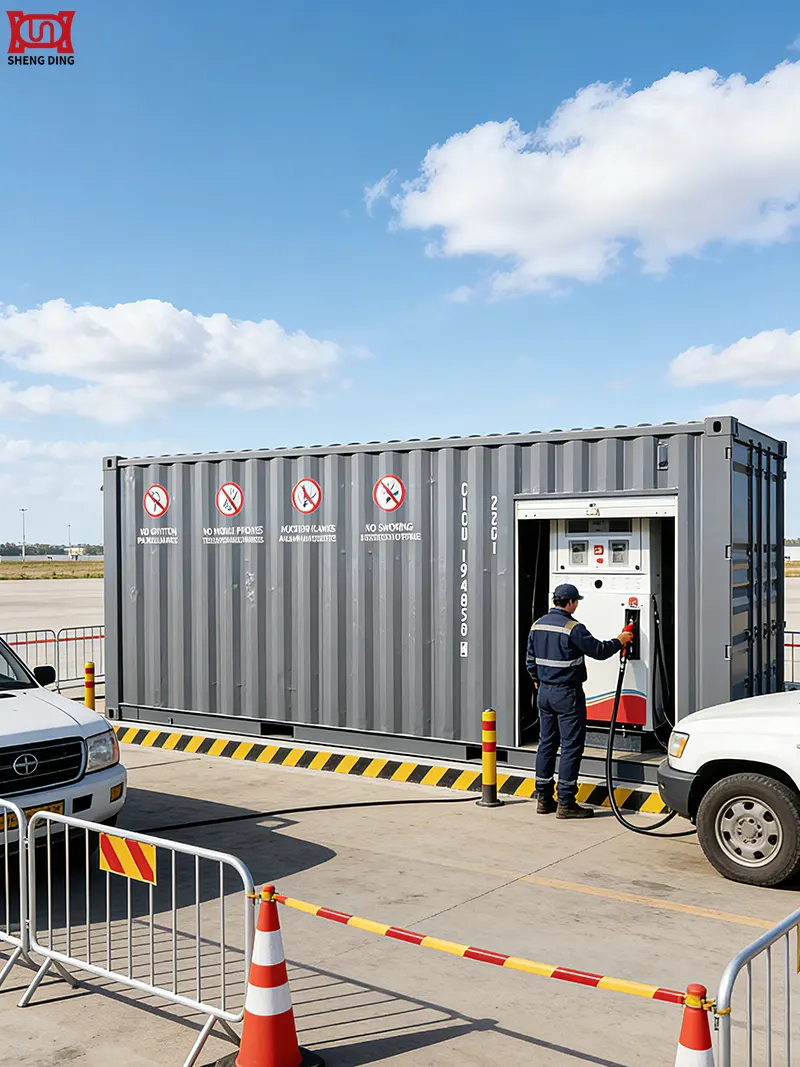
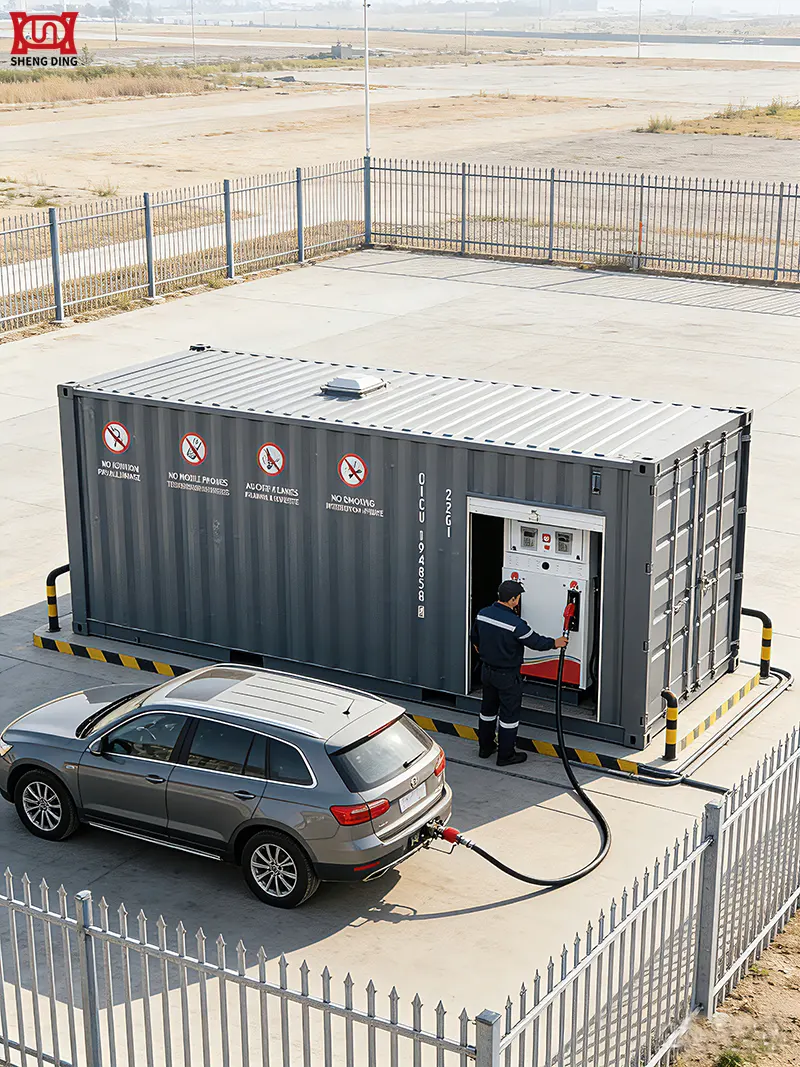
6. Static Electricity and Lightning Protection Grounding Inspection
Inspection Items:
- Tank body grounding, flange bonding, fuel dispenser grounding, lightning protection system.
Data Requirements:
- Grounding Resistance: <=10 ohm (for the overall grounding grid).
- Flange Bonding: Contact resistance <=0.03 ohm.
- Lightning Protection: Air terminals and down conductors intact; grounding resistance <=10 ohm.
7. Anti-Corrosion Coating/Lining Inspection
Inspection Items:
- Thickness of internal and external anti-corrosion layers, adhesion, pinholes, and damage.
Data Requirements:
- Thickness: Outer wall >=200 µm; inner wall >=300 µm (in accordance with design specifications).
- Adhesion: >=5 MPa (measured via pull-off method).
- Pinholes: No dielectric breakdown detected via high-voltage spark testing.
8. High-Temperature/Emergency Shut-off Protection Functions
Inspection Items:
- High-temperature shut-off valve on the oil outlet pipeline; Emergency Shut-down (ESD) system interlock.
Data Requirements:
- High-Temperature Valve: Automatically shuts off oil flow at >=70oC; response time <=5 s.
- ESD: Within <=2 s of emergency button activation, both oil inlet and outlet flows are shut off; interlock alarm functions normally.
Conclusion
In summary, the eight core inspection categories for skid-mounted fuel station tank equipment encompass a comprehensive range of requirements-spanning everything from structural integrity to electrical safety, and from explosion-proof performance to environmental leak prevention-thereby establishing a closed-loop safety inspection system. During actual operation and maintenance, it is recommended that operating entities strictly implement a tiered management mechanism comprising "monthly visual inspections, quarterly functional testing, and annual comprehensive inspections," while also establishing a dynamic inspection ledger based on the principle of "one tank, one file." Should any data anomalies or equipment defects be identified during inspections, the affected equipment must be immediately taken out of service, and a specialized agency engaged to carry out corrective actions, thereby ensuring the closed-loop management of all potential safety hazards. Only by making inspection work routine, standardized, and data-driven can we effectively fortify the safety defenses of skid-mounted fuel stations at the source, thereby guaranteeing both safety and operational efficiency.
Written by
TAIAN SHENGDING METAL CONTAINER MANUFACTURING CO., LTD.
Editor Wang
WhatsApp:+86 152 5486 3111
Email:shengdingtank@126.com


- WhatsApp
- E-MailE-Mail:shengdingtank@126.com
- WeChatWeChat:15254863111