Container Fuel Station vs Traditional Tank: 8 Benefits for On-Site Storage


When a road construction project in Zimbabwe needed fuel for its machinery, the operator chose a containerised station over a permanent build. The result: start-up costs dropped from around USD 200,000 to USD 80,000 - less than half the investment. When an Arctic fuel network needed stations in permafrost conditions where temperatures drop below -40oC, traditional underground tanks were technically impossible - containerised above-ground stations solved the problem and saved approximately 10 million rubles per station.
These are not isolated cases. Across mining, construction, logistics, and remote operations, container fuel stations are replacing traditional storage tanks - and for good reason. Here are 8 benefits that explain why.
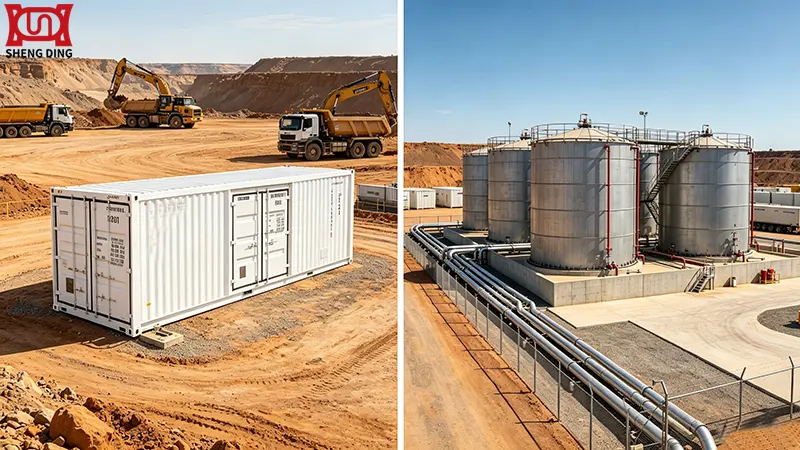
Introduction: What Is a Container Fuel Station?
A container fuel station is a complete, self-contained fuel storage and dispensing unit built inside a modified ISO shipping container. It integrates storage tanks (typically double-walled), dispensing pumps, safety equipment, control systems, and often smart monitoring - all within a standard 10ft, 20ft, or 40ft container footprint.
Unlike traditional fuel storage - which relies on in-ground or above-ground bulk tanks with separate dispensing equipment, canopies, civil foundations, drainage systems, and permanent electrical installations - a container station arrives as a single, factory-assembled unit. It requires no civil construction and can be commissioned within hours of delivery.
Below are the 8 key benefits that make container fuel stations the superior choice for on-site storage.
1. Dramatically Lower Capital Investment
The most immediate and compelling advantage is cost.
Traditional fuel storage requires significant upfront investment: excavation, in-ground tank installation (or above-ground tank foundations), concrete bunds, impermeable surfacing, drainage systems with oil-water separators, canopy structures, permanent electrical installations, and fire suppression systems. These civil elements typically add $80,000-$250,000 on top of equipment costs.
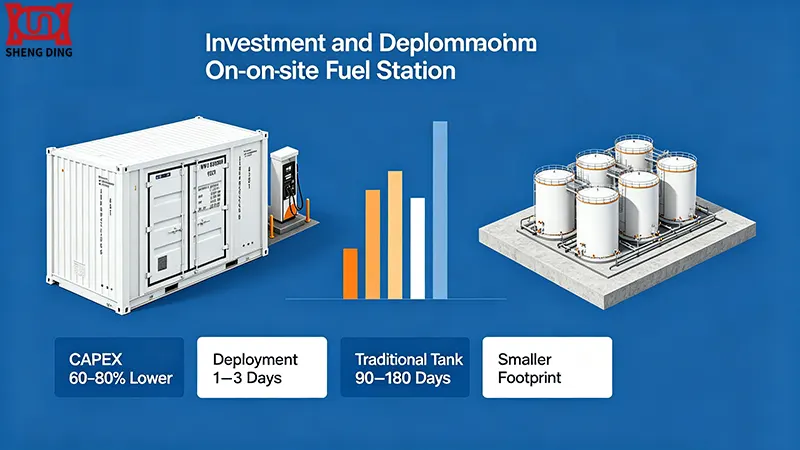
Container fuel stations eliminate this entire cost category. A permanent station's total cost - including construction, decommissioning, and site remediation - is typically 3-5 times higher than an equivalent mobile station over a 3-5 year project lifecycle.
| Cost Component | Traditional Tank | Container Fuel Station |
| Equipment (10,000L system) | $120,000-$350,000+ | $35,000-$80,000 |
| Civil works | $80,000-$250,000+ | None (concrete pad optional) |
| Total investment | $200,000-$600,000+ | $35,000-$80,000 |
In markets like Zimbabwe, operators report start-up costs dropping from around USD 200,000 for a permanent station to USD 80,000 or less for a container unit. In Russia, containerised solutions cost approximately 4 million rubles versus 10+ million rubles for stationary alternatives. Some Chinese manufacturers note that while traditional stations in metropolitan areas can cost tens of millions of RMB, containerised units can be established with an investment of just a few hundred thousand RMB.
The takeaway: Container stations reduce capital expenditure by 60-80% compared to traditional tanks.
2. Rapid Deployment - Days Instead of Months
Time is money - and container stations save both.
Traditional fuel storage requires extensive planning, permitting, excavation, foundation work, and construction. A permanent station on a greenfield site typically requires 4-16 weeks for installation, with total project timelines often stretching to 3-6 months or even 1-2 years.
Container fuel stations arrive pre-assembled and tested. They can be operational within hours of delivery. Some manufacturers report deployment times as short as 1-3 days, with foundation slab construction taking about one week and assembly completed in a single day. For emergency or short-term projects, the speed advantage is decisive.
| Timeline | Traditional Tank | Container Fuel Station |
| Installation | 4-16 weeks | 1-3 days |
| Total project | 3-6 months+ | 1-2 weeks |
| Foundation work | Extensive excavation | Simple concrete pad |
The Arctic fuel network demonstrates this perfectly: commissioning and startup took no more than two months - which, for fuel station construction, is exceptionally short.
The takeaway: Container stations deploy 10-50 times faster than traditional tank systems.
3. Built-In Secondary Containment & Environmental Protection
Environmental compliance is non-negotiable - and container stations make it simple.
Traditional underground tanks are vulnerable to corrosion, leaks, and difficult-to-detect failures. When an underground tank leaks, fuel can contaminate soil and groundwater for extended periods before detection. Above-ground traditional tanks require separate concrete bunds to provide secondary containment.
Container fuel stations use double-walled construction as standard. The container walls themselves provide secondary containment around the primary tank. Because the station is self-contained, any spills are retained within the container and will not contaminate the ground. Many units include electronic vacuum leak detection systems that continuously monitor the interstitial space.
Regulatory requirements typically mandate that secondary containment systems be able to contain 110% of the volume of the largest fuel storage container and have an impervious floor. Container stations meet this requirement by design - no additional civil work required.
The takeaway: Container stations provide factory-built environmental protection - no separate bunds, no excavation, no soil contamination risk.
4. All-Weather Protection & Equipment Longevity
Traditional above-ground tanks and dispensing equipment are exposed to the elements - rain, dust, sand, salt air, and temperature extremes.
Container fuel stations house all equipment inside a steel container that shields tanks, pumps, and electronics from environmental damage. This protection is particularly valuable in harsh environments: deserts, coastal areas with salt air, and Arctic regions where temperatures drop below -40oC.
The container's weather-tight design also prevents corrosion - a common problem with exposed above-ground tanks. Above-ground storage is generally preferred over underground storage because above-ground tanks last longer and are much easier to maintain.
The takeaway: Container stations extend equipment life through built-in environmental protection that exposed tanks lack.
5. Enhanced Security & Theft Prevention
Fuel theft is a persistent challenge for on-site storage operations.
Traditional tanks - particularly above-ground units without enclosures - are vulnerable to unauthorised access, vandalism, and fuel theft. Pumps, meters, and controls are visible and accessible.
Container fuel stations offer built-in security: lockable doors, solid steel walls, and integrated access control systems. Many units include:
- Lockable equipment cabinets housing all components
- Cardlock or RFID access control to restrict who can dispense fuel
- Surveillance camera integration
- Motorised roller shutters and badge access systems
These features greatly reduce the risk of vandalism and fuel theft. For high-security fuel storage or public retail locations, the container format's lockable enclosure is a clear advantage.
The takeaway: Container stations provide factory-integrated security that traditional tanks require expensive retrofits to match.
6. Mobility & Redeployability - An Asset, Not a Sunk Cost
A traditional fuel tank is a permanent fixture - once installed, it stays. At the end of a project, it has zero residual value and carries a decommissioning cost.
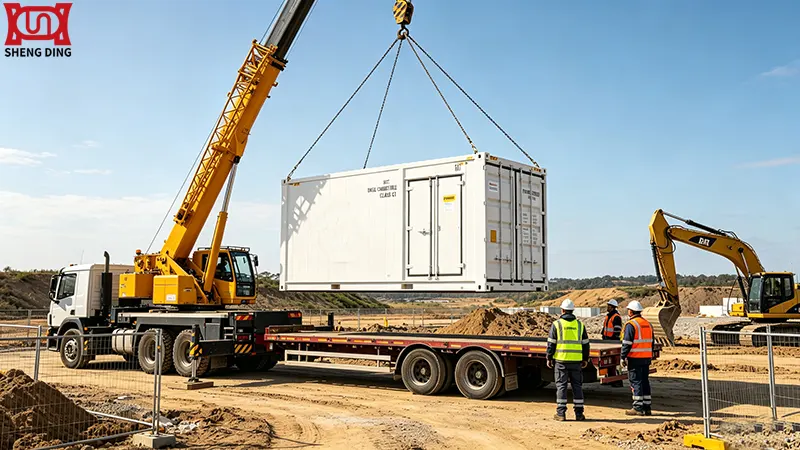
A container fuel station is a relocatable asset. When a project ends or moves - for example, a road project that needs a fuelling point 40 km from where it started eight months later - the entire station can be lifted by crane or forklift and redeployed to the next site.
Key mobility advantages:
- Standard ISO corner castings allow lifting with any container crane
- CSC certification enables shipping as standard ocean freight, saving up to 70% in mobilisation costs compared to non-containerised units
- Units can be easily dismantled and reused elsewhere
This mobility means the station retains its value and can be redeployed project after project. Containerised fuel retail facilities are described as "flexible and relatively cheap to deploy and redeploy".
The takeaway: Container stations are assets that move with your operations - traditional tanks are sunk costs left behind.
7. Standardised Global Transport & Logistics
Shipping fuel storage equipment internationally is complex and expensive - unless it's a container.
Traditional tanks - particularly large above-ground units - require specialised shipping: flat-rack, break-bulk, or RO-RO transport. Each option demands different handling equipment, freight arrangements, and often out-of-gauge shipping surcharges.
Container fuel stations are built inside standard ISO containers with valid CSC (Container Safety Convention) certification. This means:
- They ship as standard ocean freight - no special handling required
- Carriers handle them as normal boxes
- Lower ocean freight rates compared to specialised shipping
- Multimodal transport by truck, rail, and ship without special permits
- Simplified customs documentation
The takeaway: Container stations ship like any other container - reducing logistics costs and complexity by up to 70%.
8. Flexibility for Temporary & Permanent Applications
Traditional tanks are a one-size-fits-one solution - designed for a specific site and a specific project.
Container fuel stations offer unmatched flexibility:
- Temporary - ideal for construction sites, mining operations, disaster recovery, and military deployments
- Permanent - equally suitable for long-term industrial facilities, logistics depots, and fleet refuelling bases
- Scalable - modular design enables capacity expansion as needs grow
- Multi-fuel - can store diesel, gasoline, jet fuel, biofuels, and AdBlue
Traditional gas stations are impractical when operations move frequently or when permanent construction is cost-prohibitive. Container stations adapt to changing needs - from a single 20ft unit for a small construction site to multiple 40ft units for a large mining operation.
The takeaway: Container stations are one solution for every scenario - traditional tanks are locked to one location and one use.
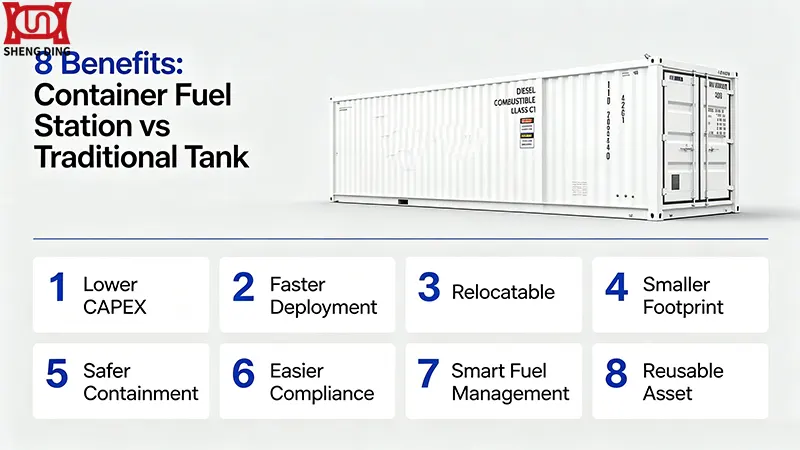
Summary: 8 Benefits at a Glance
| Benefit | Traditional Tank | Container Fuel Station |
| Capital cost | $200,000-$600,000+ | $35,000-$80,000 |
| Installation time | 4-16 weeks | 1-3 days |
| Secondary containment | Separate concrete bund required | Built-in double-wall |
| Weather protection | Exposed equipment | Fully enclosed |
| Security | Requires retrofits | Lockable, integrated |
| Mobility | Not relocatable | Fully relocatable |
| Shipping | Specialised freight | Standard ISO container |
| Flexibility | Fixed location | Temporary or permanent |
When to Choose a Container Fuel Station
| Your Scenario | Recommendation |
| Construction site with 12-36 month timeline | Container station - deploy fast, relocate when project ends |
| Mining operation in remote location | Container station - weather protection, security, mobility |
| Fleet depot needing permanent on-site fueling | Container station - lower cost than traditional build |
| Emergency response or disaster recovery | Container station - operational within days, not months |
| Arctic or extreme climate | Container station - above-ground, double-wall, all-weather |
| Retail fuel station in urban area | Container station - lower land footprint, faster ROI |
Conclusion
Container fuel stations represent a fundamental shift in how fuel is stored and dispensed on-site. They replace complex, expensive, permanent construction with a simple, factory-built solution that arrives ready to work.
The 8 benefits covered here - lower capital cost, rapid deployment, built-in environmental protection, all-weather durability, enhanced security, mobility, standardised shipping, and flexibility - add up to one conclusion: for most on-site storage applications, container fuel stations are not just an alternative to traditional tanks - they are a superior solution.
Traditional tanks may still have a place for very large, very long-term installations. But for the vast majority of industrial, construction, mining, and logistics applications - where projects move, timelines are tight, and capital efficiency matters - the container fuel station wins.
Ready to explore container fuel station solutions for your operation? Contact Shengding Container for expert guidance, custom configurations, and full-chain manufacturing support.
Written by
TAIAN SHENGDING METAL CONTAINER MANUFACTURING CO., LTD.
Editor Wang
WhatsApp:+86 152 5486 3111
Email:shengdingtank@126.com


- WhatsApp
- E-MailE-Mail:shengdingtank@126.com
- WeChatWeChat:15254863111