Skid-Mounted Fuel Station Export: 6 Essential Safety Standards for Compliance


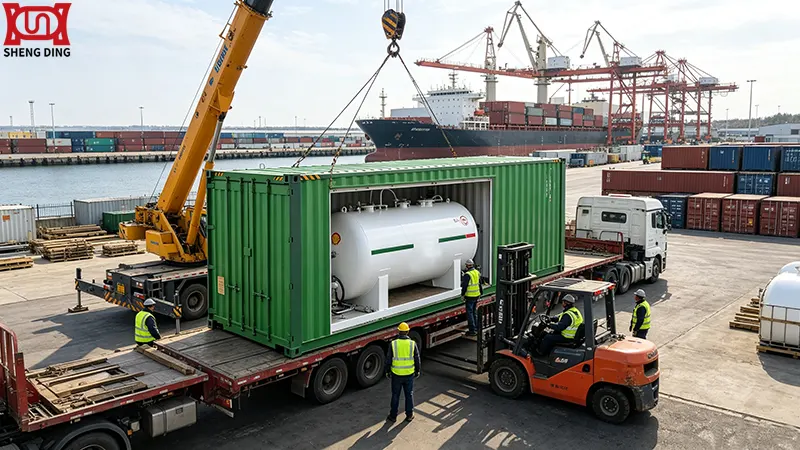
Your skid-mounted fuel station has passed factory testing. The paint is fresh, the dispenser is calibrated, and the tank is pressure-tested. But when it arrives at the destination port, customs holds the container. The electrical panel lacks the required certification mark. The shipping documents don't match the dangerous goods classification. The station sits in bonded storage while demurrage fees accumulate.
This scenario plays out more often than buyers expect. Exporting a skid-mounted fuel station involves far more than manufacturing quality - it requires navigating a complex web of international standards, regional certifications, and shipping regulations. Here are the 6 essential safety standards every exporter must master.
Introduction: The Compliance Challenge
Skid-mounted fuel stations - factory-built, transportable fueling systems that integrate storage tanks, pumps, dispensers, and safety equipment on a single steel frame - are increasingly exported from manufacturing hubs like China to markets across Southeast Asia, Africa, the Middle East, Europe, and the Americas.
But international deployment requires navigating a three-level compliance framework:
- Regional Market Access Directives - mandatory "licenses to sell" for each target market
- International Performance and Safety Standards - the "how-to-build" benchmarks
- Operational and Environmental Certifications - often project-specific requirements
For international buyers, certifications like ATEX and IECEx are non-negotiable for customs clearance and on-site regulatory acceptance. Without them, equipment can be rejected at the port, held for costly modifications, or rendered inoperable on site.
Below are the 6 essential safety standards that separate a compliant, export-ready skid-mounted fuel station from one that gets stuck at customs.
1. Explosion-Proof Certifications - ATEX, IECEx, and UL
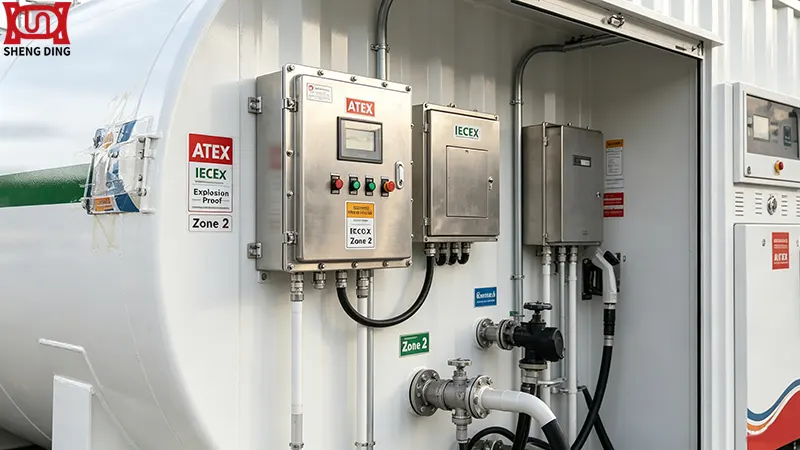
The most critical requirement for any skid-mounted fuel station is explosion-proof certification for all electrical equipment in hazardous areas. Because these stations handle flammable liquids and operate in potentially explosive atmospheres, electrical components - pumps, dispensers, control panels, sensors - must be certified to prevent ignition.
The Three Major Certification Paths
| Certification | Region | Applicable Standard | What It Covers |
| ATEX | European Union | ATEX Directive 2014/34/EU | Equipment in potentially explosive atmospheres |
| IECEx | International (70+ countries) | IEC 60079 series | Explosion-proof equipment for global markets |
| UL / UL 142 | North America | UL 142 / UL 2085 | Aboveground steel tanks and electrical safety |
ATEX (EU) and IECEx (international) share nearly identical technical foundations, both based on IEC 60079, and they certify that equipment will not become an ignition source in areas with flammable gases.
What to verify:
- All electrical components carry ATEX or IECEx certification for the target market
- The tank itself meets UL 142 or UL 2085 where specified for North American projects
- Certification documents are original, verifiable, and match the equipment serial numbers
- The supplier can provide third-party test reports for explosion-proof performance
Red flag: "Our products meet international standards" - but the supplier cannot produce original ATEX or IECEx certificates.
2. Regional Market Access - CE, EAC, and Country-Specific Marks
Beyond explosion-proof certifications, each target market requires specific market access marks that serve as the legal "license to sell."
European Union: CE Marking
The CE mark is mandatory for equipment sold in the EU. It primarily involves:
- Pressure Equipment Directive (PED 2014/68/EU) - for the tank and assemblies
- ATEX Directive (2014/34/EU) - for equipment in explosive atmospheres
- Measuring Instruments Directive (MID 2014/32/EU) - may apply to the dispenser
Eurasian Economic Union: EAC Mark
For markets including Russia, Belarus, Kazakhstan, Armenia, and Kyrgyzstan, the EAC (Eurasian Conformity) mark is required, with technical regulations like TR CU 032/2013 on pressure equipment safety.
North America: Matrix of Standards
While no single mark exists for North America, equipment must comply with a matrix of standards from:
- ASME - tank design and pressure vessels
- UL/CSA - electrical safety
- NFPA - fire safety
- Often requiring local Professional Engineer (P.E.) stamps
Other Markets
- Indonesia, Philippines, and other Southeast Asian markets - many accept IECEx, ATEX, or UL certifications combined with local approvals
- China export - CSC certificate for containerized units, ISO9001 quality certification
Red flag: The supplier assumes one certification fits all markets - each region has unique requirements.
3. Tank and Structural Standards - ASME, API, ISO, and UL
The storage tank is the largest and most critical component of any skid-mounted fuel station. Several international standards govern its design, construction, and testing.
Key Tank Standards
| Standard | Scope | Region/Application |
| ASME Boiler and Pressure Vessel Code | Tank design and pressure integrity | International |
| API 650 | Welded steel tanks for oil storage | International |
| UL 142 | Aboveground steel tanks for flammable/combustible liquids | North America |
| UL 2085 | Fire-protected and fire-resistant aboveground tanks | North America |
| EN 12285-2 | European standard for steel tanks | Europe |
| ISO 668 | Container dimensions and ratings | International shipping |
What to Verify
- Tank design complies with ASME or equivalent pressure vessel standards
- Double-wall construction with secondary containment where required
- UL 142 or UL 2085 certification for North American projects
- EN 12285-2 compliance for European projects
- Tank has passed pressure testing according to GB 50156 or equivalent
Red flag: Vague references to "international standards" without specifying which ones.
4. Dangerous Goods Shipping Compliance - IMDG, ADR, and DOT
This is the most overlooked standard - and the one that causes the most shipping delays.
The Problem
Skid-mounted fuel stations contain or have contained flammable liquids. Even when emptied and cleaned, fuel residues may remain in tanks, piping, and pumps. This means the unit may fall under dangerous goods regulations during transport.
Key Regulations
| Regulation | Mode | Region |
| IMDG Code | Maritime | International |
| ADR | Road | Europe |
| DOT | Transport | United States |
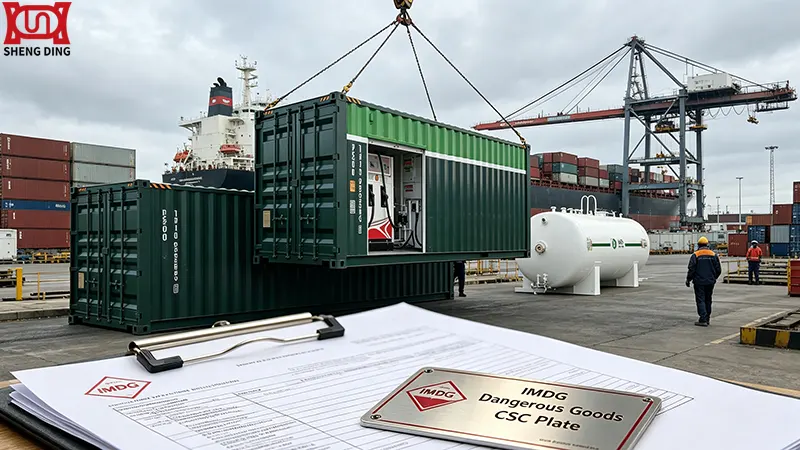
IMDG Code (International Maritime Dangerous Goods Code) is mandatory under the SOLAS Convention. If the unit is classified as dangerous goods, the shipping documents must include:
- Proper shipping name
- UN number
- Hazard class (Class 3: Flammable liquids)
- Flash point
- Packing group
Required Documentation
- CSC plate - certifies the container meets international safety standards
- Material Safety Data Sheet (MSDS) - for the fuel type
- Gas-free certificate - certifies the tank has been purged of flammable vapors
- Dangerous goods declaration - if classified as hazardous
Practical Implications
- Shipping can represent 10% to 25% of total landed cost for international buyers
- A missing CSC plate or incorrect dangerous goods classification can lead to port rejection, fines, or forced re-export
- Sea freight from China to Africa, Latin America, or Europe typically takes 2 to 8 weeks - a documentation error can add days or weeks
Red flag: The supplier cannot explain how the unit will be classified for shipping or provide the required documentation.
5. Chinese Domestic Standards - GB 50156 and AQ 3002
For manufacturers based in China - and for buyers sourcing from Chinese suppliers - compliance with Chinese domestic standards is the foundation upon which export-quality equipment is built.
GB 50156-2021
GB 50156-2021, the Design and Construction Specifications for Automobile Gasoline and Gas Stations, is the primary Chinese standard governing skid-mounted fuel stations.
Key requirements include:
- Double-walled steel tanks with leak detection in the interstitial space
- Barrier explosion-proof technology as a core safety feature
- Lightning protection and static grounding systems
- Fire resistance - tanks must withstand 1 hour of direct flame exposure
- Overfill prevention - 90% capacity alarm, 95% automatic shut-off
AQ/T 3002-2021
AQ/T 3002-2021 is the industry standard for Technical requirements for barrier and explosion-proof skid-mounted refueling (gas) devices. Issued by China's Ministry of Emergency Management, this standard specifically addresses:
- Barrier explosion-proof material - selection and installation
- Tank pressure testing
- Safety system integration
Why These Standards Matter for Export
Even when exporting, Chinese manufacturers who comply with GB 50156 and AQ 3002 produce equipment that:
- Meets the highest safety benchmarks - often exceeding minimum international requirements
- Has documented quality control and third-party testing
- Can more easily adapt to international standards because the foundation is solid
Red flag: The supplier cannot reference GB 50156 or AQ 3002 in their quality documentation.
6. Operational and Environmental Certifications
Beyond the core safety and market-access standards, several operational and environmental certifications may be required depending on the project location and application.
Vapor Recovery
For gasoline stations, vapor recovery systems are often mandatory. Certifications may come from bodies like:
- California Air Resources Board (CARB) - the strictest standard globally
- TÜV - European certification for vapor recovery units
Fuel Metering Accuracy
For commercial dispensing where fuel is sold by volume, OIML R 117 certification ensures trade-grade accuracy for fuel meters.
Quality Management
ISO9001 certification demonstrates that the manufacturer has a documented quality management system.
Extreme Environment Certifications
For projects in harsh climates - Arctic, desert, or offshore - additional certifications may be required, such as "Arctic" notation proving functionality in severe cold.
What to Verify
- Vapor recovery systems meet local environmental standards
- Fuel meters carry OIML R 117 certification where required
- The manufacturer holds ISO9001 or equivalent quality certification
- Any project-specific certifications (Arctic, offshore, etc.) are addressed
Red flag: "We can add those later" - operational certifications should be designed in from the start, not retrofitted.
Quick Reference: 6 Essential Standards Checklist
| # | Standard Category | Key Certification/Requirement | Why It Matters |
| 1 | Explosion-Proof | ATEX, IECEx, or UL | Electrical safety in hazardous areas |
| 2 | Regional Market Access | CE (EU), EAC (EAEU), UL/NFPA (NA) | Legal "license to sell" |
| 3 | Tank & Structural | ASME, UL 142/2085, EN 12285-2 | Tank integrity and safety |
| 4 | Dangerous Goods Shipping | IMDG, ADR, DOT; CSC plate | Legal transport and customs clearance |
| 5 | Chinese Domestic | GB 50156-2021, AQ/T 3002-2021 | Manufacturing quality foundation |
| 6 | Operational & Environmental | OIML R 117, CARB/TÜV, ISO9001 | Project-specific compliance |
Proactive Strategy for Export Success
The key to successful export is early engagement with your supplier. Specify the target deployment regions at the procurement stage.
Reputable suppliers will have a modular compliance strategy - designing core components to the highest common denominator (e.g., ATEX and ASME) and managing the specific certification logistics for the end destination.
This foresight prevents:
- Costly retrofits
- Customs delays
- Legal exposure
- Project timeline slippage
Conclusion
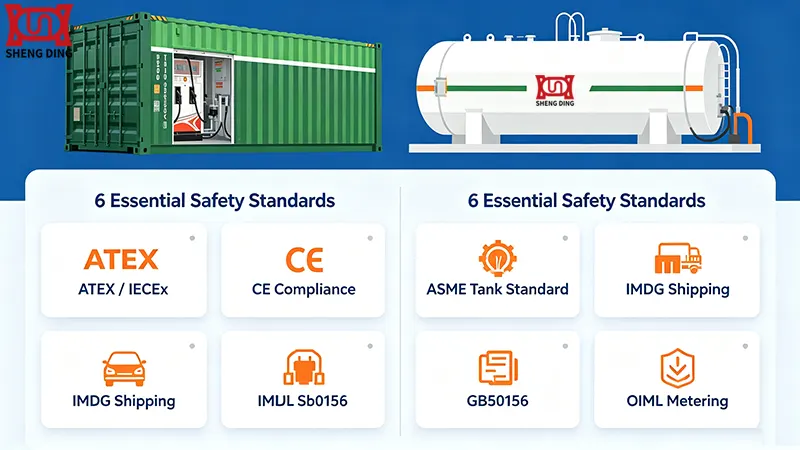
Exporting a skid-mounted fuel station is not simply a matter of manufacturing quality. It requires navigating a complex web of explosion-proof certifications, regional market access marks, tank and structural standards, dangerous goods shipping regulations, domestic manufacturing standards, and operational certifications.
These 6 essential standards form the compliance backbone of any successful international shipment:
- Explosion-Proof Certifications - ATEX, IECEx, UL
- Regional Market Access - CE, EAC, country-specific marks
- Tank and Structural Standards - ASME, UL 142/2085, EN 12285-2
- Dangerous Goods Shipping Compliance - IMDG, ADR, DOT
- Chinese Domestic Standards - GB 50156-2021, AQ/T 3002-2021
- Operational and Environmental Certifications - OIML R 117, CARB/TÜV
When evaluating an export-ready supplier, don't just ask about price and capacity. Ask about every one of these 6 standards. Request original certificates, test reports, and shipping documentation. And engage early - specify your target markets at the procurement stage, not after the unit is built.
Choose a supplier who understands compliance. Your shipment - and your project timeline - will thank you.
Ready to export a skid-mounted fuel station with full compliance? Contact Shengding Container for transparent certification documentation, export-ready configurations, and full-chain manufacturing expertise.
Written by
TAIAN SHENGDING METAL CONTAINER MANUFACTURING CO., LTD.
Editor Wang
WhatsApp:+86 152 5486 3111
Email:shengdingtank@126.com


- WhatsApp
- E-MailE-Mail:shengdingtank@126.com
- WeChatWeChat:15254863111