Self Bunded Tank Sizes: 5 Best Options for Small & Medium Mobile Fuel Operations


A construction company with five excavators. A farm with three tractors and a backup generator. A logistics depot with 20 delivery vans. What do these operations have in common? They all need on-site fuel - but none of them need a 60,000L bulk storage tank. The right self bunded tank size for small and medium mobile fuel operations falls somewhere between 1,000L and 30,000L. Here are the five best options - and how to choose the right one for your fleet.
Introduction: Why Size Is the Most Important Decision
Choosing a self bunded tank is not just about picking a steel box. The capacity you select determines:
- Refueling frequency - how often you need a fuel delivery truck on site
- Site footprint - how much space the tank occupies, including access clearance
- Transport logistics - whether the tank ships as a standard ISO container or requires special handling
- Total cost of ownership - purchase price, installation, and ongoing operational costs
- Compliance burden - larger tanks may trigger additional regulatory requirements
For small and medium mobile fuel operations, the wrong size means either too many fuel deliveries (wasting time and money) or capital tied up in capacity you never use. This guide covers the 5 best self bunded tank sizes for these operations, with real specifications and practical selection criteria.
How to Calculate Your Ideal Self Bunded Tank Capacity
Before looking at specific sizes, calculate your actual daily fuel consumption. Use this standard formula:
Tank Capacity = Daily Fuel Consumption * Days Between Deliveries * Safety Factor
Where the safety factor is typically 1.2 to 1.3 (to account for unexpected consumption spikes and tank ullage).
Step-by-Step Calculation Example
Consider a construction site with the following profile:
| Equipment | Units | Daily Consumption (L) | Subtotal (L) |
| Excavator (20-ton) | 2 | 80 | 160 |
| Bulldozer | 1 | 120 | 120 |
| Dump truck | 3 | 60 | 180 |
| Generator (backup) | 1 | 30 | 30 |
| Total daily consumption | 490 L/day |
If fuel deliveries arrive weekly (7 days):
490 L/day * 7 days * 1.2 safety factor = 4,116 L --> Round up to 4,500L
If fuel deliveries arrive every 10 days:
490 L/day * 10 days * 1.2 safety factor = 5,880 L --> Round up to 6,000L
Key insight: The same operation needs different tank sizes depending on delivery frequency. Always confirm your fuel supplier's maximum delivery interval before finalizing your self bunded tank size.
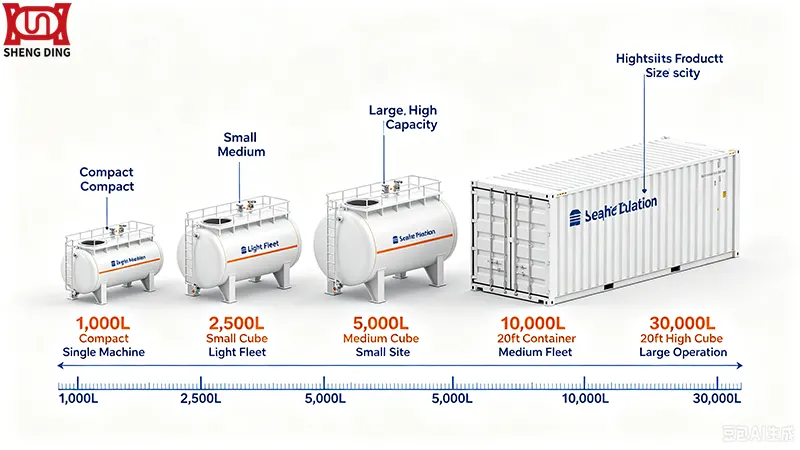
Quick Comparison: 5 Best Self Bunded Tank Sizes for Small & Medium Operations
| Option | Capacity | Footprint | Best For | Approx. Price (USD) |
| 1 | 1,000L | Compact cube (~1.9m * 1.1m) | Single vehicle / small generator | $2,500-$5,000 |
| 2 | 2,500L | Small cube (~2.3m * 1.7m) | Small fleet (2-5 vehicles) | $5,000-$10,000 |
| 3 | 5,000L | Medium cube / 10ft container | Construction site / farm | $8,000-$18,000 |
| 4 | 10,000L | 20ft container footprint | Medium fleet / remote site | $15,000-$30,000 |
| 5 | 30,000L | 20ft high cube container | Large fleet / multi-site operations | $25,000-$50,000 |
Option 1: 1,000L Self Bunded Tank - The Compact Entry Point
Best for: Single vehicle / small generator
Specifications
- Nominal capacity: 1,000L (safe fill ~950L)
- Typical dimensions: ~1,864mm (L) * 1,100mm (W) * 1,309mm (H)
- Empty weight: ~870 kg
- Footprint: Small square - fits on a standard pallet or utility truck bed
Best Applications
- Single excavator or tractor on a small site
- Backup fuel for a standby generator
- Mobile refueling for one or two vehicles
- Pilot projects or temporary installations
Why It Works for Small Operations
The 1,000L self bunded diesel tank size is the entry point for legitimate on-site fuel storage. It is small enough to be moved by forklift, yet large enough to eliminate daily jerrycan runs. For operations consuming less than 100L per day, this tank provides roughly 10 days of fuel between deliveries.
Limitations
- Not cost-effective for operations consuming more than 150L/day
- May require more frequent fuel deliveries than larger options
- Limited dispensing equipment options due to compact pump bay
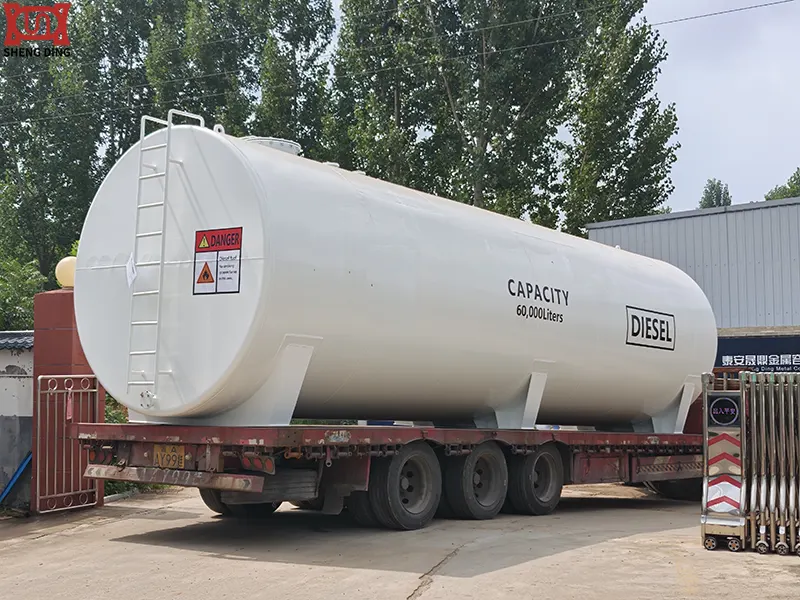
Option 2: 2,500L Self Bunded Tank - The Small Fleet Workhorse
Best for: Small fleet (2-5 vehicles)
Specifications
- Nominal capacity: 2,500L (gross 2,755L; safe fill 2,500L)
- Typical dimensions: ~2,274mm (L) * 1,674mm (W) * 1,254mm (H)
- Empty weight: ~1,189 kg
- Construction: 6mm internal and external steel linings
- Features: Forklift pockets, lifting eyes, internal baffles
Best Applications
- Small construction crews (2-5 machines)
- Agricultural operations with multiple tractors
- Logistics depots with 10-20 vehicles
- Remote work sites with weekly fuel deliveries
Why It Works for Small & Medium Operations
The 2,500L self bunded fuel tank size hits a sweet spot: it holds enough fuel for a full week of moderate consumption while remaining compact enough to fit in tight site layouts. The 2,500L size is specifically designed for "the small to medium operator who needs the convenience of refuelling vehicles on site."
With a 2,500L capacity, an operation consuming 300L/day gets 8 days of autonomy - enough to align with standard weekly fuel delivery schedules.
Limitations
- May still require frequent deliveries for high-consumption operations
- Not suitable for operations with more than 5 heavy machines
Option 3: 5,000L Self Bunded Tank - The Construction Site Standard
Best for: Construction site / farm
Specifications
- Nominal capacity: 5,000L (safe fill 5,000L)
- Available configurations: Steel cube or 10ft container footprint
- Typical dimensions (cube): ~2,150mm (L) * 1,500mm (W) * 2,210mm (H)
- Empty weight: ~1,500-2,000 kg
- Container option: Fits 10ft high cube footprint
Best Applications
- Active construction sites with 5-10 machines
- Agricultural operations with large fleets
- Mining exploration camps
- Event or temporary fuel supply points
Why It Works for Small & Medium Operations
The 5,000L self bunded tank size is the most popular choice for construction sites because it balances capacity with mobility. It can be delivered on a standard flatbed truck and positioned by a mid-size crane or heavy forklift.
Many 5,000L models are available in ADR and UN-certified configurations for transport, and can be mounted on skid frames for easy relocation between project phases.
Limitations
- Requires more substantial foundation than smaller tanks
- May need crane assistance for initial positioning
- Larger footprint may not suit constrained urban sites
Option 4: 10,000L Self Bunded Tank - The Medium Fleet Solution
Best for: Medium fleet / remote site
Specifications
- Nominal capacity: 10,000L (safe fill 9,500L)
- Container footprint: 20ft container (6,058mm * 2,438mm * 2,591mm)
- Inner tank dimensions: ~4,500mm * 1,500mm * 1,500mm (for 10,000L 20ft model)
- Total weight (empty): ~4,230 kg
- Total weight (full): ~12,730 kg
Best Applications
- Medium-sized construction projects
- Remote mining or oil & gas operations
- Fleet depots with 30-50 vehicles
- Multi-site operations requiring fuel mobility
Why It Works for Small & Medium Operations
The 10,000L self bunded tank is the point where containerized designs become highly attractive. As a 20ft containerized unit, it ships as standard ocean freight, can be lifted by any container crane, and meets CSC certification requirements for international transport.
For a fleet consuming 1,000L/day, this tank provides 10 days of autonomy. For a construction site consuming 500L/day, it provides roughly 19 days between deliveries.
Containerized 10,000L Specifications (20ft)
| Parameter | Specification |
| Outer container dimensions | 6,058 * 2,438 * 2,591 mm |
| Inner tank dimensions | 4,500 * 1,500 * 1,500 mm |
| Total volume | 10,000 L |
| Total weight (empty) | ~4.23 tons |
| Container type | 20ft standard / high cube |
Limitations
- Requires proper foundation (reinforced concrete pad or compacted gravel base)
- Higher capital cost than smaller options
- May require regulatory approval depending on jurisdiction
Option 5: 30,000L Self Bunded Tank - The Large-Scale Mobile Operation
Best for: Large fleet / multi-site operations
Specifications
- Nominal capacity: 30,000L (safe fill ~26,500L for 20ft high cube)
- Container footprint: 20ft high cube (6,058mm * 2,438mm * 2,896mm)
- Empty weight: ~7,100 kg
- Features: Integral pump bay, dispensing equipment, monitoring systems
Best Applications
- Large construction projects with 10+ heavy machines
- Mining operations with continuous fuel demand
- Major logistics fleets (50+ vehicles)
- Port or airport fuel supply
- Multi-site fuel distribution hub
Why It Works for Small & Medium Operations
The 30,000L self bunded tank size represents the upper limit of what most small and medium operations need. It is large enough to support operations consuming 2,000-3,000L per day with weekly deliveries, yet still transportable as a standard 20ft container.
Units like the GTT-28 (28,000L, 26,500L safe fill) and T30 (30,000L) are available in 20ft high cube configurations with integral pump bays, making them true "plug-and-play" fueling stations.
Limitations
- Significant capital investment ($25,000-$50,000+)
- Requires substantial foundation and site preparation
- May trigger additional regulatory requirements (environmental impact assessments, fire department approval)
- Full weight of ~37 tons requires careful foundation design
Comparison Summary: 5 Best Self Bunded Tank Sizes
| Specification | 1,000L | 2,500L | 5,000L | 10,000L | 30,000L |
| Safe fill | ~950L | 2,500L | 5,000L | 9,500L | ~26,500L |
| Footprint | Compact cube | Small cube | Medium cube / 10ft | 20ft container | 20ft high cube |
| Empty weight | ~870 kg | ~1,189 kg | ~1,500-2,000 kg | ~4,230 kg | ~7,100 kg |
| Full weight | ~1,820 kg | ~3,689 kg | ~6,500-7,000 kg | ~12,730 kg | ~37,100 kg |
| Forklift movable | Yes | Yes | Heavy forklift | Crane required | Crane required |
| CSC shippable | No | No | Optional | Yes | Yes |
| Best for | 1 vehicle / generator | Small fleet 2-5 | Construction site | Medium fleet | Large operation |
| Approx. price | $2.5K-5K | $5K-10K | $8K-18K | $15K-30K | $25K-50K |
Key Sizing Factors Beyond Capacity
When selecting your self bunded tank size, capacity is only the starting point. Consider these additional factors:
1. Site Access and Layout
Measure your access route before ordering. A 20ft containerized tank requires a minimum 3m-wide access path and sufficient turning radius for delivery trucks. A 5,000L cube may fit through a standard 3m gate; a 30,000L unit will not.
2. Fuel Delivery Infrastructure
Confirm the maximum volume your fuel supplier's delivery truck can discharge in a single visit. Most tanker trucks carry 20,000-36,000L. If your tank is 30,000L but the delivery truck only carries 20,000L, you'll never fill it in one visit - wasting capacity.
3. Power Availability
If your site has no reliable power, choose a tank with a manual or solar-powered dispensing system. Larger tanks with integrated pumps require mains power or a generator for operation.
4. Regulatory Thresholds
In many jurisdictions, tanks above certain capacity thresholds trigger additional regulations - environmental impact assessments, fire department inspections, or spill prevention plan requirements. Check local regulations before selecting your size.
5. Future Growth
If your fleet is expanding, choose a tank one size larger than your current needs. The cost difference between a 5,000L and 10,000L tank is far less than the cost of replacing a tank prematurely.
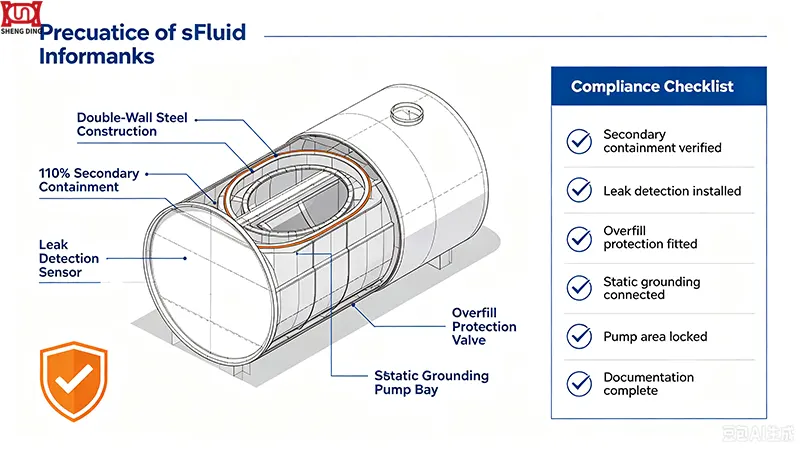
Compliance Checklist for Small & Medium Operations
Regardless of which self bunded tank size you choose, ensure these compliance features are included:
- 110% secondary containment - the outer bund must hold at least 110% of the inner tank's full capacity
- Double-wall steel construction - 5-6mm inner wall, 3-5mm outer wall
- Overfill protection - 90% alarm and 95% automatic shut-off valve
- Leak detection system - interstitial monitoring with audible/visual alarm
- Static grounding - with grounding alarm interlock to prevent fueling without proper grounding
- Fire-safe ball valves - standard on all quality tanks
- Lockable pump bay - prevents unauthorized access and fuel theft
- Compliance certification - AS1940, AS1692, UL 142, or equivalent
- Pressure and hydrostatic testing - documented test reports
Frequently Asked Questions
What is the smallest self bunded tank size available?
Self bunded tanks are available from as small as 250L for pickup-mounted units. However, for practical on-site fuel storage, the smallest practical size is 1,000L - anything smaller requires too-frequent refilling to be operationally efficient.
Can I use one self bunded tank for both diesel and gasoline?
Yes, but with precautions. Gasoline requires explosion-proof fill material (barrier explosion-proof technology) and vapor recovery systems that diesel does not. If you need both fuels, specify a multi-compartment tank with separate dispensing systems for each fuel type.
How long does a self bunded tank last?
A quality self bunded steel tank typically lasts 20+ years with proper maintenance. The outer bund should be inspected annually for corrosion, and the leak detection system should be tested every 30 days.
Do I need a concrete foundation for a 5,000L tank?
Not necessarily. Self bunded tanks can be placed on a compacted gravel base or concrete pad. For a 5,000L tank (full weight ~7,000 kg), a reinforced concrete pad or well-compacted gravel base is recommended. Larger tanks (10,000L+) typically require a reinforced concrete foundation.
Can I relocate a self bunded tank after installation?
Yes - this is one of the primary advantages of self bunded tanks over traditional underground storage. Tanks up to 2,500L can be moved by forklift; larger units require crane assistance. Containerized models (10,000L+) can be shipped as standard ISO freight for multi-site deployment.
Need help selecting the right self bunded tank size for your operation?
Shengding Container offers self bunded tanks from 1,000L to 68,000L, with full compliance documentation, custom dispensing configurations, and export-ready containerized options.
Written by
TAIAN SHENGDING METAL CONTAINER MANUFACTURING CO., LTD.
Editor Wang
WhatsApp:+86 152 5486 3111
Email:shengdingtank@126.com


- WhatsApp
- E-MailE-Mail:shengdingtank@126.com
- WeChatWeChat:15254863111