How to Choose a Skid-Mounted Fuel Station: 10 Questions for Your Supplier in 2026


Buying a skid-mounted fuel station is not a routine purchase - it's a long-term capital investment. Choosing the wrong supplier can lead to safety violations, costly operational downtime, and unexpected expenses. Before you sign any contract, ask your supplier these 10 critical questions to ensure you're getting a compliant, durable, and cost-effective solution.
Introduction
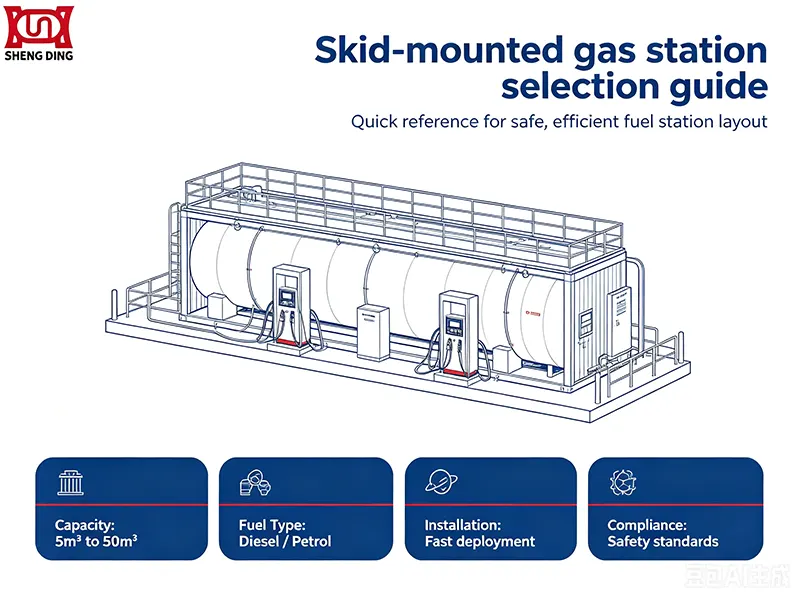
The skid-mounted fuel station market is booming. In 2026, the global mobile container fuel station market is projected to reach USD 3.07 billion, with China's domestic market alone exceeding RMB 48 billion. But with rapid growth comes a flood of suppliers - some with deep manufacturing capabilities, others little more than assembly shops working out of rented workshops.
Here's the reality: not all skid-mounted fuel stations are created equal. A cheaper unit can cost you far more in the long run through safety fines, frequent breakdowns, and poor fuel efficiency. Conversely, the right station - properly specified and sourced from a reliable manufacturer - can deliver 15% fuel cost savings and 80% less downtime for refueling logistics, as demonstrated by projects like the Hainan Transportation Investment Group's construction site.
So, how do you separate the best suppliers from the rest? Ask these 10 essential questions before you buy.
1. What Certifications Do Your Skid-Mounted Fuel Stations Hold?
Certifications are not just paperwork - they are legal proof that your station can operate without regulatory issues.
What to ask:
- Do you comply with GB 50156-2021 (China) or NFPA 30A (International)?
- Do you hold ATEX or IECEx certifications for explosion-proof equipment (critical for export)?
- Is your barrier explosion-proof material certified under AQ 3002?
- Can you provide third-party test reports for tank pressure integrity, leak detection, and fire resistance?
Why it matters:
Uncertified equipment will fail inspections and can be shut down by local authorities. For international buyers, ATEX and IECEx certifications are non-negotiable for customs clearance and on-site regulatory acceptance.
Red flag: "Our products meet international standards" - but the supplier cannot produce original certificates.
2. Are You a Full-Chain Manufacturer or an Assembly Shop?
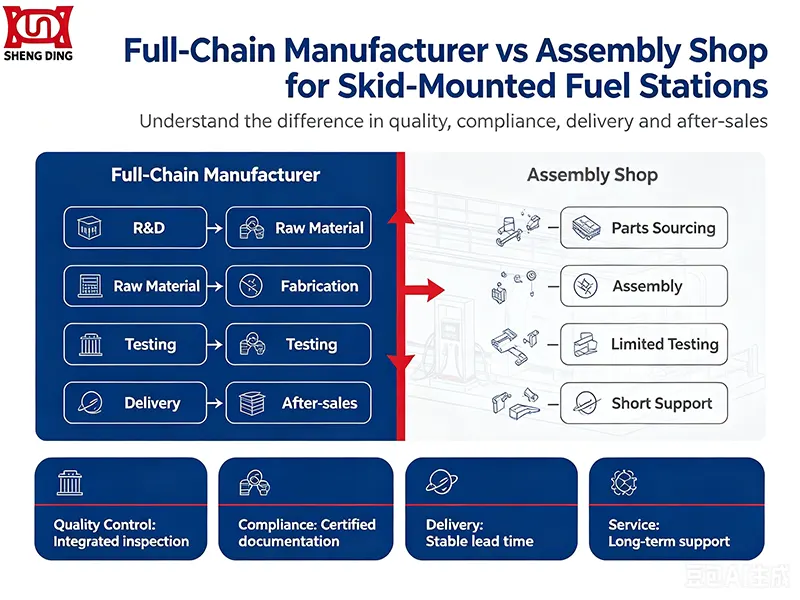
This is perhaps the most important question for long-term reliability.
What to ask:
- Do you manufacture the barrier explosion-proof material yourself, or do you source it from third parties?
- Do you produce the tanks, safety systems, and control panels in-house, or are they outsourced?
- Can we visit your factory to see your production process and quality control?
Why it matters:
Industry data shows that manufacturers with full-chain capabilities - from raw material processing to complete equipment integration - have a market survival rate 4.2 times higher and customer repurchase rates 3.8 times higher than pure assembly operations. Full-chain control means consistent quality, shorter lead times, and better after-sales support.
Red flag: The supplier cannot clearly describe their production process or refuses factory visits.
3. What Capacity and Configuration Options Do You Offer?
Your application determines your capacity needs - but flexibility matters too.
What to ask:
- What tank volumes do you offer? (Typical range: 1,000L to 60,000L+)
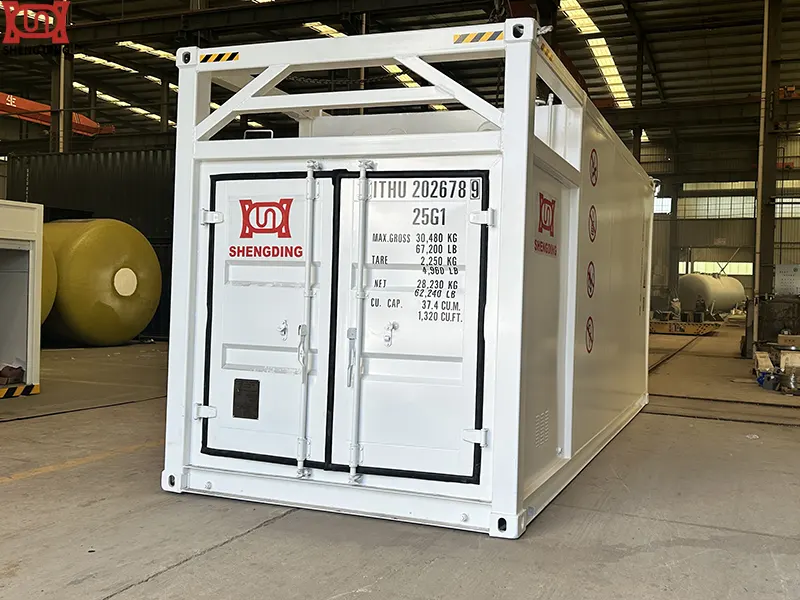
- Do you provide 20ft and 40ft containerized units as well as open skids?
- Can you customize the number of dispensing points, hose lengths, and pump flow rates?
- Are multi-fuel configurations available (diesel, gasoline, biofuels, or even future hydrogen blending)?
Why it matters:
A construction site with five excavators needs a different configuration than a logistics depot with 50 trucks. Choosing the wrong capacity either strands capital or forces frequent, costly refills. Additionally, investing in multi-energy-ready equipment protects you against future fuel transitions.
Red flag: "We only offer standard models" - no customization indicates limited engineering capability.
4. Which of the 9 Essential Safety Systems Are Included as Standard?
Safety systems are where corners are most often cut. Ask for a clear, line by line breakdown.
What to ask:
- Is the barrier explosion-proof fill standard in all tanks?
- Do you include automatic fire suppression (activation <=95oC)?
- Is there an emergency pressure relief device and high-temperature automatic shut-off valve?
- Is the tank double-walled with a continuous leak detection system?
- Do you provide vapor recovery, ESD (emergency shut-down), and static grounding with alarms?
Why it matters:
These nine systems are mandated by GB 50156-2021 and SH/T 3134-2023. According to the 2025 revision, skid-mounted units must achieve "plug-and-play, one-touch start-stop" functionality - a requirement that eliminated about 30% of traditional manual-weld assemblers. Safety is non-negotiable for both regulatory compliance and operational peace of mind.
Red flag: "We can add those as options at extra cost" - critical safety features should never be optional.
5. Does Your System Include Smart Monitoring and IoT Capabilities?
In 2026, "dumb" equipment is obsolete. Smart features directly impact your operational costs.
What to ask:
- Does the system include remote tank level monitoring with real-time data accessible via app or web portal?
- Are there IC card or license plate recognition systems for usage tracking?
- Does the system provide fault self-diagnosis and predictive maintenance alerts?
- Can the data integrate with my existing fleet management or ERP system?
Why it matters:
Smart equipment with IoT monitoring commands a purchase premium of 12% to 18% - but delivers 23% savings in operation and maintenance costs over its lifecycle. The penetration of intelligent units has already exceeded 60% in 2026. Without these features, you're flying blind on inventory, risking fuel theft, and missing preventative maintenance windows.
Red flag: "We don't do smart systems; they're too complicated" - the supplier is lagging behind the industry.
6. How Is the Station Packaged and Shipped for International Transport?
Logistics can make or break your project budget and timeline.
What to ask:
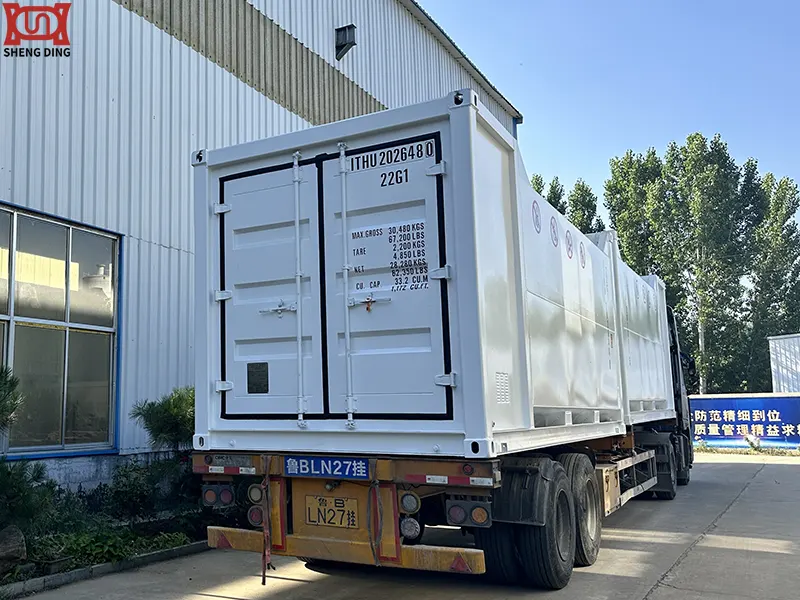
- For containerized units, does the container hold a valid CSC (Container Safety Convention) plate?
- For open skids, what shipping methods do you recommend (flat-rack, break-bulk, RO-RO)?
- Are the tanks drained, cleaned, and vented for safe ocean transport?
- Do you provide fumigation-compliant wooden crates for sensitive components?
Why it matters:
In 2025, China's exports of barrier explosion-proof skid-mounted stations grew by 41% year-over-year. A containerized unit with a CSC plate ships as standard ISO freight - drastically lowering ocean rates and simplifying port handling. Improper packaging leads to damage in transit and customs clearance headaches.
Red flag: The supplier is vague about shipping details or cannot provide recent Bill of Lading examples.
7. What On-Site Support Do You Provide for Installation and Commissioning?
Even the best equipment is useless if it sits in a crate because you can't get it installed.
What to ask:
- Do you provide detailed installation drawings and foundation specifications?
- Can you send a technician for on-site commissioning or supervision?
- Do you offer remote installation guidance via video call for overseas customers?
- What is the typical lead time from order to delivery, and from delivery to first dispense?
Why it matters:
A standard installation takes 7-15 days from pad readiness, but complications with utilities or local inspectors can stretch that timeline. Suppliers with strong technical support teams - including remote diagnostics - help you get operational faster. Some leading manufacturers now offer "plug-and-play" commissioning where the unit is tested and ready to dispense within 48 hours of site power and fuel connection.
Red flag: "You can figure it out yourself with the manual" - insufficient technical support signals limited after-sales commitment.
8. What Is Your Warranty and After-Sales Service Policy?
Long-term support is where true supplier value emerges.
What to ask:
- What is the warranty period for the tank, dispenser, electronics, and safety systems?
- Do you have spare parts inventory available for quick dispatch?
- What is your response time for emergency technical support?
- Do you offer extended service contracts or preventative maintenance visits?
Why it matters:
Double-wall tanks and safety systems are built to last 8-10 years, but pumps, meters, and electronics require periodic replacement. A supplier with local distributors or global shipping partnerships ensures you aren't waiting weeks for a critical spare part. Full-chain manufacturers typically offer better warranty terms because they control the entire production line and can quickly diagnose issues.
Red flag: Warranty is only 6 months, or the supplier cannot show a parts catalog.
9. What Does Your Quotation Actually Include - and What Are the Hidden Costs?
Price comparisons are meaningless without understanding what's included.
What to ask:
- Does the quoted price include factory testing, certification fees, and export packaging?
- Are freight, insurance, and customs duties quoted separately, or included in the FOB/CIF price?
- Does the price cover on-site installation, staff training, and local inspection assistance?
- Are there additional costs for software licensing (IoT platform) or extended warranties?
Why it matters:
The cheapest quote often arrives with a long list of "extras" - freight surcharges, certification paperwork fees, training costs, and commissioning charges. A transparent supplier provides a complete landed-cost breakdown. When comparing quotes, look beyond the unit price and calculate the total cost of ownership (TCO) over 5 years, including operation, maintenance, and energy losses.
Red flag: The quotation is a single line item with no breakdown; the supplier evades questions about additional fees.
10. Can You Provide References and Case Studies in My Industry?
Proof of performance trumps all marketing claims.
What to ask:
- Can you share case studies from customers in my industry (mining, logistics, ports, construction, etc.)?
- Do you have video testimonials or site visit references I can contact?
- How many units have you supplied to clients in my region?
- What were the operational results (fuel savings, downtime reduction) for those customers?
Why it matters:
A track record in your specific application reduces your risk significantly. For example, a mining operation in Northern Chile has different requirements (dust, altitude, remote access) than a port in Singapore (salt air, high humidity, space constraints). Suppliers who have solved similar challenges can offer proven solutions rather than theoretical proposals. In 2025, manufacturers with international references saw overseas orders account for over 35% of total business.
Red flag: "We can't share customer information due to confidentiality" - legitimate suppliers have anonymized case studies or willing references.
Quick Reference: 10-Question Summary Checklist
| # | Question | Critical Checkpoint |
| 1 | Certifications | GB 50156, NFPA 30A, ATEX/IECEx, AQ 3002 |
| 2 | Manufacturing depth | Full-chain vs. assembly shop |
| 3 | Capacity & configuration | Customization options, multi-fuel readiness |
| 4 | Safety systems | All 9 essential systems as standard |
| 5 | Smart/IoT features | Remote monitoring, IC card, self-diagnosis |
| 6 | Transport & packaging | CSC plate (for containers), shipping method clarity |
| 7 | Installation support | Drawings, on-site or remote commissioning |
| 8 | Warranty & after-sales | Spare parts availability, response time |
| 9 | Pricing transparency | Complete landed-cost breakdown, TCO clarity |
| 10 | References & case studies | Industry-matched proven performance |
Conclusion
Choosing a skid-mounted fuel station in 2026 is about more than picking a tank and a pump. It's about selecting a long-term partner who ensures regulatory compliance, delivers intelligent efficiency, and provides reliable support across the equipment's lifecycle.
By asking these 10 questions, you'll:
- Filter out unqualified assembly shops and fly-by-night operators
- Secure the best value - not just the lowest price
- Ensure your station is safe, smart, and ready for the evolving energy landscape
- Build a transparent relationship with a supplier who stands behind their product
Take your time, ask every question, and request written responses. A reputable supplier will welcome your due diligence - because they know their quality speaks for itself.
Ready to select the right skid-mounted fuel station for your operation? Contact Shengding Container for transparent quotations, factory visits, and customized solutions backed by full-chain manufacturing expertise.
Written by
TAIAN SHENGDING METAL CONTAINER MANUFACTURING CO., LTD.
Editor Wang
WhatsApp:+86 152 5486 3111
Email:shengdingtank@126.com


- WhatsApp
- E-MailE-Mail:shengdingtank@126.com
- WeChatWeChat:15254863111