Seven Key Precautions for Using Skid-Mounted Fuel Stations in High-Temperature Areas


In high-temperature climates, continuous exposure to sunlight and soaring temperatures significantly exacerbate the temperature rise of skid-mounted fuel station tanks, fuel expansion, and accelerated vaporization. This can easily lead to various safety hazards such as excessive tank pressure, aging and leakage of seals, overheating of electrical equipment, and static electricity buildup, greatly increasing the probability of fires, explosions, and fuel leaks. As integrated and modular refueling equipment, skid-mounted fuel stations have limited adaptability to high-temperature environments. Inadequate maintenance and protection, or improper operation, can easily result in safety vulnerabilities. To comprehensively mitigate the risks of high-temperature operation, standardize on-site operating procedures, strengthen equipment protection and control, and solidify the safety production line, based on the climatic characteristics of high-temperature areas and the safety operation specifications for skid-mounted fuel stations, the following seven core safety precautions for using skid-mounted fuel stations in high-temperature environments are hereby clarified.
1. Factors to Consider When Choosing a skid-mounted fuel Station in High-Temperature Areas
1.1. Lighting Equipment
- All lighting fixtures should be explosion-proof and high-temperature resistant, with an operating environment temperature tolerance >=80oC.
- The lamp body and lampshade are made of heat-resistant and flame-retardant materials to prevent aging and cracking due to exposure to sunlight; incandescent lamps and ordinary LED lamps are prohibited.
- Layout: Full coverage of the tank area, fuel dispensers, and unloading area; the horizontal distance between the lamps and the tank body/fuel inlet is >=1.5m.
1.2. Switches, Buttons, Junction Boxes
- Explosion-proof junction boxes, explosion-proof buttons, and explosion-proof switches are selected, with housing temperature resistance >=70oC.
- Internal wiring terminals use high-temperature resistant insulation components (temperature resistance >=100oC) to prevent softening, leakage, and short circuits due to high temperatures.
- All enclosure sealing rings are made of fluororubber, suitable for high-temperature operating conditions, preventing oil and gas penetration and rainwater intrusion.
1.3. Power and Control Equipment
- The entire system is placed in a dedicated explosion-proof control cabinet with sunshade and ventilation, and the cabinet is equipped with a heat insulation cover/sunshade.
- Forced cooling within the cabinet: Standard configuration includes an industrial cooling fan and heat dissipation channels. The fan automatically starts and stops when the ambient temperature is >=38oC.
- Temperature controllers, pressure gauges, and oil/gas detectors: Explosion-proof and high-temperature resistant types are selected, with an operating temperature range of -20oC to 70oC. Data drift is eliminated at high temperatures, and alarm accuracy deviation is <=+-1%.
1.4. Motors and Oil Pumps
- Fuel dispenser motors and oil pump motors: Explosion-proof rating Ex d II BT4, insulation class not lower than F (temperature resistance 155oC).
- Motor housing is heat-insulated to prevent direct sunlight exposure; continuous full-load operation is prohibited during high-temperature periods.
1.5. Monitoring and Communication Equipment
- Cameras, audible and visual alarms, and intercom equipment: Must be explosion-proof, with a housing temperature resistance >=75oC.
- Cable interfaces are explosion-proof sealed; wiring must not be exposed.
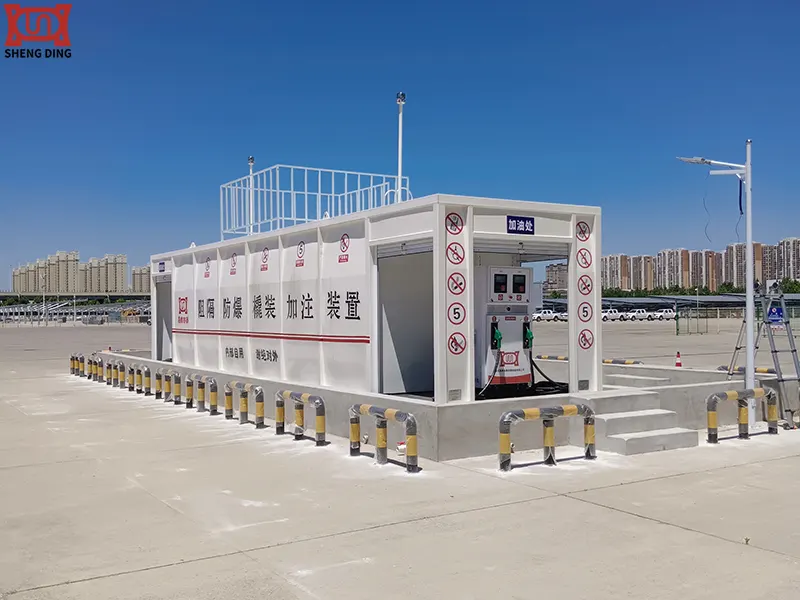
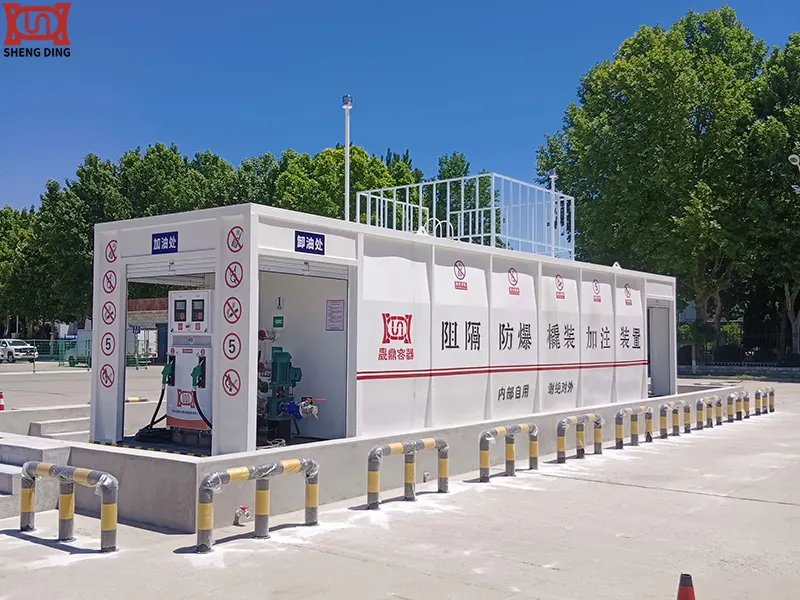
2. Basic Requirements for Skid-Mounted Fuel Station Installation in High-Temperature Areas
- Sunshading and Heat Insulation: All outdoor electrical equipment must be fully covered with sunshades to prevent exposure to direct sunlight. Control cabinets and instrument boxes must be at least 1.2m above the ground, away from ground heat radiation.
- Ventilation and Heat Dissipation: Explosion-proof control cabinets and electrical rooms must be well-ventilated, and ventilation openings must not be blocked by debris; sealed cabinets must not be operated in a closed environment at high temperatures for extended periods.
- Spacing Requirements: The horizontal distance between electrical equipment and hazardous sources such as oil tanks, fuel dispensers, and unloading ports must be at least 1m to reduce the risk of oil and gas contact.
3. Seven Precautions for Using Skid-Mounted Fuel Stations in High-Temperature Environments
3.1. Tank and Oil/Gas Temperature Control
- Upper Limit of Safe Temperature: Oil temperature inside the tank <=45oC, tank surface temperature <=60oC; forced cooling should be initiated when the ambient temperature >=38oC.
- Sunshading: A sunshade canopy should be installed above the tank, providing 100% sun protection, which can reduce the ambient temperature by 8-12oC.
- Spraying: Automatic/manual spraying system; water temperature <=30oC; spraying intensity 5-8 L/(m2*h); cooling capacity 5-7oC.
- Ventilation: Side ventilation louvers in the tank area; ventilation rate >=2 times/minute.
- Monitoring Frequency: Manual temperature measurement daily at 8:00/14:00/20:00; comparison with DCS automatic data; alarm for deviation > +-2oC.
3.2. Pressure and Breathing Valve Safety Management
- Working Pressure: Atmospheric pressure inside the tank; breather valve setting: +1.96 kPa/-0.49 kPa (vacuum).
- High Temperature Pressure Rise Limit: For every 10oC increase in oil temperature, vapor pressure increases by approximately 30%; when the ambient temperature is >=40oC, pressure is recorded every 2 hours; pressure relief is initiated if it exceeds +1.5 kPa.
- Breathing Valve Maintenance: Check weekly; check every 3 days when the air temperature is >=35oC; ensure no blockages, jamming, and intact seals.
3.3. Oil and Gas Evaporation and Explosion Prevention
- Evaporation Control: At high temperatures of 38-45oC, the daily gasoline evaporation is approximately 0.3%-0.5% of the tank volume; tank pressure control, minimizing breathing frequency, and closed-loop operation are necessary.
- Explosion-proof Barrier: The tank is filled with aluminum alloy explosion-proof barrier material at a density of 25-30 kg/m3, which can suppress deflagration and reduce evaporation by 20%-30%.
- Oil and Gas Concentration: The oil and gas concentration in the tank area should be <=25% LEL; exceeding this limit triggers an alarm. One combustible gas detector is installed every 50m2, 0.3-0.6 m above the ground.
3.4. High-Temperature Safety Accessories and Automatic Protection
- High-Temperature Oil Shut-off Valve: Mandatory installation on the oil outlet pipeline; automatically shuts off at 70oC+-3oC, fully closing within 1-3 seconds; manual reset is required.
- Emergency Pressure Relief: The pressure relief valve is set at +2.5 kPa, with a relief capacity >=0.1 m3/min, preventing overpressure and tank expansion.
- Automatic Fire Extinguishing: Equipped with dry powder/foam automatic fire extinguishing devices inside the tank/tank area, with an activation temperature of 68oC and a spraying time >=30 seconds.
- Overflow Prevention: High liquid level alarm (90% tank capacity), emergency shut-off, accuracy <=+-1%.
3.5. Static Electricity and Lightning Protection Grounding
- Grounding Resistance: Grounding resistance of tank body, fuel dispenser, pipelines, and unloading area <=4 ohm; tested monthly during high-temperature seasons, and mandatory after thunderstorms.
- Bridging and Static Electricity Prevention: Pipeline flange bridging resistance <=0.03 ohm; Static electricity grounding alarm installed in the unloading area; unloading is prohibited if grounding is poor.
- Lightning Protection: Lightning rod protection covers the entire equipment, grounding resistance <=10 ohm; refueling is suspended and non-essential electrical appliances are turned off during thunderstorms.
3.6. Equipment Aging and Sealing Protection
- Seals: Temperatures >=35oC accelerate rubber aging; seals and gaskets are inspected every 3 months and must be replaced every 6 months; material selected is fluororubber (temperature resistance -20oC-200oC).
- Pipelines and Hose: Fuel dispenser hoses must withstand temperatures >=80oC, with no cracks, bulges, or leaks; inspect every two weeks, and replace immediately if damaged.
- Corrosion Protection: Tank anti-corrosion coating must be intact; it is prone to cracking under high temperatures and dryness; inspect monthly, and repair any peeling exceeding 5%.
3.7. High-Temperature Operations and Inspection Management
- Operating Hours: Avoid peak high-temperature periods of 11:00-16:00; prioritize unloading between 20:00-8:00 the next day, when oil temperature <=38oC.
- Inspection Frequency: Twice daily at normal temperatures, once every 2 hours at high temperatures; focus on checking temperature, pressure, leaks, grounding, and fire-fighting equipment.
- Personnel Protection: Wear anti-static work clothes, high-temperature resistant shoes, goggles, and oil-resistant gloves; avoid prolonged outdoor work at midday to prevent heatstroke.
- Emergency Plan: If the temperature exceeds 45oC or the oil/gas concentration exceeds the standard, immediately stop operations, activate the sprinkler system, and evacuate personnel; conduct drills once per quarter.
4. Key Data Overview
| Item | Safety Threshold | High Temperature Enhancement Requirements |
| Tank Inlet Oil Temperature | <=45oC | Spray/Shading Activation at >=38oC |
| Tank Surface Temperature | <=60oC | Shading Cooling 8-12oC |
| Tank Inlet Pressure | -0.49-+1.96 kPa | Recorded every 2 hours at >=40oC |
| Grounding Resistance | <=4 ohm | Monthly Testing During High-Temperature Season |
| Oil Gas Concentration | <=25% LEL | 1 Detector per 50m2 |
| Fuel Cut-off Valve Operating Temperature | 70oC+-3oC | Full Closure within 1-3 seconds |
5. Skid-Mounted Fuel Station Tank Body Protection
5.1. Full-Area Sunshade Protection
- Construct a fixed sunshade/heat-insulating awning to fully cover the tank, fuel dispenser, and unloading port. The awning material should be flame-retardant, heat-insulating color steel plate with a reflective coating. This can reduce the equipment surface temperature by 8-12oC, preventing a sudden rise in oil temperature caused by direct sunlight.
- Requirements: The net distance between the awning and the top of the tank must be >=0.8m to ensure ventilation and heat dissipation. Completely sealing the tank is strictly prohibited.
5.2. Automatic Spray Cooling System
- Spray pipes surround the outside of the tank, equipped with a temperature-sensing linkage device.
- Set trigger temperature: Automatic start at ambient temperature >=38oC, spray water temperature <=30oC, spray intensity 5-8L/(m2*h), continuous cooling of 5-7oC.
- A spare manual spray valve is provided. Daily testing is conducted to ensure the pipes are unobstructed and the spray nozzles are not blocked.
5.3. Explosion-proof Barrier + Sealed Anti-Volatile Material
- The aluminum alloy explosion-proof barrier material inside the tank remains intact, with a filling density of 25-30 kg/m3, suppressing oil and gas deflagration and reducing volatilization by 20%-30%.
- The tank opening and manhole cover are fully sealed. During high-temperature periods, minimize the frequency of opening the covers to reduce oil and gas spillage.
6. Protection of Piping and Sealing Components in Skid-Mounted Gas Stations
6.1. Pipe and Hose Selection
- The oil delivery steel pipe is insulated and wrapped; fuel dispensers and unloading hoses must use oil-resistant and flame-retardant rubber hoses with a temperature resistance of >=80oC. Ordinary rubber hoses are prohibited.
- Rubber ages faster at high temperatures. Visual inspections are conducted every two weeks; any hoses showing cracks, bulges, or softening must be replaced immediately.
6.2. Enhanced Sealing Protection
- Flanges, valves, interfaces, and breather valve gaskets are all replaced with fluororubber (temperature resistance range -20oC-200oC).
- Inspection Cycle: A comprehensive inspection of sealing points is conducted every 3 weeks. All gaskets and sealing rings must be replaced every 6 months to prevent high-temperature oil and gas leaks.
6.3. Pipeline Thermal Insulation Protection
- Exposed outdoor oil pipelines are wrapped with flame-retardant thermal insulation cotton to prevent heat conduction and avoid oil expansion and pressure increases within the pipeline.
7. Special Protection for Skid-Mounted Fuel Station Safety Accessories
7.1. Temperature-Sensing Emergency Shut-Off Valve
- High-temperature shut-off valves are installed on the main oil outlet and unloading pipelines. The activation threshold is 70oC+-3oC, requiring complete shut-off of the oil circuit within 1-3 seconds. The opening and closing function is simulated and tested daily.
7.2. Double Protection with Breather Valve + Pressure Relief Valve
- Breather valve settings: Positive pressure opening +1.96kPa, negative pressure opening -0.49kPa; Overpressure relief valve setting +2.5kPa.
- During high-temperature seasons (temperature >=35oC), inspect every 3 days, cleaning oil and debris from the valve body to prevent jamming and failure.
7.3. Liquid Level/Pressure/Oil/Gas Monitoring and Protection
- Combustible gas detectors are installed at a rate of one unit per 50m2, with an installation height of 0.3-0.6m above the ground. The alarm threshold is <=25%LEL, and sensitivity is calibrated daily.
- Tank pressure and oil temperature are monitored online in real time. Automatic audible and visual alarms are triggered if the data deviation exceeds +-2oC.
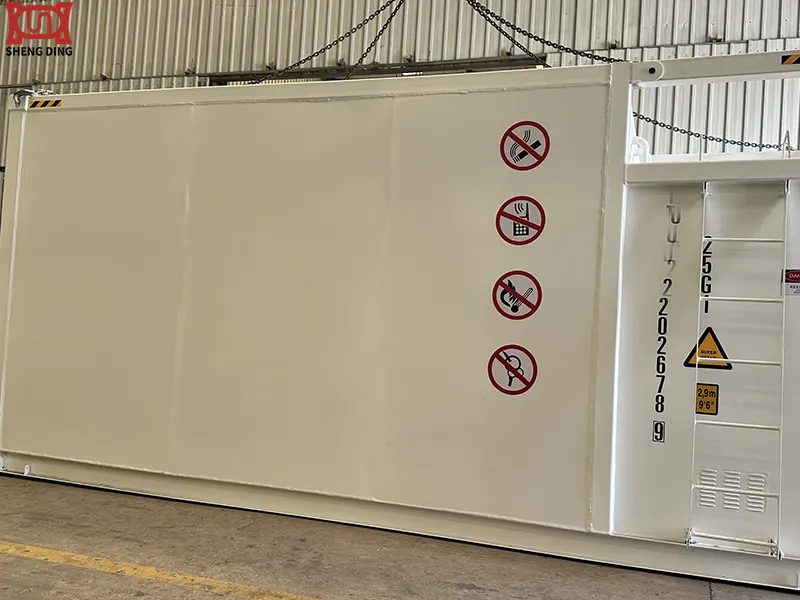
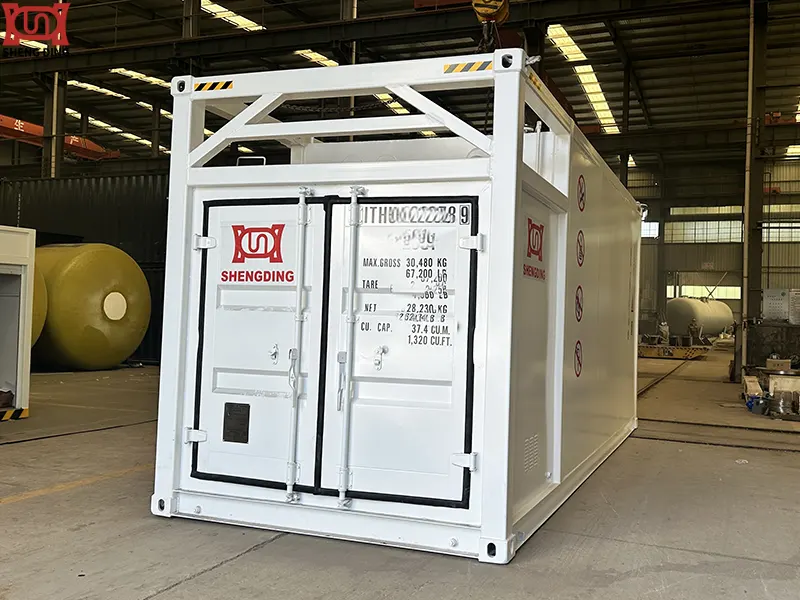
8. Explosion-proof and Heat-insulating Protection for Skid-mounted Fuel Station Electrical Equipment
8.1. Explosion-proof Rating Compliance
- All motors, switches, lights, and junction boxes in the station are of Ex d II BT4 or higher explosion-proof type. Heat insulation covers are installed on the casings to prevent overheating from direct sunlight from affecting electrical performance.
- Electrical terminals are protected with high-temperature resistant insulation. Exposed or aged wiring is strictly prohibited.
8.2. Power Distribution and Heat Dissipation
- Distribution boxes and control cabinets are placed in shaded and ventilated areas, with cooling fans installed inside. Avoid prolonged full-load operation of equipment during high-temperature periods. Check wiring daily for softening or overheating.
9. Enhanced Lightning and Static Electricity Protection for Skid-Mounted Fuel Stations
9.1. Reinforced Grounding System
- The tank, fuel dispenser, oil pipeline, unloading arm, and sunshade shall be independently grounded, with a grounding resistance <=4ohm; lightning protection grounding resistance <=10ohm.
- Requirements: Grounding resistance shall be tested monthly in high-temperature, dry environments, and must be tested after thunderstorms; equipotential bonding shall be applied to both ends of flanges and hoses, with a bonding resistance <=0.03ohm.
9.2. Static Electricity Protection
- A static electricity grounding alarm shall be permanently installed in the unloading area. Unloading operations are strictly prohibited if the grounding is not connected or the alarm is not deactivated.
- All personnel shall wear anti-static work clothes and anti-static shoes; synthetic fiber clothing is prohibited.
In summary, the safe operation of skid-mounted fuel stations in high-temperature areas hinges on seven key aspects: temperature and pressure control, explosion and leak prevention, equipment protection, electrical management, lightning and static electricity protection, aging maintenance, and standardized operations. High temperatures pose the greatest challenge to the safe operation of skid-mounted fuel stations, as various equipment hazards and operational risks amplify with rising temperatures. Routine maintenance requires strict implementation of all high-temperature protection and control measures, increased inspection frequency, adherence to operating procedures, timely identification and rectification of potential hazards, and routine equipment maintenance and emergency preparedness. Through comprehensive and meticulous safety management, we can effectively mitigate various safety risks brought about by high-temperature environments, prevent accidents from occurring at the source, and ensure the continuous, stable, safe, and compliant operation of skid-mounted fuel stations in high-temperature areas.
Written by
TAIAN SHENGDING METAL CONTAINER MANUFACTURING CO., LTD.
Editor Wang
WhatsApp:+86 152 5486 3111
Email:shengdingtank@126.com


- WhatsApp
- E-MailE-Mail:shengdingtank@126.com
- WeChatWeChat:15254863111