The 9 Important Considerations for Installing SF Double-Wall Oil Tanks in Africa


Shengding SF double-wall oil tanks, with their excellent resistance to high temperatures, salt corrosion, and leaks and explosions, are widely used in various oil storage scenarios in Africa, including gas stations, mining infrastructure, and logistics depots. Africa's complex climate and geology present numerous unique challenges, such as equatorial heat and exposure, coastal high-salt corrosion, rapid rises in groundwater levels during the rainy season, frequent thunderstorms and static electricity, and limited local infrastructure, creating significant differences from conventional installation environments in China. To avoid common construction hazards such as tank floating, fiberglass damage, pipeline leaks, inadequate grounding, and failure to pass environmental impact assessments, and to ensure the long-term stable operation, compliance, and 30-year service life of Shengding SF double-wall oil tanks in African projects, the following nine specific installation considerations have been formulated, strictly adapting to the extreme working conditions and local petroleum environmental protection installation standards in Africa.
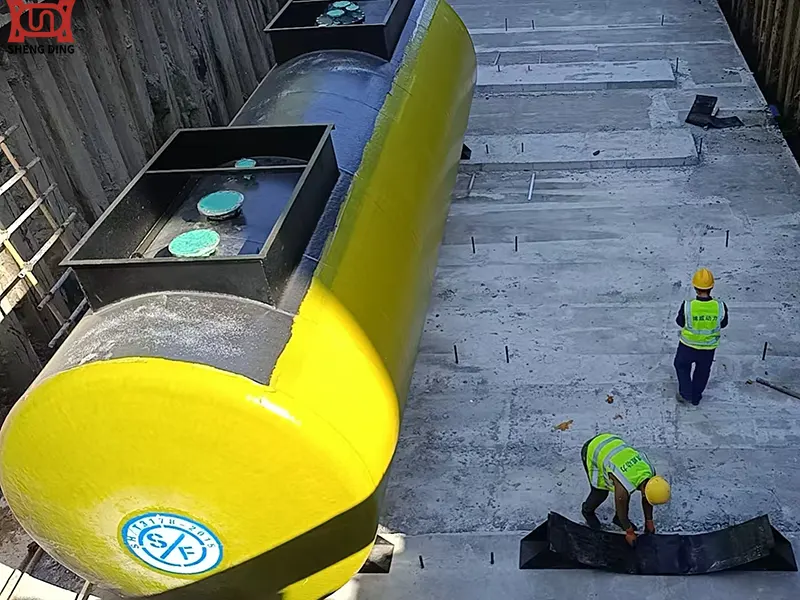
1. What is an SF double-wall oil tank?
1.1. Full Name and Definition
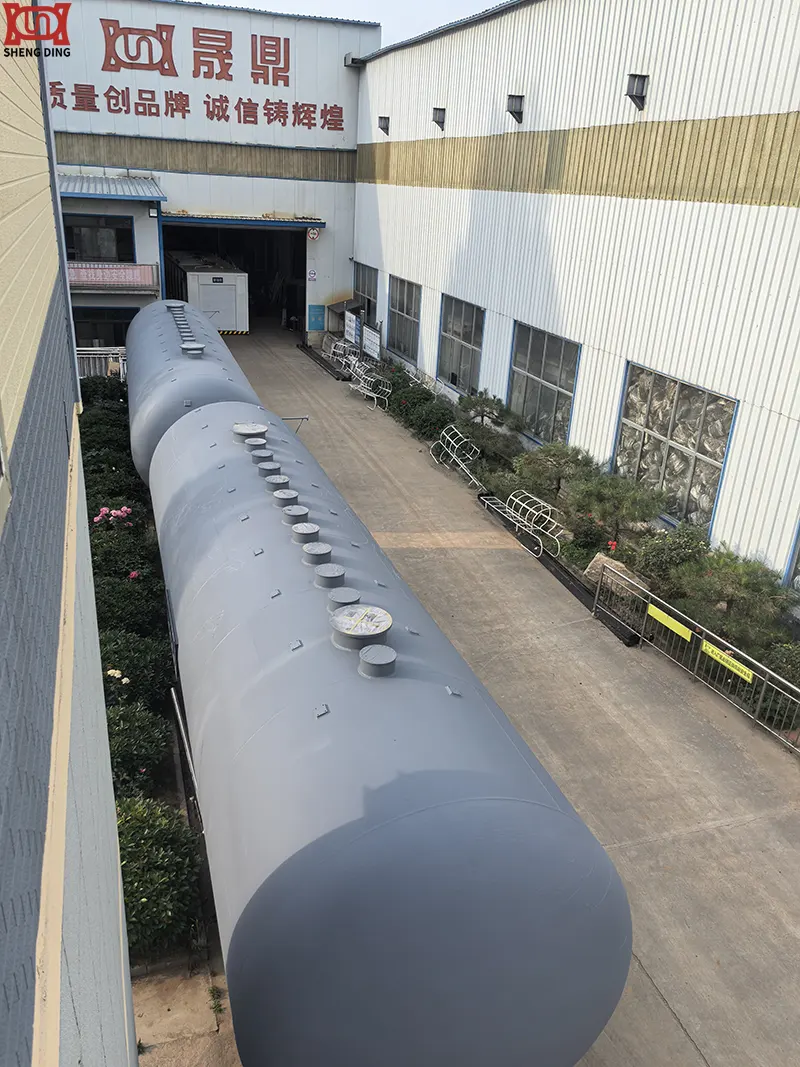
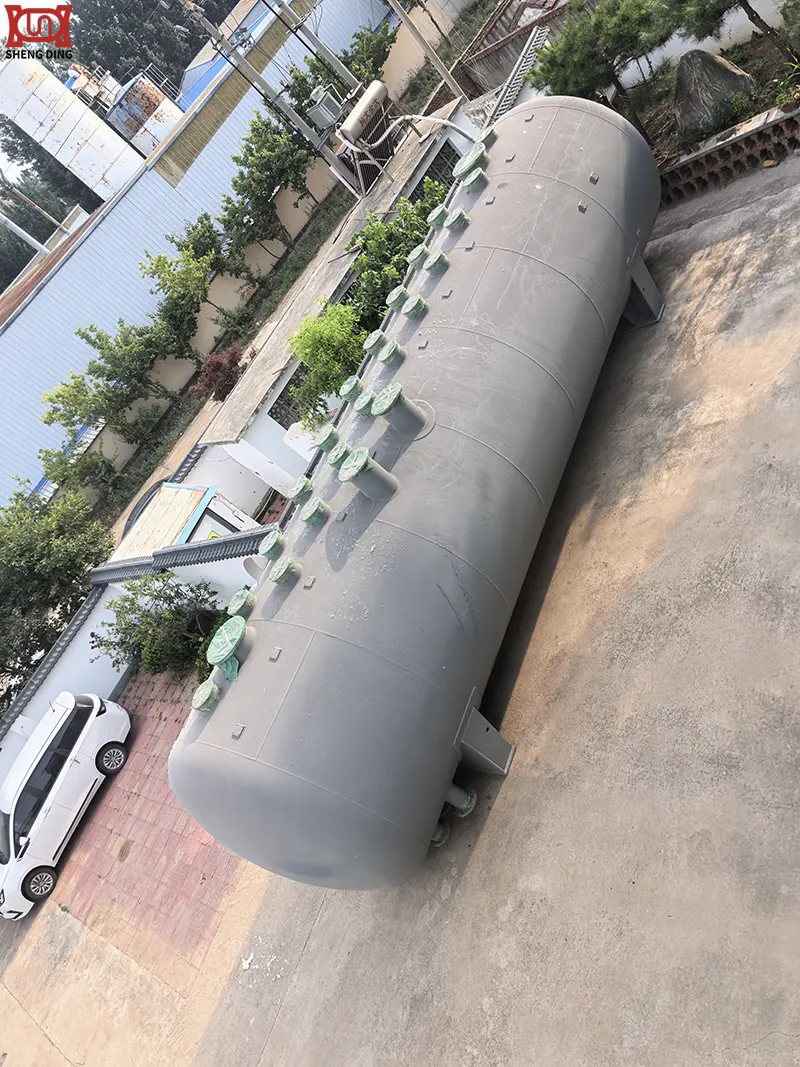
SF = Steel-FRP, a double-walled underground oil storage tank with a steel inner tank and a glass fiber reinforced plastic (FRP) outer tank. Industry abbreviation: SF double-walled tank. National Standard No.: JC/T2286-2014; Gas Station Specification GB50156-2021.
1.2. Core Structure
- Inner Layer S: Material: Q235-B carbon steel, standard wall thickness 6-8mm, with internal reinforcing rings, can be single-compartment or multi-compartment, used for storing gasoline, diesel, and methanol fuel; inner wall epoxy zinc-rich heavy-duty anti-corrosion treatment, resistant to oil corrosion.
- Outer Layer F: Integral spiral wound molding, wall thickness >=4mm; insulating and non-conductive, isolating from electrochemical corrosion caused by soil, groundwater, and saline-alkali; resistant to pressure, soil pressure, settlement, and tearing.
- Continuous Through-Cavity: A continuous, 0.1-3.5mm through-cavity is uniformly maintained between the inner and outer tanks, eliminating dead zones. The bottom is connected to a leak detection pipeline for continuous leak monitoring.
- Equipped Leak Monitoring System: A dual-mode monitoring unit (dry vacuum/wet level) provides 24-hour real-time monitoring. In case of oil leakage from the inner tank or water ingress from a damaged outer tank, the equipment immediately triggers an audible and visual alarm to prevent oil from seeping into the soil or water sources.
1.3. Working Leak Prevention Principle
- Inner Tank Leakage: Oil flows into the interlayer. The monitoring probe senses the level/pressure and triggers an alarm. The oil remains within the interlayer and will not leak out or contaminate the soil.
- Outer Fiberglass Damage: Groundwater seeps into the interlayer, also triggering an alarm. This will not corrode the inner steel tank.
- Double-layer physical isolation completely solves the environmental problems of corrosion and leakage, soil and groundwater pollution associated with traditional single-layer steel tanks buried underground.
2. Five Core Advantages
- Superior Corrosion Resistance and Long Lifespan: Fiberglass insulation eliminates electrolytic corrosion; while ordinary single-layer steel tanks have a buried lifespan of 8-10 years, SF double-layer tanks are designed for a lifespan of >=30 years, making them highly adaptable to coastal high-salt and alkaline environments and high-temperature, high-salt soils in Africa.
- Safe, Explosion-Proof, and Leak-Proof: Double-layer barrier + 24/7 leak alarm mitigates the risks of oil spills, fires, and soil pollution, meeting the mandatory environmental standards for gas stations in various countries.
- Lightweight and Easy to Construct: Compared to all-steel SS double-layer tanks, the weight is significantly reduced, resulting in lower costs for hoisting, backfilling, and transportation. No need to construct a leak-proof concrete tank pool; direct burial is possible.
- Extremely Low Operation and Maintenance Costs: No cathodic corrosion protection required; only annual interlayer vacuum pressure testing; readily available and interchangeable parts.
- Optimal Cost-Effectiveness: Compared to FF all-fiberglass double-walled tanks, it has a lower cost, superior strength compared to fiberglass tanks, and superior corrosion resistance compared to all-steel SS tanks, making it the mainstream choice for gas stations and self-operated gas stations worldwide.
3. Nine Important Considerations for Installing SF Double-Walled Tanks in Africa
3.1. Pre-Export Compliance and Tank-Specific Factory Adaptation
- Complete Certification Documents: SONCAP certification is required for West Africa (Nigeria), and PVoC/COC certification is required for East Africa (Kenya/Tanzania). Both are indispensable; failure to comply will result in detention and fines upon arrival at the port. A complete set of factory documentation is required for the tank: interlayer sealing test report, fiberglass weathering salt spray test report, steel plate material certificate, welding non-destructive testing report, Chinese and English MSDS, and volume calibration table.
- Enhanced Tank Environmental Resistance: In coastal high-salt soil areas, the outer fiberglass layer is thickened to >=5mm; in inland high-temperature desert areas, an additional UV-resistant surface coating is added. The inner steel tank undergoes epoxy zinc-rich heavy-duty anti-corrosion treatment, with a 0.5mm corrosion allowance to meet the long-term burial requirements of acidic and saline-alkali soils in Africa.
- Customized High-Temperature Accessories: Breathing valves, leak detectors, and sealing strips are selected to withstand temperatures above 45oC. Ordinary domestic accessories are prone to aging and cracking in equatorial regions within 3-6 months.
3.2. Site Survey and Specialized Foundation Settlement and Buoyancy Control Treatment
- Mandatory Soil Testing: Differentiating between three types of areas-highly corrosive soft soil in coastal mangrove forests, red clay during the rainy season, and loose sandy soil in deserts; in soft soil areas, C30 reinforced concrete foundations with a bearing capacity >=120kPa are used, and settlement observation points are added.
- Forced Anti-buoyancy Design: During Africa's rainy season, short-term torrential rains and soaring groundwater levels can easily cause empty tanks to float and tear pipelines. Anti-buoyancy anchors/counterweight concrete blocks are used, and a 1.5mm HDPE impermeable membrane is laid at the bottom of the pit to prevent groundwater corrosion of the foundation.
- Pit Drainage System: A ring-shaped drainage ditch is excavated around the pit, and a gravel filter layer is laid at the bottom. In desert areas, a collection well is added for pumping out water; this prevents prolonged immersion of the tank pit by rainwater.
3.3. Strict Control of Backfill Materials for the Pit, Adapted to Complex African Soil:
- Local sea sand, red clay, and mixed soil containing stones are prohibited for backfilling: Sea sand contains chloride ions that corrode the fiberglass outer layer, and red clay expands when exposed to water, causing deformation of the tank. Only clean, neutral river sand/fine pebbles with a particle size < 3mm and free of sharp or hard objects are used for backfilling.
- Layered Compaction Standard: Water should be sprayed and compacted in 30cm layers, with a compaction coefficient >=95%; backfilling should be done simultaneously on both sides of the tank, with a height difference of no more than 20cm between sides to prevent lateral displacement of the tank.
- Top Covering: The top cover thickness should be >=80cm. Direct burial of construction waste and large rocks is prohibited. In windy and sandy areas, sandbags should be added to the top layer to stabilize the soil and prevent rainwater erosion of the exposed tank.
3.4. Lifting and Tank Protection
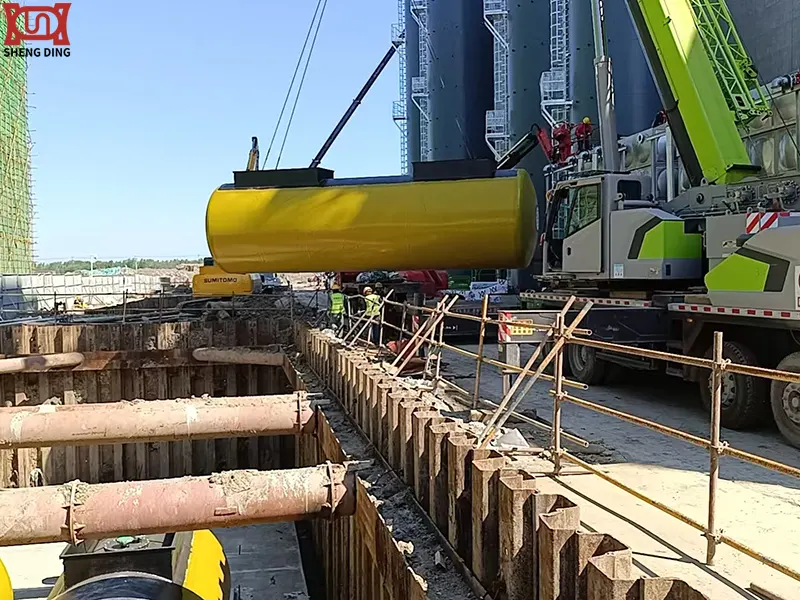
- Lifting Lug Stress: It is strictly forbidden to bind the FRP outer wall during lifting. Use soft synthetic fiber slings. Steel wire ropes must not directly contact the outer layer of the tank to prevent scratching the FRP anti-corrosion layer; the tank body should be wrapped with rubber protective pads during lifting.
- Inspection for Damage During Shipping: Upon arrival at the construction site, a full visual inspection of the tank is required. Scratches and damage to the FRP must be repaired and cured on-site with resin before lowering the tank into the pit; a vacuum pressure test should be performed on the interlayer beforehand, maintaining pressure for 30 minutes without pressure drop to be considered (qualified).
- Off-peak construction during high-temperature periods: In Africa, daytime surface temperatures exceed 45¡ãC. Hoisting and fiberglass repair work is only permitted between 6-10 AM and after 4 PM. High temperatures and direct sunlight can cause resin curing failure and softening/deformation of the adhesive strips.
3.5. Lightning protection, static electricity prevention, and equipotential grounding
- Desert high-resistivity soil resistance reduction solution: The resistivity of arid sandy soil in Africa is extremely high, rendering ordinary grounding electrodes ineffective. A multi-set copper grounding electrode + electrolyte resistance-reducing agent grid equipotential grounding network is used. Oil tanks, pipelines, operating wells, and refueling machines are all connected via cross-connection, with a total grounding resistance < 0.03ohm.
- Cross-connection static electricity prevention: Copper conductive plates are installed between flanges of all metal pipes, and static electricity cross-connection is applied to the metal joints at both ends of non-metallic pipes. Gauge holes and manhole covers use copper fittings to prevent sparks from steel friction.
- Lightning protection for ventilation risers: Fire-resistant ventilation risers are >=4m above ground level, with a dedicated lightning arrester installed at the top, and are at least 25m away from prefabricated houses, shrubs, and open flame areas.
3.6. Installation and Adaptation of Double-Layer Interlocking Leakage Monitoring System
- Rain and Sun Protection for Monitoring Host: Due to the high temperature and humidity of open-air operating wells in Africa, the monitoring control cabinet is equipped with a stainless steel rain and sun protection box with built-in desiccant; high-temperature and aging-resistant cables are selected, and the joints are waterproof and sealed.
- No Bending Dead Zones in Interlocking Piping: The interlocking liquid/vacuum conduit is laid smoothly, avoiding 90¡ã bends to prevent high-temperature deformation and blockage; a vacuum pressure test is performed after installation to simulate groundwater immersion conditions during the rainy season.
- Simplified Local Maintenance: Includes an English operation manual; parts are selected based on readily available local models to avoid future repairs without spare parts.
3.7. Pipeline Installation and Sealing High-Temperature Corrosion Resistance Process
- Pipe Material Selection: Seamless anti-corrosion steel pipes or oil-resistant PE composite pipes are used for buried oil pipelines; all welds are sandblasted for corrosion protection; high-temperature resistant fluororubber is used for flange gaskets, as ordinary rubber gaskets harden and leak in the high temperatures of Africa within 1-2 months.
- Flexible Buffer Joints: In areas prone to foundation settlement, metal corrugated pipe compensators are installed on the inlet and outlet oil pipelines to offset soil settlement during the rainy season and the cracking of welds due to thermal expansion and contraction.
- Operating Well Seepage Prevention: The wellhead is integrally cast with concrete, and the inner wall is coated with seepage-proof and anti-corrosion paint. A water pump is installed inside the well to prevent rainwater from flooding valves and monitoring interfaces.
3.8. Local Construction Safety and Pre-positioning of Supporting Materials
- Sufficient On-site Firefighting and Seepage Prevention Materials: Due to the high volatility of oil and gas at high temperatures, each tank area is equipped with dry powder fire extinguishers, oil-absorbing felts, and seepage-proof sandbags; in remote areas where emergency supplies are unavailable, they must be shipped by sea simultaneously with the equipment.
- Hot Work Control: African villages have abundant weeds and are dry and flammable; dry grass and shrubs within 30 meters of the foundation pit are cleared; hot work permits are issued for zoned isolation, with dedicated personnel on duty, and hot work is avoided during the midday heat.
- Local Labor Technical Training: The entire process includes English construction drawings and safety regulations, with a focus on backfilling, double-walled tank pressure testing, and grounding operations. Local workers lack experience in double-walled tank construction; Chinese technical personnel will supervise the entire process.
3.9. Commissioning Pressure Testing and Rainy Season Maintenance Pre-planning:
- Phased Pressure Testing: First, vacuum leak testing of the double-walled tank; then, full pressure testing with clean water for 48 hours to observe settlement; finally, trial oil injection. Adding diesel or gasoline without pressure testing is strictly prohibited.
- High-Temperature Oil and Gas Management: After commissioning, control the oil inlet flow rate to reduce static electricity buildup; regularly clean the breather valve to remove dust blockages; in windy and sandy areas, open the cover monthly for dust removal.
- Long-Term Maintenance Provisions: Construct simple drainage slopes around the tank area; retest soil corrosion and grounding resistance annually in coastal areas; reserve maintenance access to meet future double-walled tank inspection and maintenance needs.
4. Application Prospects of SF Double-Walled Tanks in Africa
- Rapidly Increasing Double-Walled Tank Penetration: Currently, the proportion of double-walled tanks in gas stations in African towns is less than 30%, but this is expected to increase to over 60% in the next 5 years, with a continuously expanding market for retrofitting existing tanks.
- Widespread Adoption of Intelligent Monitoring Systems: SF double-walled tanks with remote IoT alarms are gradually replacing traditional dry-type monitoring units, suitable for unmanned operation and maintenance in mines and remote gas stations.
- Integrated Skid-Mounted + Buried SF Combined Solutions Becoming Mainstream: Skid-mounted refueling machines combined with buried SF storage tanks are being used in mining areas and small suburban stations, enabling rapid modular deployment.
- Environmental Upgrades Driving Product Iteration: Customers are increasingly favoring customized high-salt-resistant and high-temperature-resistant models, reducing the competitiveness of standard tanks.
- Increased Demand for Complete Packages: Customers are no longer purchasing tanks separately, but demanding complete turnkey solutions including tanks, pipelines, monitoring systems, and foundation construction.
5. Case Studies of Shengding SF Double-Wall Oil Tanks in Africa
5.1. Nigeria Chain Private Gas Station Project
5.1.1. Project Overview
- Location: Chain private gas stations in Lagos and Kano, Nigeria (core West African oil market)
- Supply Scale: 68 customized Shengding SF double-wall tanks (20m3 and 30m3) per station, delivered in batches by sea to 12 stations
- Project Timeline: Shipments in 4 batches throughout 2024, all passing inspection by the Nigerian Petroleum Regulatory Authority (DPR)
5.1.2. Africa-Specific Customized Upgrade (Adaptable to Coastal High-Salinity Soils)
- Outer fiberglass layer thickened to 5mm, with added UV-resistant resin layer, resistant to continuous high-temperature exposure at equatorial 45oC;
- Inner tank steel plate thickened to 7mm, with epoxy zinc-rich heavy-duty anti-corrosion double-layer spraying, allowing 0.5mm allowance for salt and alkali corrosion;
- Upgraded high-temperature resistant components: fluororubber flange gaskets, high-temperature breather valve, waterproof and sun-proof leakage monitoring unit;
- Comes with a complete set of SONCAP and COC material reports in both Chinese and English, and a 30-minute vacuum pressure test report for the interlayer, enabling one-time customs clearance and EIA environmental impact assessment approval.
5.1.3. Implementation Challenges and Shengding Solutions
- Local rainy season groundwater levels rise sharply, causing empty tanks to float: Includes Shengding's standardized anti-buoyancy concrete counterweight + foundation pit ring drainage construction drawings, along with nine English installation specifications;
- Local construction workers lack experience with double-layer tanks: Includes a complete English construction manual, and arranges for domestic engineers to provide online video guidance throughout the foundation pit, backfilling, grounding, and pressure testing processes;
- Strong chloride ion corrosion in coastal areas: Abandoning the traditional SS double steel tank solution, the SF fiberglass insulation layer eliminates electrochemical corrosion, saving the long-term maintenance costs of cathodic protection.
5.1.4. Operational Results
Since its commissioning in 2024, all 68 tanks have shown no leakage or outer layer cracking, and the interlayer monitoring system has operated stably. Compared to older single-layer steel tanks in the surrounding area, this avoids hefty fines for oil spills into the soil. The tanks at each station are designed for a service life of up to 30 years, and the local petroleum association has selected these Shengding SF tanks as the standard for new gas stations.
5.2. Self-use Oil Storage Project for a Large Copper-Cobalt Mine in the Democratic Republic of Congo
5.2.1. Project Overview
- Location: Lubumbashi open-pit metal mine in the Democratic Republic of Congo, without centralized municipal oil supply; self-built underground oil storage area in the field.
- Supply Specifications: 42 units of 15m3 Shengding SF double-walled oil tanks, equipped with complete pipelines, lightning protection and anti-static systems, and intelligent remote leakage monitoring equipment.
- Medium Used: Diesel fuel specifically for mining excavators, drilling rigs, and generator sets.
5.2.2. Core Pain Points of the Project and Shengding's Adaptive Solution
- Extremely Long Transportation Chain: Domestic sea freight to Dar es Salaam Port in Tanzania, then 2000km land transport across Zambia into the Democratic Republic of Congo; the entire journey is bumpy and prone to scratching the fiberglass. Shengding's solution uses a thickened rubber protective layer to completely wrap the outer layer of the tanks, reinforced with lifting lugs, and packaged in export-grade wooden frames, ensuring zero tank breakage throughout the entire process.
- Inland red clay expands when exposed to water, and the foundation is prone to settlement: Standardized drawings for C30 reinforced concrete foundations are provided. Neutral river sand is backfilled in layers on both sides of the tank simultaneously. Direct backfilling with local expanding red clay is prohibited.
- Arid sandy soil has extremely high resistivity, posing a high risk of lightning and static electricity fires: A customized multi-set copper grounding electrode + resistance-reducing agent equipotential grounding network is provided. All oil tanks, operating wells, and refueling machines are connected via cross-connection, achieving a grounding resistance of < 0.03ohm.
- The mining area is remote, lacking dedicated personnel for daily inspections: IoT-enabled remote leakage monitoring allows real-time oil leak and water ingress alarms to be received on the customer's headquarters mobile phone, reducing on-site maintenance manpower.
5.2.3. Customer Feedback:
The local mining company originally planned to purchase single-layer steel tanks, but due to Congolese environmental regulations prohibiting single-layer underground oil storage, they switched to a Shengding SF double-layer solution. No leakage alarms occurred in the first year of operation. The failure rate of components in high-temperature outdoor environments is far lower than that of imported European and American tanks, reducing overall procurement and maintenance costs by 40%.
6. Shengding SF Double-Layer Oil Tanks: Core Advantages in Africa
- Customized Adaptation to Africa's Extreme Climate: Thickened FRP for high-temperature and salt spray resistance; different versions produced for coastal, desert, and red clay regions.
- One-Stop Customs Clearance Documentation: Compliant with mandatory certifications for West Africa (SONCAP), East Africa (PVoC), and South Africa (SANS); complete set of bilingual (Chinese and English) test reports to avoid cargo detention upon arrival.
- Complete Technical Delivery: Free provision of foundation pit anti-buoyancy, lightning protection grounding, backfilling construction drawings, and an English manual covering nine installation precautions; online remote technical guidance.
- Low Cost Throughout the Lifecycle: Compared to SS double-walled steel tanks, it eliminates the need for cathodic protection; compared to single-walled tanks, it avoids environmental penalties for oil leaks; 30-year long-term corrosion resistance.
- Mature Export Logistics Guarantee: Years of experience in shipping to Africa by sea; professional tank protection packaging; extremely low damage rate during long-distance sea-land combined transport.
7. Existing Market Challenges
- Some less developed countries have lax enforcement of regulations, allowing low-priced single-walled tanks to continue to siphon off the low-end market in the short term;
- Poor logistics in inland Africa lead to high risks of damage during long-distance land transport, necessitating reinforced fiberglass protective packaging at the factory;
- Local laborers lack experience in double-walled tank construction, requiring accompanying English construction manuals and installation technical guidance for exports;
- Inconsistent customs clearance and certification standards across countries necessitate advance compliance with local mandatory certifications such as SONCAP, COC, and PVC.
In summary, Shengding SF double-walled oil tank installation in Africa focuses on nine core aspects, covering compliance with customs clearance, foundation anti-buoyancy, tank protection, backfilling standards, lightning and static electricity protection, monitoring systems, pipeline sealing, on-site construction, pressure testing, and maintenance. Strict adherence to these standards ensures perfect adaptation to the extreme environments of Africa, including high temperatures, high salinity, high groundwater levels, and complex soil conditions, effectively preventing common engineering problems such as corrosion leakage, tank deformation, buoyancy damage, and failure to pass acceptance tests. Leveraging years of experience in implementing overseas projects in Africa, Shengding provides safe, compliant, and long-term dual-layer oil storage solutions for gas stations, mines, and storage projects across Africa, offering customized product processes, standardized installation specifications, and comprehensive technical guidance services. This ensures stable commissioning, long-term operation and maintenance, and zero-failure operation for every offshore tank.
Written by
TAIAN SHENGDING METAL CONTAINER MANUFACTURING CO., LTD.
Editor Wang
WhatsApp:+86 152 5486 3111
Email:shengdingtank@126.com


- WhatsApp
- E-MailE-Mail:shengdingtank@126.com
- WeChatWeChat:15254863111